 SpockOps
What GitHub Actions costs a regulated engineering team, and what it costs to govern it
What GitHub Actions, runners and agents cost a regulated engineering team, what DORA, PCI DSS and SOX require of a change, and how SpockOps governs all of it.
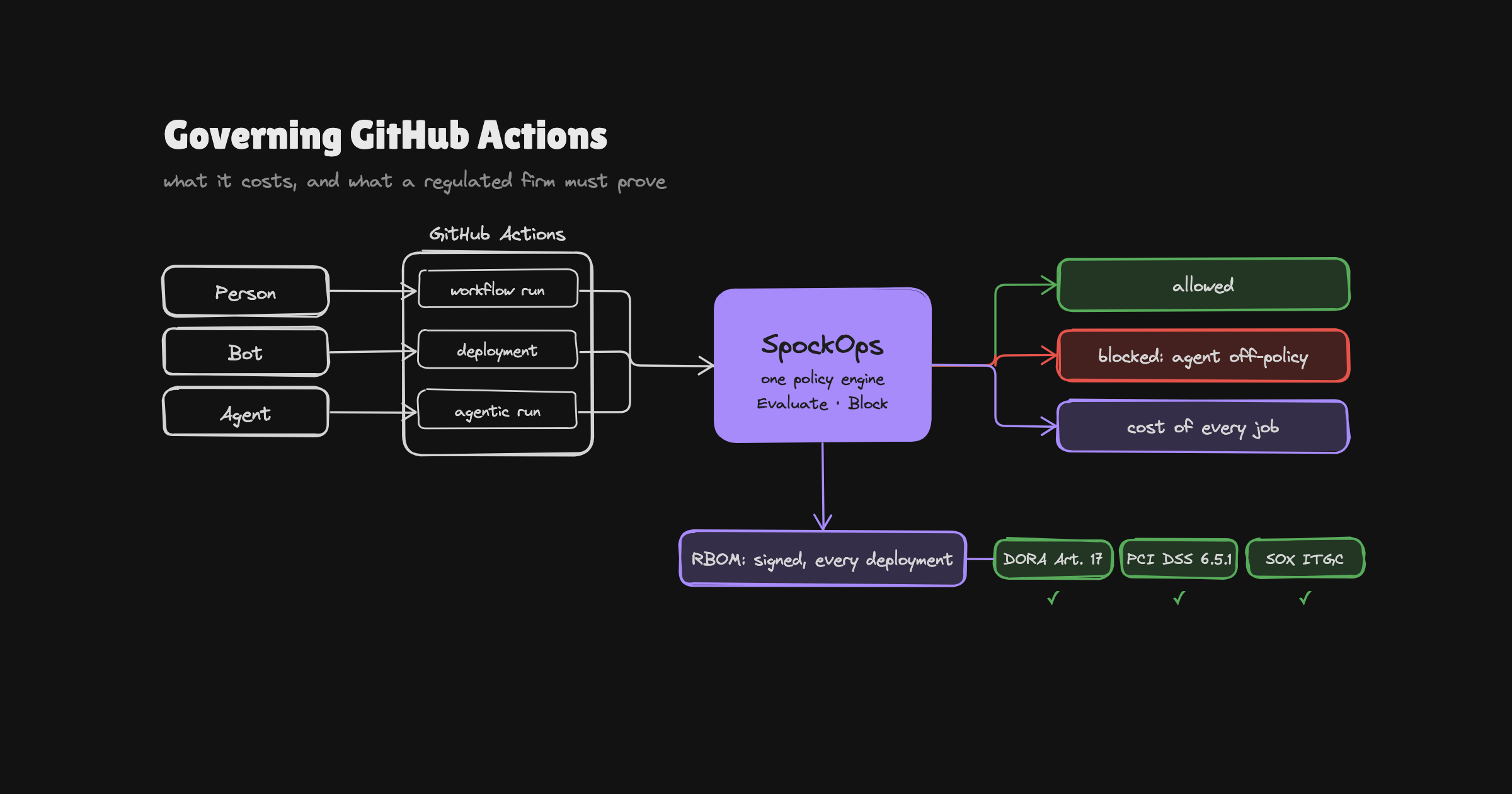

A regulated engineering team with a platform budget of $500,000 to $2,000,000 a year spends, by our estimate, 8% to 10% of it on GitHub Actions: hosted minutes, self-hosted runner hardware and the AI usage of agents. That spend runs the workflows regulators examine most closely, yet few teams can say who may run them, where, or at what cost. SpockOps is built to be the tool of choice for GitHub Actions governance and deployment audit trails.
The subject has become pressing. The EU's Digital Operational Resilience Act has applied to banks, insurers and payment firms since 17 January 2025. In March 2025, a compromised GitHub Action exposed CI secrets in a component used by more than 23,000 repositories. AI agents now run inside the same pipelines. CI has become part of the regulated estate, and it needs to be governed like the rest of it.
How much does CI cost a regulated engineering team? #
No public survey reports GitHub Actions spending for regulated firms, so we modeled it from GitHub's list prices and moderate assumptions. Each engineer uses 1,000 standard hosted minutes and 200 larger-runner minutes a month; the team owns ten self-hosted machines for every hundred engineers, each bought for $1,500; and agents use $5 of AI per engineer a month. The prices are GitHub's own: $0.006 to $0.062 a minute for standard runners and $0.022 a minute for an 8-core Linux runner, with the 50,000 minutes included in GitHub Enterprise deducted.
| Annual figures | 150 engineers, $500k budget | 400 engineers, $1.2M budget | 700 engineers, $2M budget |
|---|---|---|---|
| Hosted minutes, standard and larger runners | $18,960 | $59,760 | $108,720 |
| Self-hosted hardware (over 3 years) and running cost | $12,000 | $32,000 | $56,000 |
| Agent AI usage | $9,000 | $24,000 | $42,000 |
| Total CI spend | $39,960 | $115,760 | $206,720 |
| Share of platform budget | 8.0% | 9.6% | 10.3% |
These are moderate figures. Large monorepos, heavy macOS or Windows builds and wider use of agents all push them higher. Enterprise agreements may bring them down. Either way, a meaningful share of the platform budget is spent in a system that, for most teams, produces a single invoice total and little else.
Why is that spend so hard to govern? #
Because it is spread across places that were never designed to be read together.
Hosted minutes appear on GitHub's invoice. Self-hosted runners appear nowhere on it: the hardware is a purchase recorded once, and its electricity is on another bill. Agent AI usage may be billed by GitHub, Anthropic, OpenAI or Google, depending on the engine. A large firm typically runs several GitHub organizations, for different business lines or acquisitions, each with its own settings and its own runners.
The controls are just as scattered. GitHub's workflow execution protections govern who may trigger a workflow, within one enterprise, organization or repository. Each agentic workflow carries its own safeguards in its own file. Deployment approvals sit on each environment. None of them, on its own, answers the question an auditor or a budget holder actually asks: across everything we run, who ran what, where, under which rule, and at what cost?
What do regulators require of a software change? #
Three regimes recur in banking and payments, and they ask for strikingly similar things.
EU DORA. The Digital Operational Resilience Act requires financial entities to maintain ICT change management procedures. Its technical standard, Delegated Regulation (EU) 2024/1774, Article 17, requires "mechanisms to ensure the independence of the functions that approve changes", "the documentation and communication of change details", fall-back procedures, and procedures to "document, re-evaluate, assess, and approve emergency changes after their implementation." (This DORA is distinct from the DORA delivery metrics of the DevOps Research and Assessment program, which SpockOps also reports.)
PCI DSS v4.0. Requirement 6.5.1 requires that "changes to all system components in the production environment are made according to established procedures", including "documented change approval by authorized parties" and "procedures to address failures and return to a secure state."
SOX IT general controls. Auditors test change management directly. As one industry summary puts it, they expect "complete audit trails with timestamps and user identifiers", and "developers deploying and approving their own changes is a common audit finding."
The common thread is clear. Each change must be authorized by the right people, made in a controlled way, separated from the person who requested it, and recorded so that it can be reconstructed later. In a modern bank, a large share of those changes pass through GitHub Actions.
What must a regulated team decide? #
Translated into the terms of a CI pipeline, those requirements become a set of decisions that should be made once and enforced everywhere.
- Who may run each workflow? Which people, bots and agents may start which workflows, and which may not.
- Where may it run? On GitHub-hosted or self-hosted runners, and on which operating system: Linux, Windows or macOS. A workflow that handles production credentials may be confined to self-hosted runners inside the firm's network.
- From which branches? A release workflow that may run only from
main, or from protected release branches, cannot be started from a developer's experiment. - By which triggers? Which events may start a workflow at all. Triggers that run code from forks, such as
pull_request_target, deserve particular care. - What may agents do? Which AI engines and models are approved, which version of the agentic workflow compiler produced each workflow, how agents are isolated, what they may write and how much they may spend.
- What may deploy? Which actors, runners and sources may reach each environment, decided independently of the person who requested the deployment.
- What does it cost, and to whom? What each workflow, team and runner costs, and whether the self-hosted hardware is paying for itself.
The first four are the ordinary controls of a CI estate. The fifth is new, and growing quickly. The sixth is where change control meets production. The seventh is what the budget holder asks.
What does SpockOps govern? #
SpockOps answers all seven decisions with one policy engine, across every GitHub organization and account the firm connects. Every policy runs in Evaluate mode, which records what would happen, or Block mode, which stops what breaks the rule, and every evaluation is kept with who, what and which rule applied.
| Decision | What GitHub provides natively | What SpockOps governs |
|---|---|---|
| Who may run each workflow? | Actor and event allowlists, within one enterprise, organization or repository | People, bots and agents, per workflow, across every organization |
| Where may it run? | Runner groups and labels, configured per organization | Hosted or self-hosted runners, and the operating system: Linux, Windows or macOS |
| From which branches? | Branch rules on environments, for deployment jobs | Branch rules on any workflow run |
| By which triggers? | Event allowlists; a default block on pull_request_target in public repositories from 2 December 2026 |
Allowed triggers per workflow, alongside actor, runner and branch in one policy |
| What may agents do? | Safeguards set in each agentic workflow by its author | The agent engine, model, inference credentials, gh-aw compiler version, strict compilation, agent firewall, threat detection before writes, approved write actions and maximum AI credits |
| What may deploy? | Required reviewers, wait timers and branch rules on each environment | A deployment protection rule that approves or rejects by actor, kind of actor, runner and origin, independently of the requester |
| Can each deployment be proven later? | Deployment history in the GitHub interface and API | The Release Bill of Materials: a signed record of every deployment, built on a chained audit trail, described below |
| What does it cost? | A usage report and budgets on dollar totals | Cost of every job and step net of included minutes; hosted, self-hosted and AI spend in one figure; budgets that alert; payback of every self-hosted runner |
| Is the supply chain sound? | Allowed-actions settings and SHA pinning policies | An inventory of every action in use, advisories mapped to the workflows that use them, and one pull request that pins all of them to commit SHAs |
Two rows deserve emphasis. Workflow governance is the foundation: most of a regulated firm's control objectives are met by deciding who may run what, where, from which branch and on what trigger. Agentic governance is the frontier. To our knowledge, SpockOps is the first governance engine to offer full support for GitHub Agentic Workflows, holding every agent in every repository to the same approved engines, models, compiler versions, isolation and spending limits.
How is each deployment proven to an auditor? #
With a Release Bill of Materials, or RBOM, which SpockOps issues for every deployment that passes through its deployment protection rule. A software bill of materials records what is inside an artifact. An RBOM records what happened when a commit was deployed, and whether it was allowed.
Each RBOM describes one deployment: the commit and the environment, the pull request it came through, who requested it and whether that was a person, a bot or an agent, the workflow file and pinned actions that ran, the runner and whether it was hosted or self-hosted, every policy exactly as it stood when it was evaluated, each rule's result, the reviewers, the verdict and the final outcome with its timings.
Two properties make it evidence rather than a report. Each RBOM is signed by SpockOps in the same standard envelope format that GitHub's own artifact attestations use, so anyone holding SpockOps' published public key can verify it offline, without access to SpockOps. And it rests on an append-only deployments audit trail in which each record carries the fingerprint of the one before it, so that editing or deleting any part of the history breaks the chain visibly.
For a regulated firm, that corresponds closely to what an auditor asks for: who requested the change and who approved it, which controls were applied, when each step happened, and proof that the record has not been altered since. An RBOM can be attached to a change ticket or placed in an evidence folder as it is. The Release Bill of Materials explains the format in full, and audit streaming sends the whole record to the firm's SIEM.
What does governance return? #
A governance layer costs a small fraction of the CI spend it governs, and a smaller fraction still of the platform budget. The return comes in four forms.
Spend that can be attributed. With every job priced and every workflow, team and agent visible, waste becomes something a team can find. For a 400-engineer team, the model above puts usage-based spend, hosted minutes and AI, at roughly $84,000 a year; every 1% it is reduced is worth about $840.
Hardware that can be justified. Self-hosted runners are common in regulated firms, and they are usually a good investment that nobody can demonstrate. Priced against the hosted runner each machine replaces, a $1,500 machine doing 10,000 minutes of 8-core work a month pays for itself in under eight months. In SpockOps' pre-release workspaces, runners have typically paid for themselves within a few months and then saved an average of about $200 a month each. For the 400-engineer model, the fleet does roughly $105,600 a year of work that would otherwise be billed by GitHub.
Evidence that already exists. Policy verdicts and deployment decisions are produced by every run, without anyone assembling them, and they correspond directly to the change-control requirements of DORA, PCI DSS and SOX. The Release Bill of Materials turns each deployment into a signed, tamper-evident record that can be handed to an auditor as it is.
Risk that is reduced. IBM's 2025 study puts the average breach in financial services at $5.56 million, with supply chain compromise among the most common ways in. In March 2025, the compromise of the tj-actions/changed-files action exposed CI secrets in a component used by more than 23,000 repositories. Pinned actions, agents that cannot use unapproved credentials and workflows that cannot run on the wrong runner each narrow the path such an incident can take.
Where to begin #
Start where an auditor would look first, in Evaluate mode, so that nothing changes until the rules are right.
- Install the SpockOps GitHub App on each organization; no workflow changes.
- Write workflow policies for your release and deployment workflows: who may run them, from which branches, on which triggers, and only on self-hosted runners of the approved operating system.
- Add an agentic policy covering every agentic workflow: approved engines and models, approved credentials, compiler version, firewall, threat detection and AI-credit limits.
- Enable the deployment protection rule on production environments.
- Register self-hosted machines with their purchase price and running cost.
- Review the verdicts, findings and cost after a month, then move policies to Block.
SpockOps installs in about five minutes.
Further reading: GitHub Actions workflow governance, The Release Bill of Materials, How GitHub Agentic Workflows work, Have your self-hosted runners paid for themselves? and How SpockOps Gets 0% Downtime.
Questions
How much do regulated engineering teams spend on GitHub Actions?
By our model, about 8% to 10% of a $500,000 to $2,000,000 platform budget: roughly $40,000 to $207,000 a year for 150 to 700 engineers, across hosted minutes, self-hosted hardware and agent AI usage.
Which regulations apply to CI/CD in financial services?
Commonly the EU Digital Operational Resilience Act and its change-management standard, PCI DSS v4.0 Requirement 6.5.1, and SOX IT general controls. Each requires changes to be authorized independently, documented and recorded.
Can SpockOps restrict where a workflow runs?
Yes. A workflow policy can require hosted or self-hosted runners and a specific operating system, Linux, Windows or macOS, alongside rules on who may run it, from which branches and on which triggers.
Does SpockOps govern GitHub Agentic Workflows?
Yes. To our knowledge it is the first governance engine to fully support them, covering the agent engine, model, inference credentials, gh-aw compiler version, strict compilation, agent firewall, threat detection, write actions and AI-credit limits.
What is a Release Bill of Materials (RBOM)?
An RBOM is a signed record of one deployment: what was released, to which environment, who requested it, which policies were checked, who approved it and how it ended. It rests on a chained audit trail, so altered history is visible. SpockOps issues one for every deployment that passes through its deployment protection rule.
Does SpockOps change our workflows?
No. SpockOps is a GitHub App, so nothing runs inside your pipelines.
Related posts
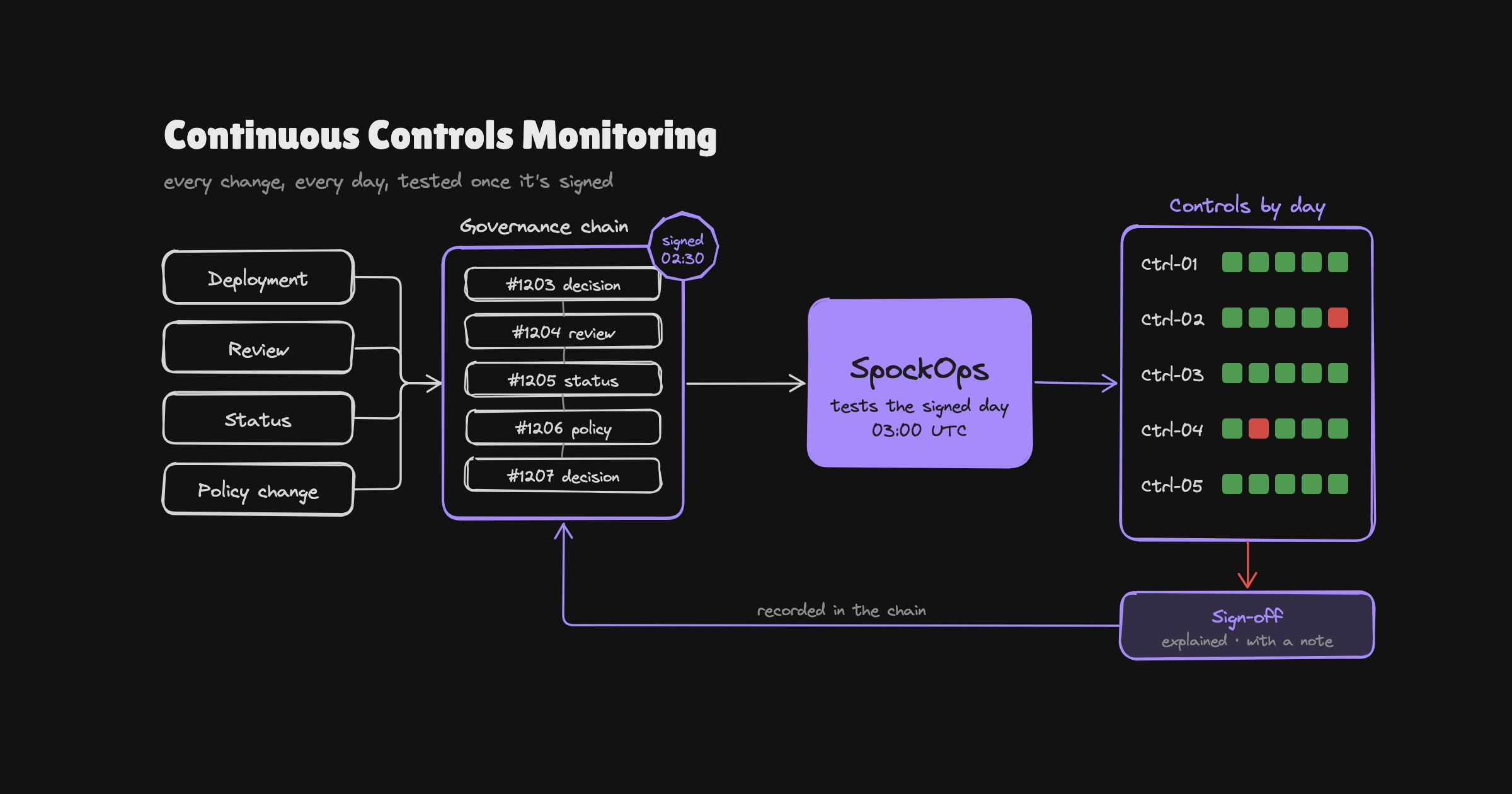
Continuous controls monitoring: testing every change, every day
Change management is usually tested once a year on a sample. SpockOps tests seven change controls every day over every production deployment, from a signed record an auditor can check.
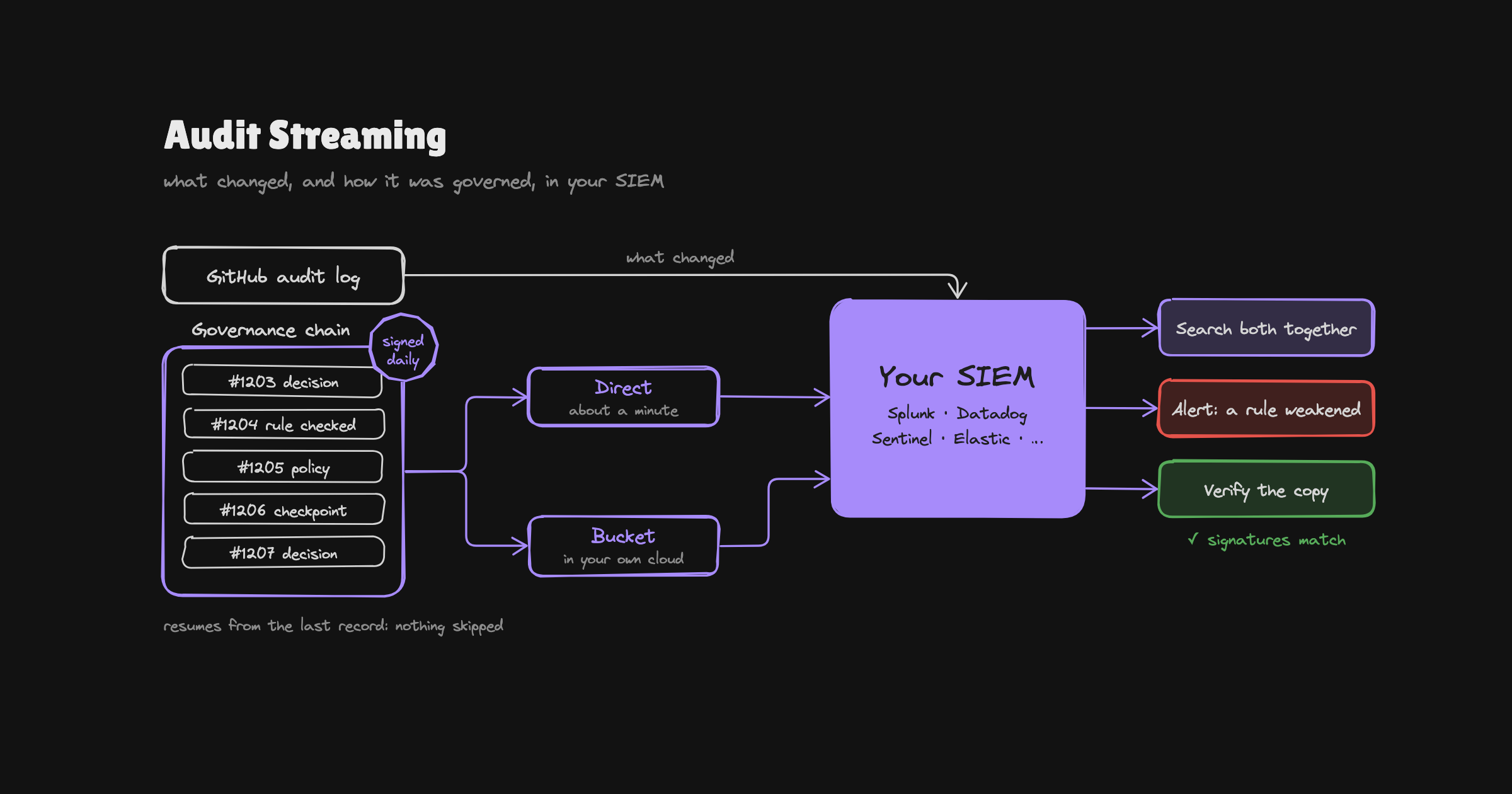
Audit streaming: what GitHub's audit log cannot tell your SIEM
GitHub's audit log shows what changed. The governance chain shows how that change was governed, and audit streaming sends it to your SIEM in the same format, with a copy you can verify.
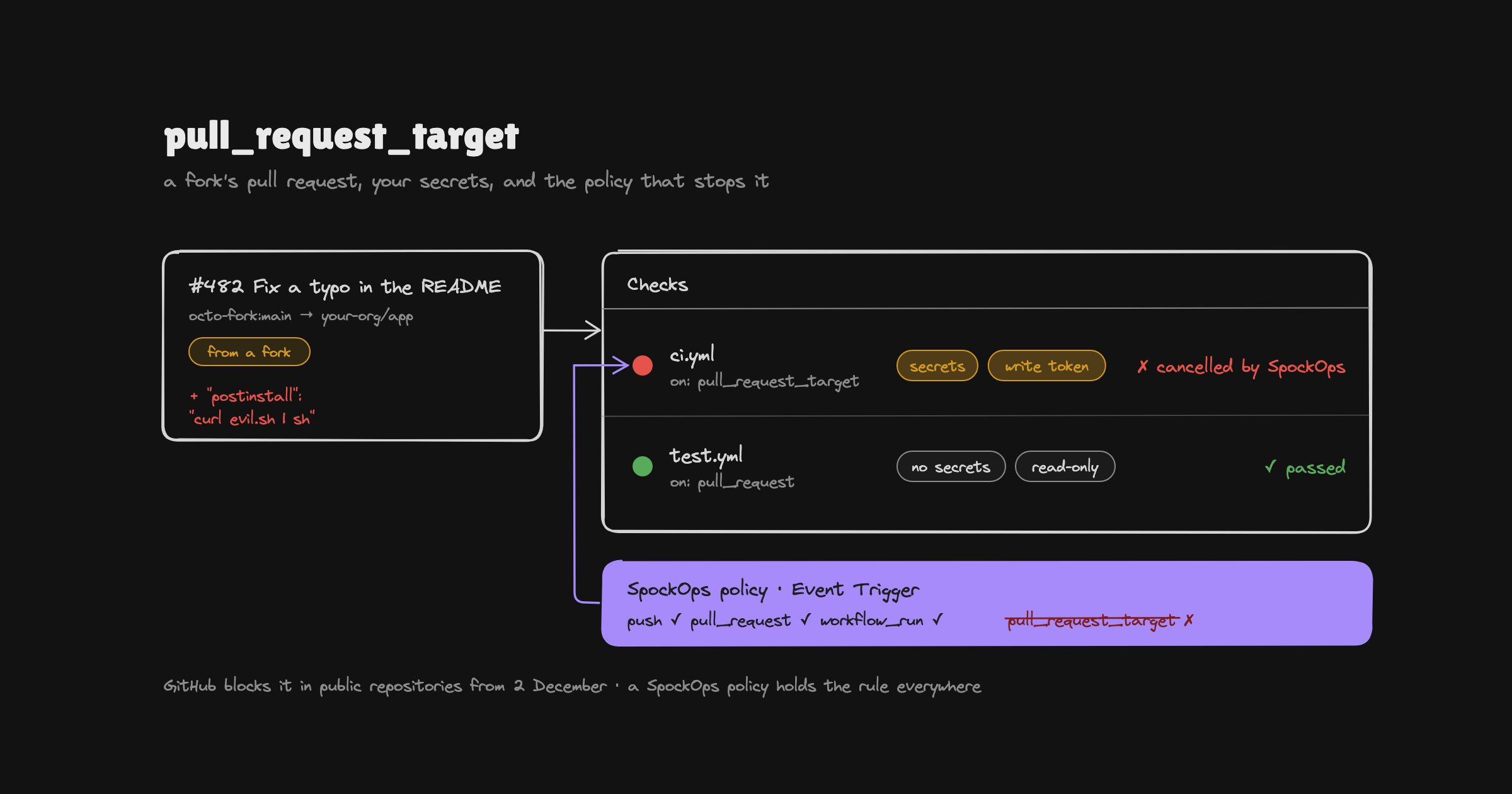
pull_request_target: why to stop using it, and what to use instead
GitHub blocks pull_request_target by default from 2 December. Why the trigger is dangerous, the simple two-workflow pattern to use instead, and how to keep it out of every repository.
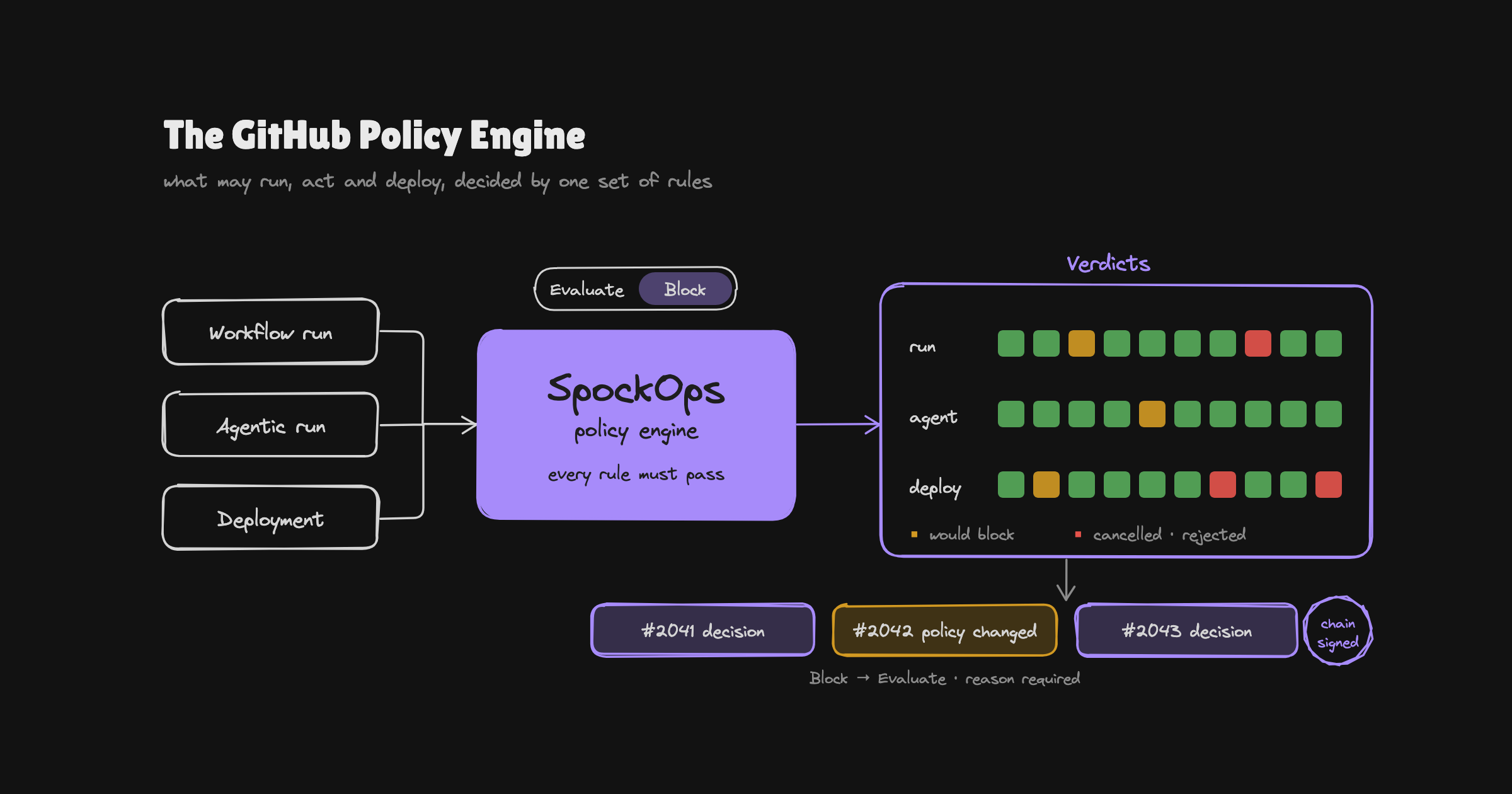
The GitHub policy engine: how SpockOps decides what may run, act and deploy
A policy engine for GitHub Actions: one set of rules for workflow runs, agentic workflows and deployments, tried in Evaluate, enforced in Block and recorded.
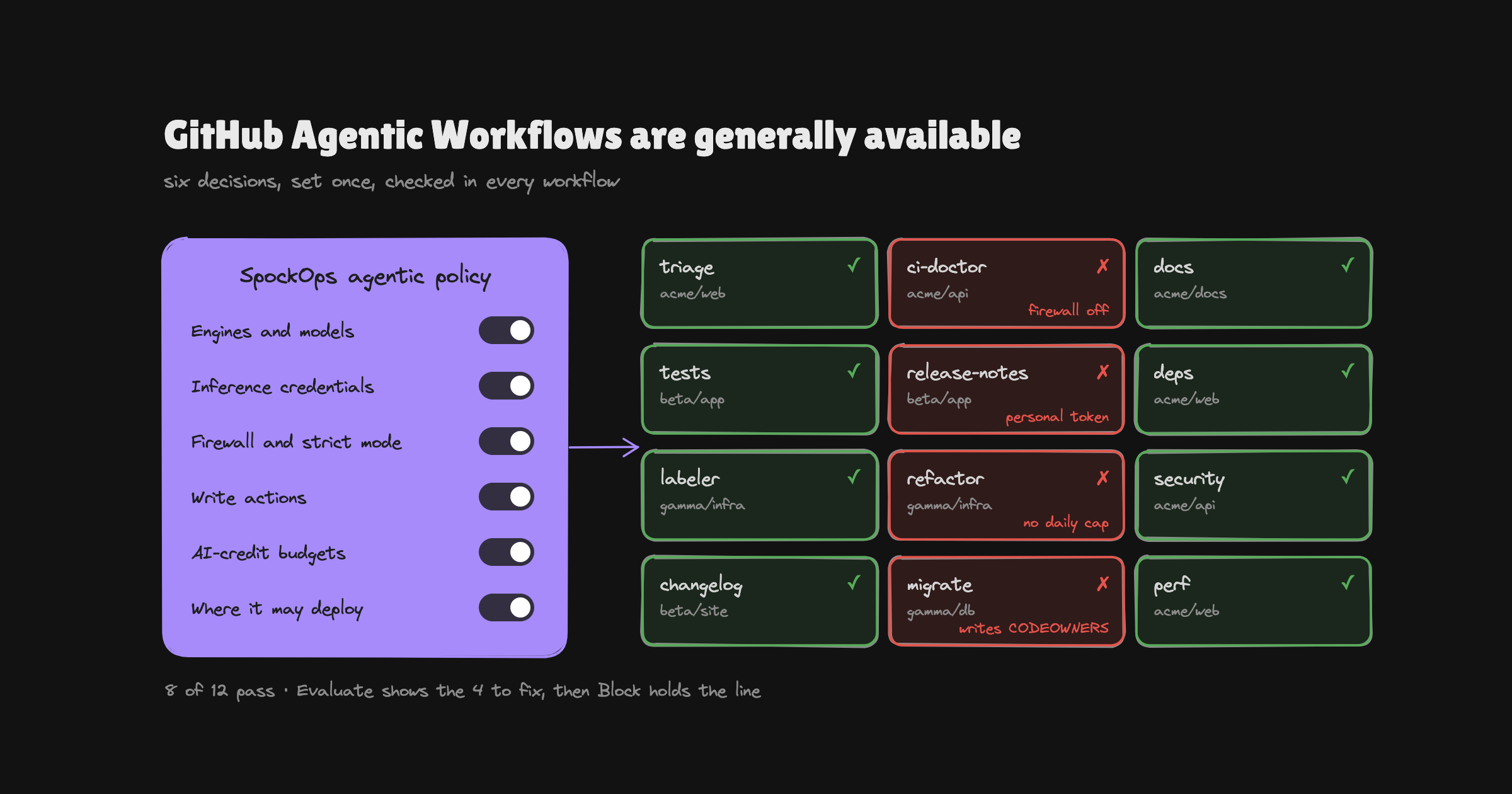
GitHub Agentic Workflows are generally available: six decisions before your teams turn them on
GitHub Agentic Workflows are generally available. The six decisions an enterprise should make first: engines, credentials, isolation, writes, spend and deployments.
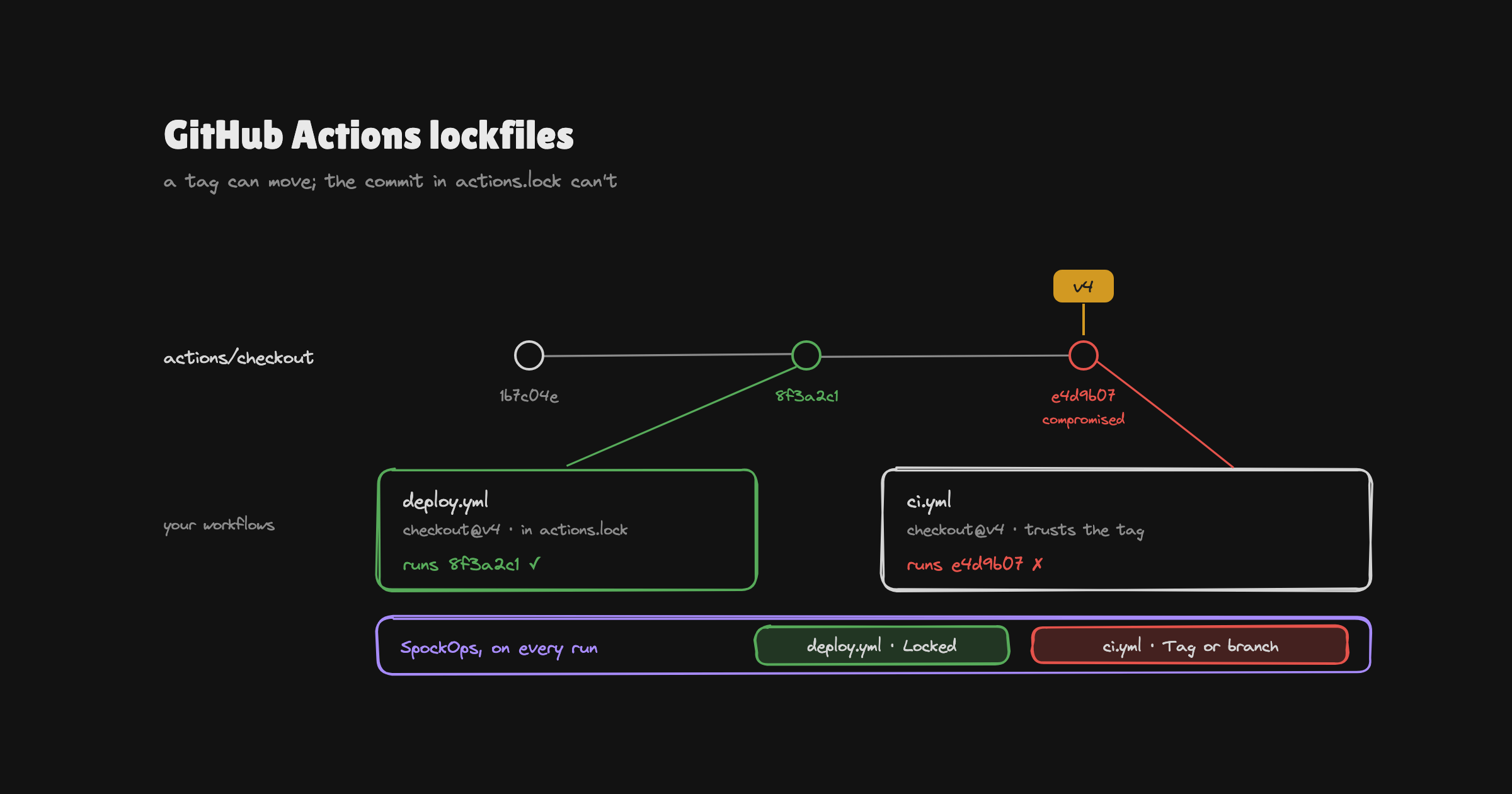
GitHub Actions lockfiles are generally available: what they fix, and what to watch across every repository
GitHub Actions workflow lockfiles pin every action, transitive dependency and reusable workflow to a commit. What they fix, what they don't, and how to start using one today.