 SpockOps
The governance engine for GitHub Actions
Know why every change was allowed.
One rulebook for people, bots and AI agents. Every run checked as it starts, every deployment decided before production, and every decision signed into a record your auditors can re-run.
The rulebook
One rulebook for people, bots and agents
Write a policy once and SpockOps checks it as each workflow, agent or deployment starts, in every organization you connect. Each policy watches in Evaluate first; switch it to Block when you're ready.
- botdependabot[bot]
- opens a pull request
- workflow run
- Where
- Every workflow
- Who
- People, and approved bots
- Branches
- Only main and release/*
- Triggers
- Pull requests and pushes
- Runners
- Self-hosted, on Linux
- agentcopilot
- writes tests
- agentic run
- Where
- Every agentic workflow
- Engines
- Copilot or Claude only
- Build
- Compiled in strict mode
- Network
- Behind the agent firewall
- Writes
- Comments and labels only
- personalice
- deploys to production
- deployment
- Where
- The production environment
- Who
- Members of release-team
- Branch
- Only main
- Checks
- test and lint must pass
- Runners
- Self-hosted only
Until now
GitHub Actions had settings. Now it has a policy engine.
GitHub gives you switches: allowlists, runner groups and required reviewers, set one repository or organization at a time. There was nowhere to write a rule once and have every run, agent and deployment checked against it. That's what SpockOps is.
-
Before
Settings, one repository at a time
Allowed actors, branches, runners and reviewers live in each repository and organization. Nobody sees them all at once, and loosening one leaves no reason behind.
-
Before
A protection rule, on its own
A deployment protection rule answers one environment, once. It can't see the run, the actor or the agent behind it, and nobody keeps why it said yes.
-
Now
One engine for every decision
One rulebook over workflow runs, AI agents and deployments, in every organization. Watch in Evaluate, enforce in Block, and every verdict is signed into a chain.
Rolling it out
Watch first. Block when you're sure. Prove it after.
A gate in front of production is only safe if you can see what it would do before it does it. So every policy starts by watching, and nothing changes for your engineers until you say so.
-
Evaluate
Watch
Each rule records what it would have done and changes nothing. Run it for a week or two and see whom it would affect before it affects anyone.
SpockOps policy · would block · recorded -
Block
Enforce
Switch a policy to Block when you're sure. A run that breaks it is cancelled, a deployment is rejected before production, and the reason sits on the check beside the tests.
SpockOps policy · blocked: unapproved runner -
The chain
Prove
Every verdict, and every change to a policy with who made it and why, is written to a hash-chained record, signed daily. Remove or alter one, and the chain breaks.
#1207 decision · signed 02:30 UTC
Deployments
More than a deployment protection rule
SpockOps answers GitHub's protection rule with your whole rulebook behind it, the same way in every organization, and keeps why.
- Decides on the factsWho asked, what kind of actor, the branch, the checks, the runner and where it came from.
- Watches before it blocksIn Evaluate it records what it would do; in Block it rejects before production.
- Keeps a receiptEvery decision in the chain, and a signed record of every deployment.
- ✓Who askedalice, release-team
- ✓Kind of actorA person
- ✓Branchmain
- ✓Checkstest and lint passed
- ✓RunnerSelf-hosted, trusted for production
- ✓Originacme/api, not a fork
Evidence
Test every change, not a sample of 25
Auditors sample because checking evidence by hand is expensive. When every decision is recorded as it happens, and the record can't be altered unnoticed, every change can be tested, every day.
-
The ledger
The governance chain
- Every decision, review, outcome and policy change
- Hash-chained, so none can go missing unnoticed
- Signed every night against published keys
-
The receipt
A signed record of every deployment
- What shipped, who asked, the rules checked
- Who approved it, and how it ended
- Verifiable offline, by anyone
-
The controls
Continuous controls monitoring
- Seven change controls, tested daily on every deployment
- Each failure signed off with a reason, never by its author
- Mapped to the frameworks below, in part, honestly
-
The stream
In the SIEM you already run
- Splunk, Datadog, Sentinel, Elastic, Panther and more
- Beside GitHub's audit log, in its format
- Or a bucket in your own cloud account
Beyond GitHub's settings
What GitHub provides, and what SpockOps adds
SpockOps builds on GitHub's own controls rather than replacing them, and holds them to one standard across every organization and account you connect.
| Decision | GitHub natively | SpockOps |
|---|---|---|
| Who may run each workflow? | Actor and event allowlists, within one enterprise, organization or repository | People, bots and agents, per workflow, across every organization |
| Where, and from which branches? | Runner groups and labels per organization; branch rules for deployment jobs | Hosted or self-hosted runners and their operating system, and branch rules on any run |
| What may agents do? | Safeguards set in each agentic workflow by its author | Approved engines and models, strict compilation, the agent firewall, threat detection before writes, allowed write actions and an AI spending limit |
| What may deploy? | Required reviewers, wait timers and branch rules on each environment | A deployment protection rule that decides by actor, kind of actor, runner and origin, independently of the requester |
| Who changed the rules? | An audit log of setting changes | Every policy change classified (strengthened, weakened, widened), a reason required to weaken one, in the same chain as the decisions |
| Can each deployment be proven later? | Deployment history in the interface and API | A signed record of every deployment, on a chained audit trail an auditor can re-run |
Further reading
How it works, in more detail
-
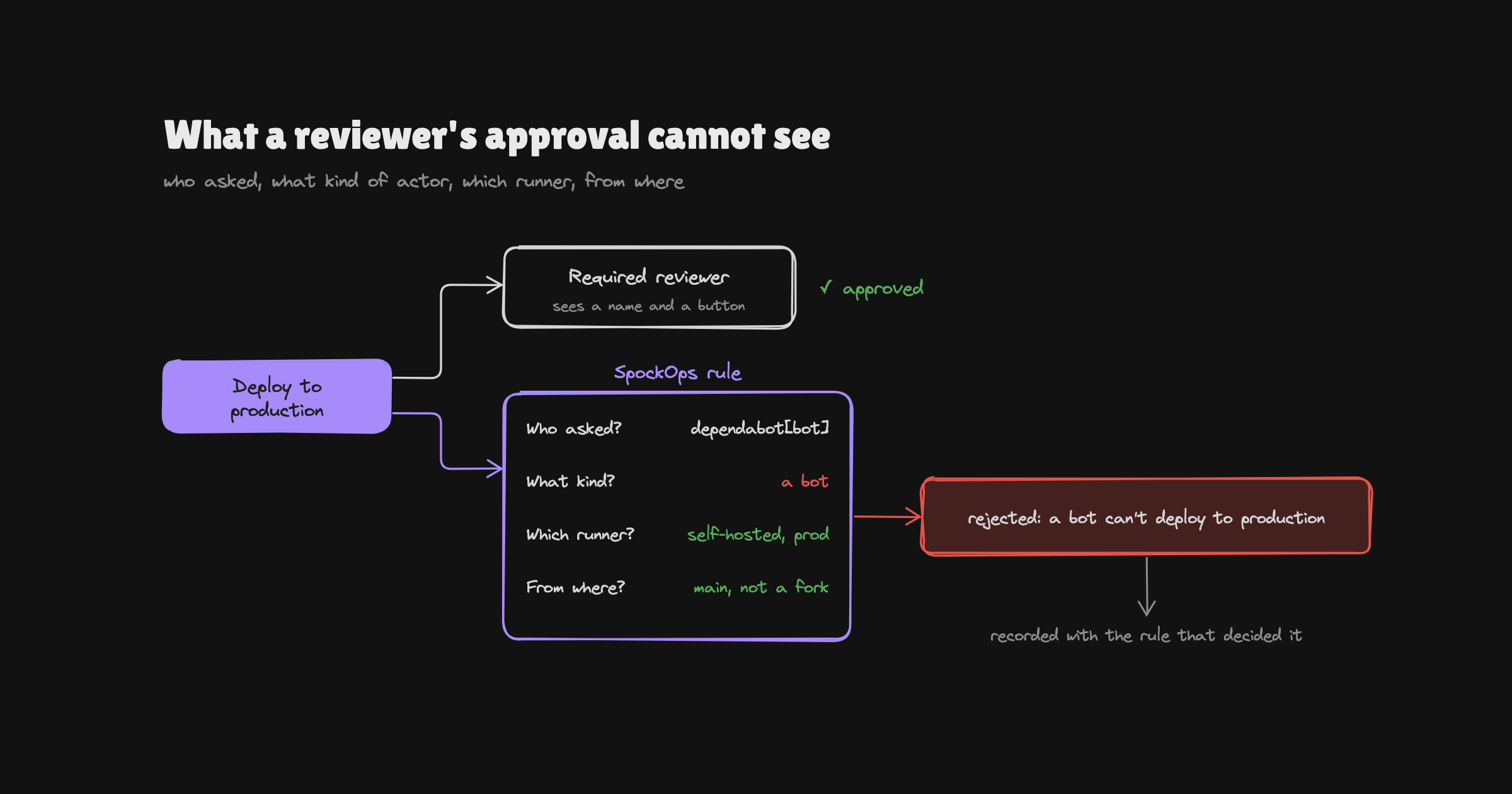
Deployment protection rules: what a reviewer's approval cannot see
How GitHub deployment protection rules work, what required reviewers cannot see, and how SpockOps approves each deployment by actor, runner, kind and origin.
-
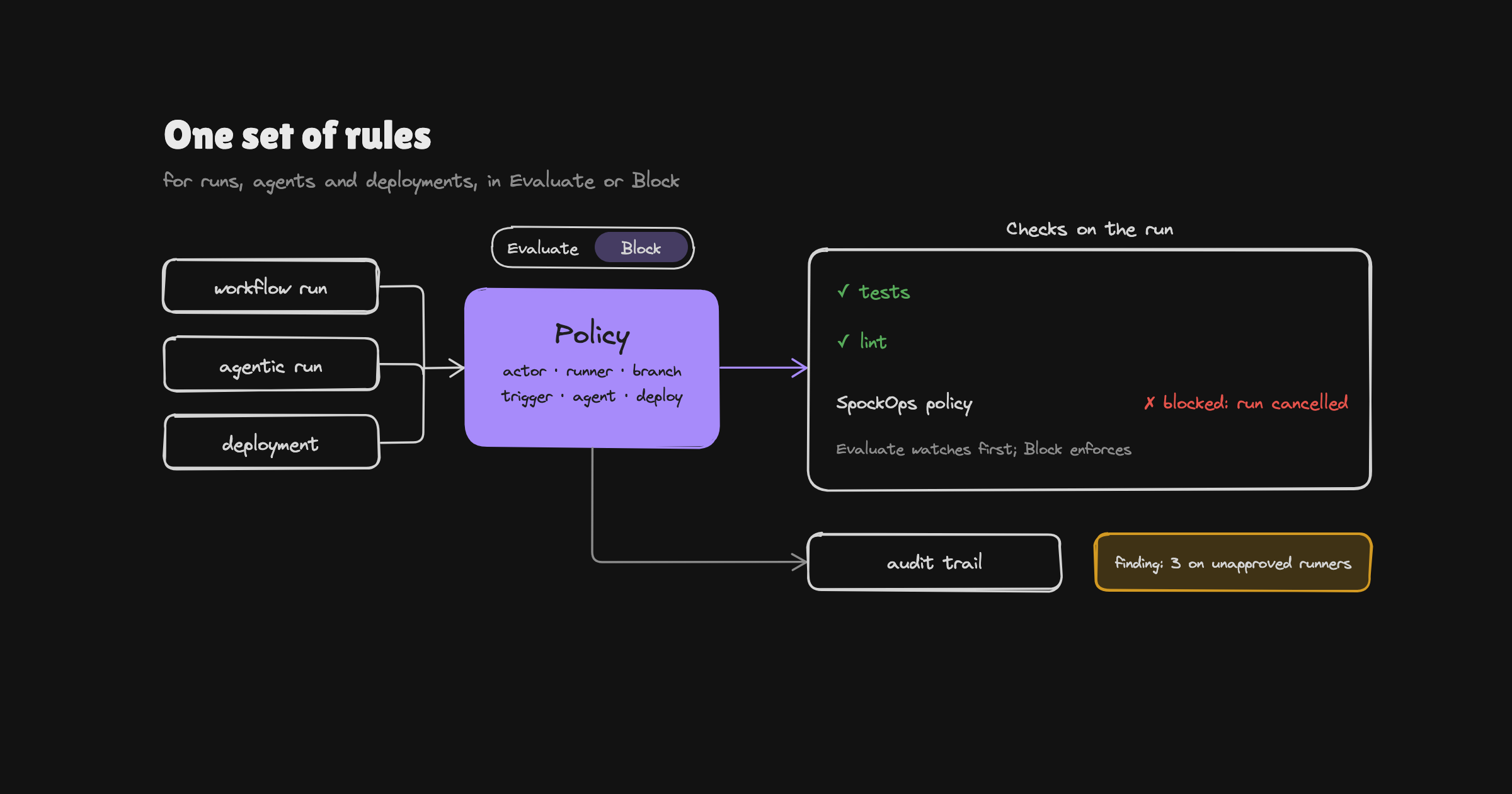
GitHub Actions workflow governance: one set of rules for runs, agents and deployments
Workflow governance for GitHub Actions: one engine for runs, agentic workflows and deployments, in Evaluate or Block, with findings that say what to fix …
-
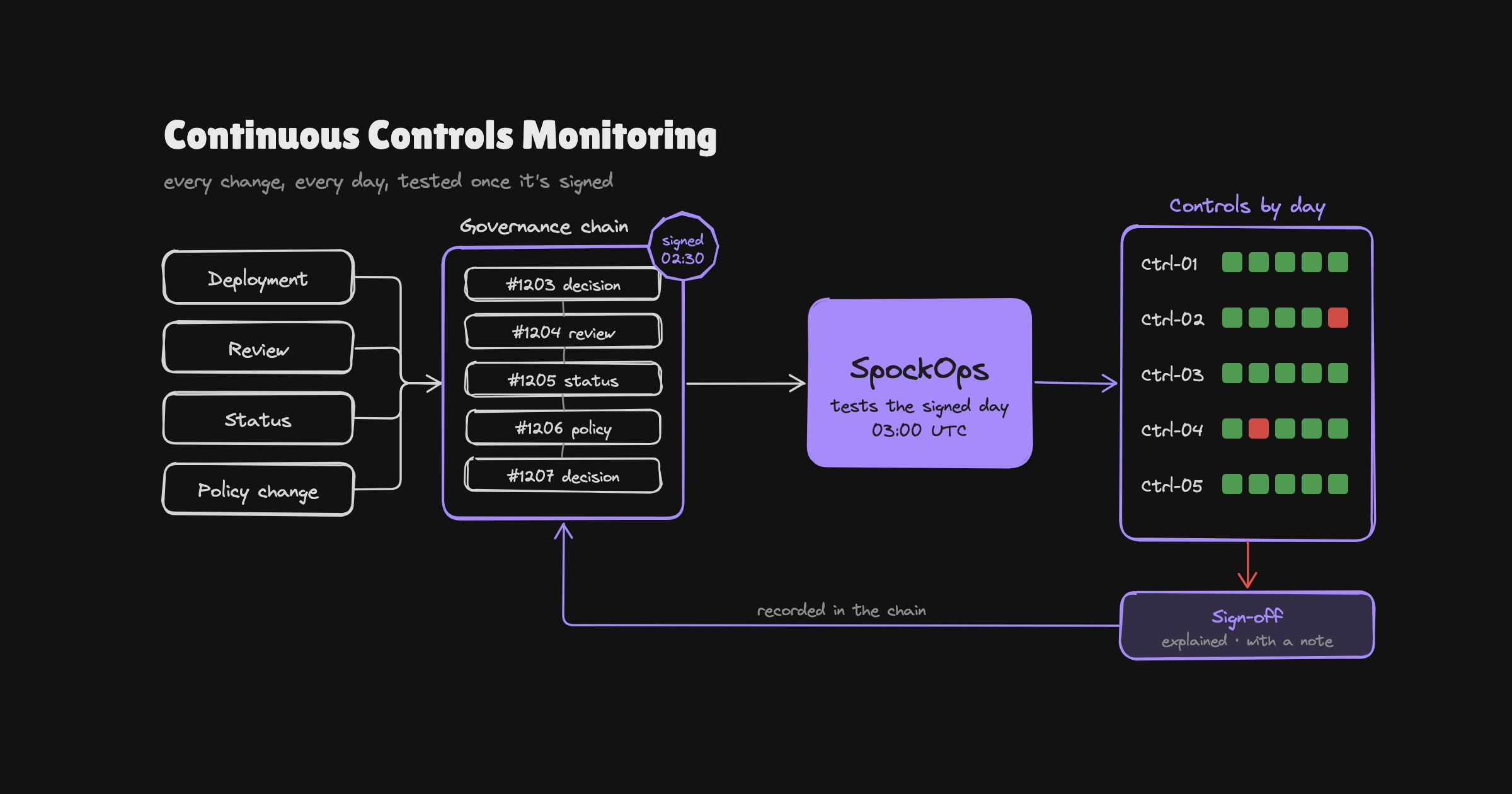
Continuous controls monitoring: testing every change, every day
Change management is usually tested once a year on a sample. SpockOps tests seven change controls every day over every production deployment, from a …
Before you turn it on
Do we have to change our workflows?
No. SpockOps is a GitHub App. It works from GitHub's webhooks and API, checks runs as they start and answers deployments through a deployment protection rule. Nothing runs inside your pipelines.
What if a rule is wrong?
Every policy starts in Evaluate: SpockOps records what each rule would have done and changes nothing. Watch it for a week, see whom it would affect, then switch it to Block. You can switch back at any time, and the change is recorded with its reason.
How is this different from GitHub's required reviewers?
A required reviewer sees a name and a button. SpockOps decides each deployment by who asked, what kind of actor it is (a person, a bot or an AI agent), which runner it ran on and where it came from, the same way in every organization, and records why it was allowed.
Does it govern AI agents?
Yes. Agentic policies hold every GitHub Agentic Workflow to approved engines and models, strict compilation, the agent firewall, threat detection before writes, the write actions you allow and a spending limit, across every repository.
What does an auditor get?
A hash-chained record of every decision, review, outcome and policy change, signed daily; a signed Release Bill of Materials for every deployment; and daily control results mapped to PCI DSS, SOX IT general controls and DORA. The auditor can export the chain, verify it against published keys and re-run the tests.
Get started
Start watching
this afternoon.
Install the App on one organization, write your first policy in Evaluate, and see what it would have done to this week's runs and deployments. No changes to any workflow or repository.