 SpockOps
The ledger and the receipt: how SpockOps proves every deployment
A hash-chained audit trail proves no deployment is missing. An RBOM proves each one is exactly what it claims. Why regulated firms need both, and how an audit uses them.
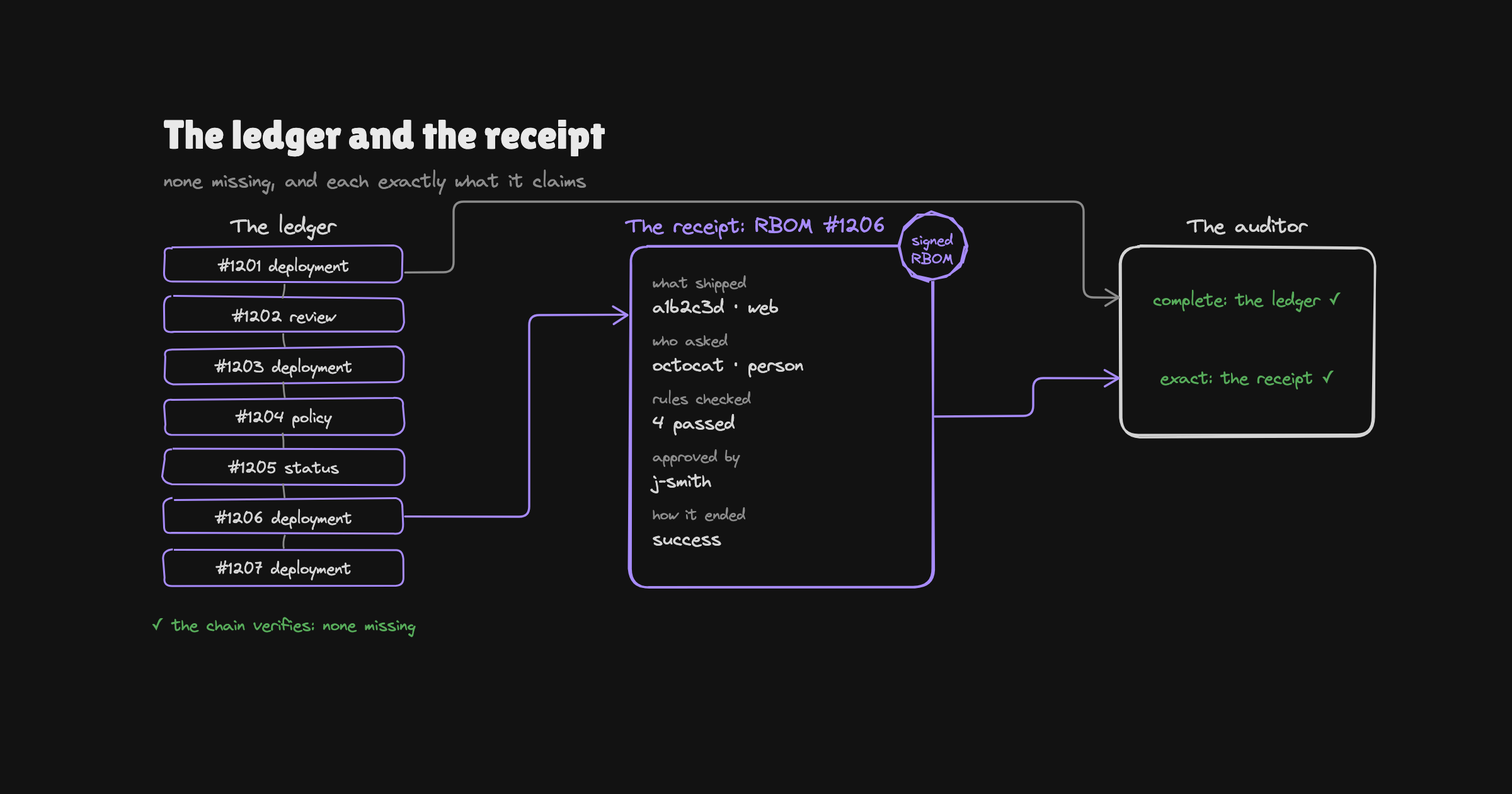

SpockOps keeps two kinds of deployment evidence, and a regulated firm needs both. The audit trail is the ledger: it proves that no deployment is missing and none has been altered. The Release Bill of Materials is the receipt: it proves that one deployment is exactly what it claims to be, and it can be checked by anyone, anywhere.
The distinction mirrors something every finance team already knows. A bank statement shows that every transaction is accounted for; a receipt proves the details of one. Neither replaces the other, and an auditor asks for both. The same is true of software changes in a bank, an insurer or a payments firm, where regulations such as the EU's Digital Operational Resilience Act, PCI DSS and SOX make change control a tested control rather than a matter of good practice. GitHub Actions governance for regulated industries covers what each of them asks for.
How does an auditor test change control? #
In two steps, and each needs a different kind of evidence.
First, the population. The auditor asks for every production change in the period under review, then satisfies themselves that the list is complete. A change missing from the list is a change that was never tested. Practitioners describe this as proving the population, typically from a deployment log or change report, tested against the systems it came from: BDO's guidance on information produced by the entity tells auditors to "trace selected source transactions into the report to confirm completeness."
Second, the sample. From that population the auditor selects a number of changes and asks for the evidence behind each: who requested it, who approved it, which controls applied, whether it was tested, and how it ended. Each item in the sample is judged on its own evidence.
Most firms find both steps laborious. The population is exported from several systems and reconciled by hand. The evidence for each sampled change is assembled from screenshots, tickets and logs, often weeks after the event, and nothing in it proves that it reflects what actually happened at the time. SpockOps is designed to answer each step directly, with a different instrument for each.
What is the ledger? #
The ledger is SpockOps' deployment audit trail: a continuous record of every deployment decision in a workspace, in order.
Every deployment that reaches an environment protected by SpockOps' deployment protection rule is recorded as it is decided, with the requester, the environment, the rules that applied and the verdict, followed by each reviewer's decision and the deployment's final status. Each record carries a cryptographic hash that covers its own contents and the hash of the record before it, and the database refuses to edit or delete a record once it is written. A missing or altered entry breaks the chain visibly instead of passing unnoticed, and SpockOps shows whether the chain is intact. Once a day SpockOps signs a checkpoint of the chain with its private key, so anyone holding SpockOps' public key can confirm the chain's state on any date. Changes to the policies themselves, workflow, agentic and deployment, are records in the same chain, so the rules and the decisions they produced sit side by side.
The ledger is built for the people who run the controls. It lives inside SpockOps, where it can be filtered by target, environment and kind of event, and where each decision can be read in context: what was deployed before it, and what happened after. When the auditor asks for every production change in the third quarter, the ledger is the answer, and its unbroken chain is the evidence that the answer is complete.
What is the receipt? #
The receipt is the Release Bill of Materials, or RBOM: a self-contained, signed record of a single deployment that can leave SpockOps and still be trusted.
Each RBOM holds everything needed to judge one deployment on its own: the commit and the environment; who requested it, and whether that was a person, a bot or an AI agent; a fingerprint of the workflow that ran and the actions it used; the runner, and whether it was hosted or self-hosted; every policy exactly as it stood when it was evaluated, with each rule's result; the reviewers; the verdict; and the final outcome.
An RBOM is signed in the same standard format GitHub uses for its own artifact attestations, so it can be verified offline, by someone who has never logged into SpockOps, using SpockOps' published public key. It can be attached to a change ticket, a release record or an auditor's evidence folder, and it remains verifiable wherever it is stored.
Why does a regulated firm need both? #
Because they prove different things, to different people, in different places.
| The ledger: the audit trail | The receipt: RBOM | |
|---|---|---|
| Proves | No deployment is missing and none has been altered | One deployment is exactly what it claims to be |
| Audit step it answers | The population: every change in the period | The sample: the evidence for each selected change |
| Scope | Every deployment decision in a workspace, in sequence | A single deployment, complete in itself |
| Where it lives | Inside SpockOps | Wherever the evidence is needed: a ticket, a release, an evidence folder |
| Who reads it | Platform leads, internal compliance, incident reviewers | External auditors, regulators, change advisory boards, customers' security teams |
| How it is checked | In SpockOps, with filters, context and the chain's state | Offline, by anyone with SpockOps' public key |
The two are also one record seen two ways. Each RBOM carries the sequence numbers and hashes of its deployment's records in the audit trail, and whether the chain was intact when it was issued, so any receipt can be matched to its place in the ledger. A firm never has to reconcile the two: the population and the evidence for every item in it come from the same chain.
How does an audit run with both? #
Consider a year-end review of change control for a payments platform.
- The request. The auditor asks for every production deployment between 1 July and 30 September.
- The population. The compliance team filters the audit trail to the production environment and that period, and exports it. The intact chain shows that nothing has been removed, which answers the completeness question without a manual reconciliation.
- The sample. The auditor selects 25 deployments from the list.
- The evidence. For each one, the team downloads its RBOM. Each is a single file containing the requester, the approver, the controls that applied, the reviewers and the outcome.
- The verification. The auditor verifies the files on their own machine, without access to SpockOps or to the firm's GitHub organizations, and confirms that each is genuine and unaltered.
What usually takes weeks of exports, screenshots and reconciliation becomes a filter, an export and a folder of files. Just as important, the evidence was created when each deployment happened, not assembled afterwards, which is the property an auditor values most.
What do they not prove? #
Good evidence states its limits, and these are the limits of both.
- Neither proves the deployed code was safe. They record which controls ran and what they concluded, not whether those controls were sufficient.
- Neither covers what SpockOps did not see. A deployment to an environment without SpockOps' protection rule appears in neither. The population is complete for protected environments, so every production environment should be protected.
- Both attest what GitHub reported. They record what GitHub told SpockOps and what SpockOps decided.
Within those limits, the pair gives an auditor what change control requires: a complete population, and verifiable evidence for every item in it.
Where to begin #
The ledger starts recording the day SpockOps protects an environment, so the sooner it is in place, the longer the history an auditor can rely on.
- Install the SpockOps GitHub App on each organization.
- Enable SpockOps as a deployment protection rule on every production environment.
- Write the policies your auditors expect: independent approval, production only from protected branches and approved runners, and separate rules for bots and agents.
- Review the audit trail with your compliance team, and agree how it will be presented at the next audit. To keep a copy in your own SIEM or bucket, turn on audit streaming.
Every deployment through the rule gets its RBOM from the first day. To test change-management controls over the ledger every day, see continuous controls monitoring.
Questions
What is the difference between a deployment audit trail and an RBOM?
The audit trail is the ledger: an append-only, hash-chained record of every deployment decision, which proves none is missing. An RBOM is the receipt: a self-contained, signed record of one deployment, which proves its details and can be verified anywhere.
Why do auditors need both?
Change-control testing has two steps. The auditor first confirms the population of changes is complete, then examines evidence for a sample. The audit trail answers the first step; RBOMs answer the second.
Can an auditor verify the evidence without access to our systems?
Yes, that is the purpose of the RBOM. Each one is signed in a standard attestation format and verifiable offline with SpockOps' published public key.
Do we have to reconcile the audit trail with the RBOMs?
No. Each RBOM carries the hashes of its deployment's records in the audit trail, and whether the chain was intact when it was issued, so both come from the same sequence of records.
Which deployments are covered?
Every deployment to an environment protected by SpockOps' deployment protection rule. Deployments to unprotected environments are not recorded, so every production environment should be protected.
Are changes to the deployment policies themselves recorded?
Yes. Creating or changing a deployment policy is a record in the same audit trail, in sequence with the decisions it governs.
Related posts
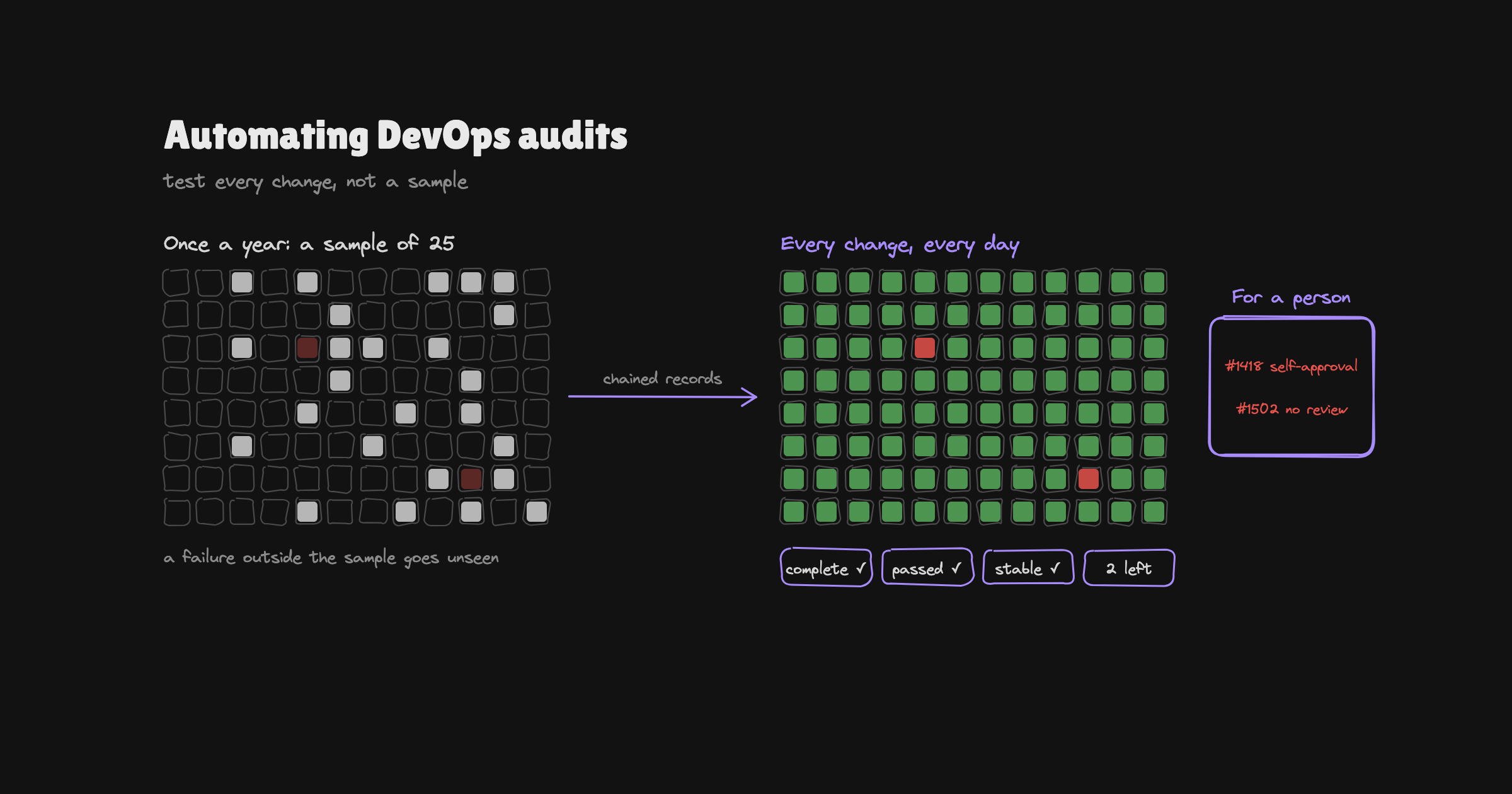
Automating DevOps audits: test every change, not a sample
Auditors sample changes because checking evidence is costly. Chained deployment records make it cheap, so every change can be tested, every day.
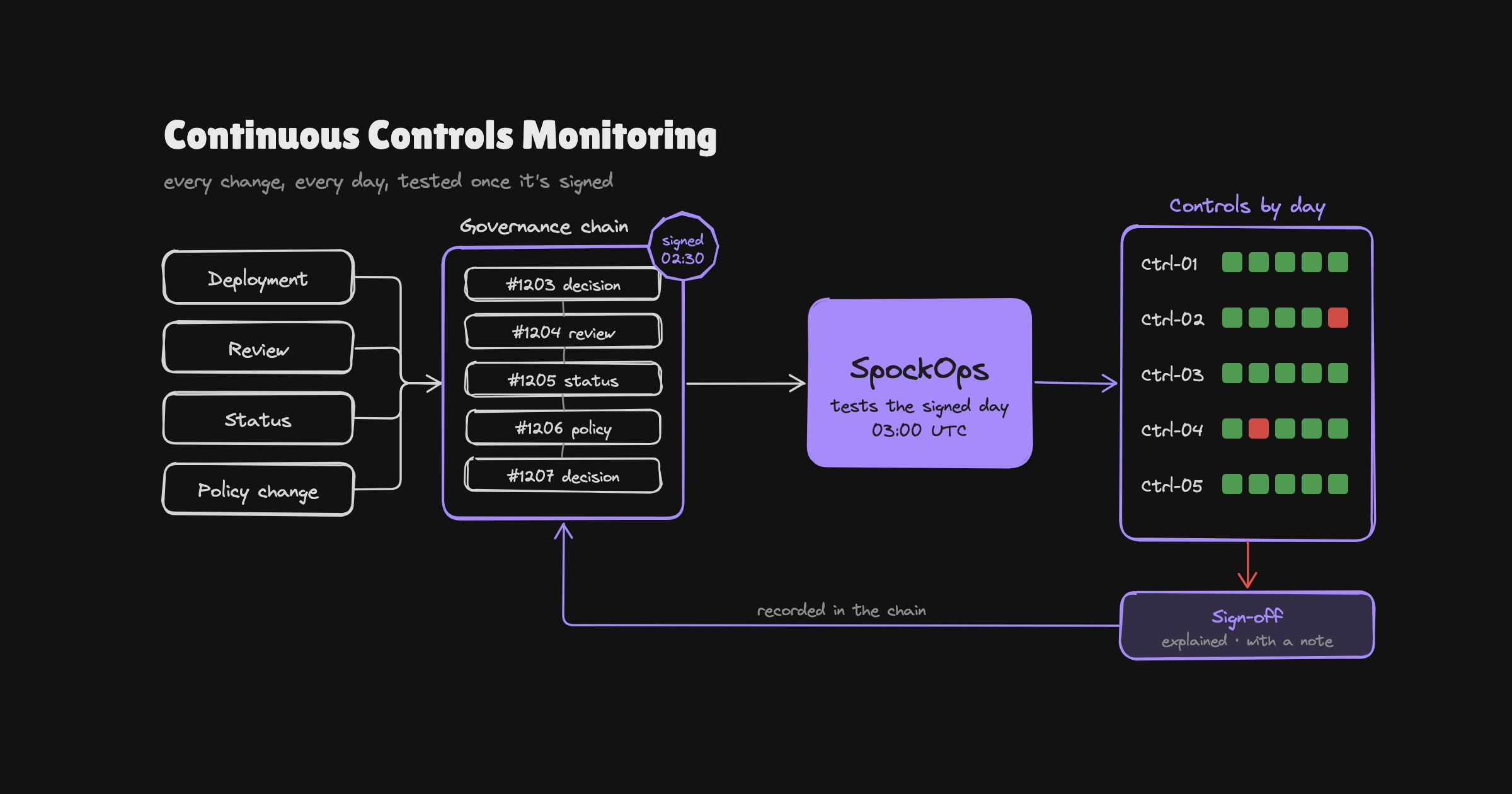
Continuous controls monitoring: testing every change, every day
Change management is usually tested once a year on a sample. SpockOps tests seven change controls every day over every production deployment, from a signed record an auditor can check.
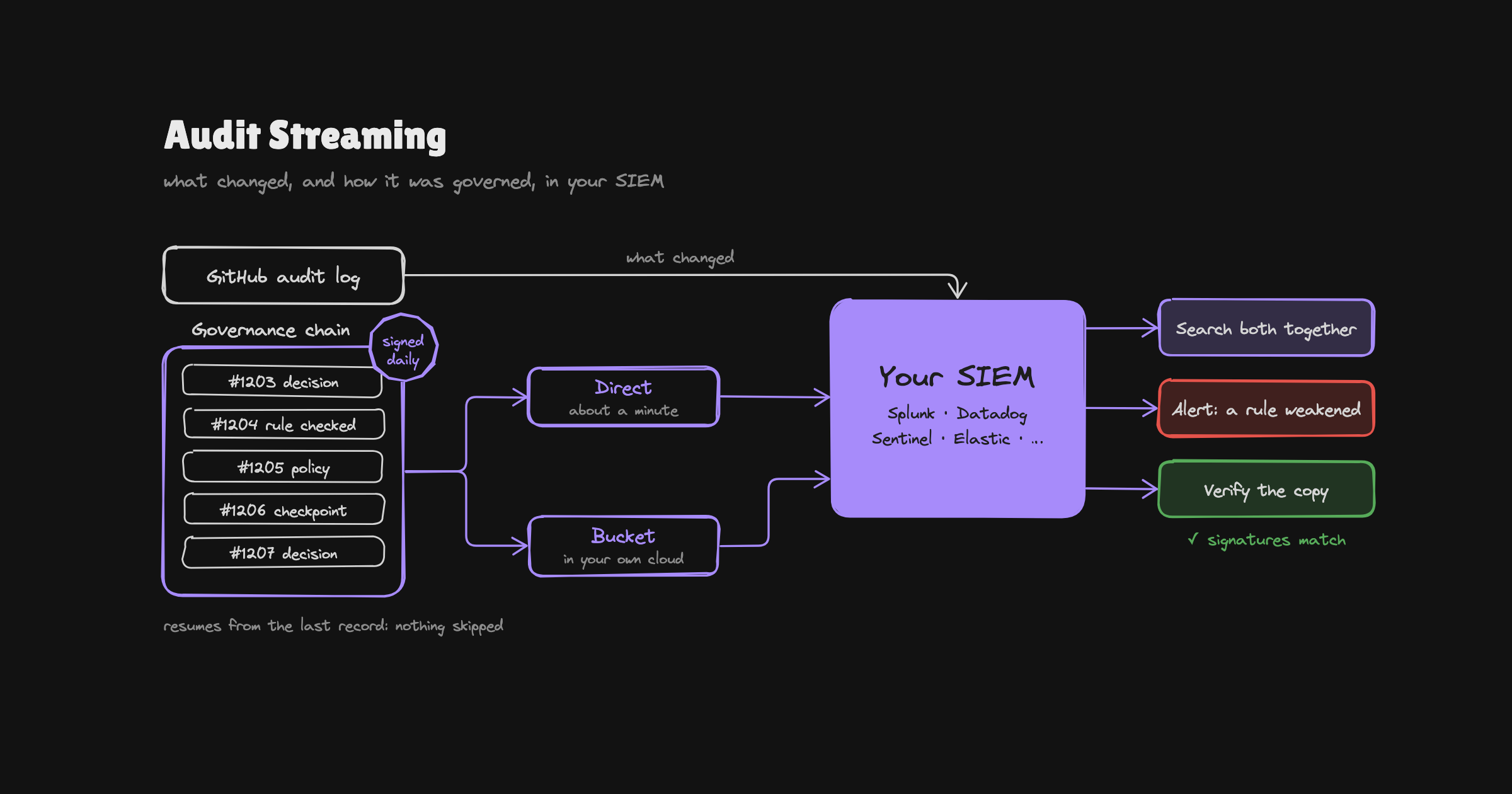
Audit streaming: what GitHub's audit log cannot tell your SIEM
GitHub's audit log shows what changed. The governance chain shows how that change was governed, and audit streaming sends it to your SIEM in the same format, with a copy you can verify.
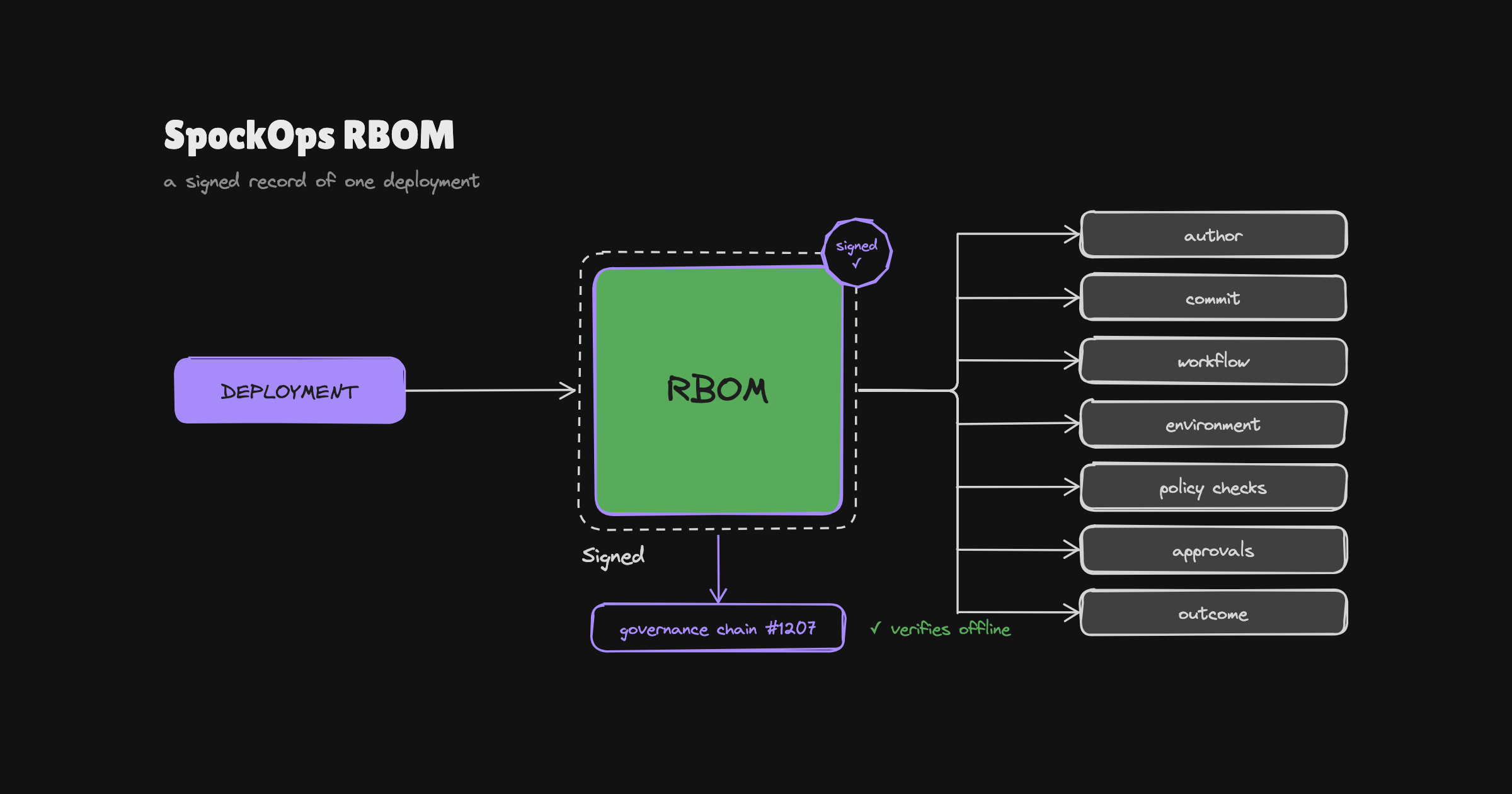
The Release Bill of Materials: a signed record of every deployment
An RBOM is a signed, chained record of one deployment: what shipped, who asked, which rules were checked, who approved it and how it ended.
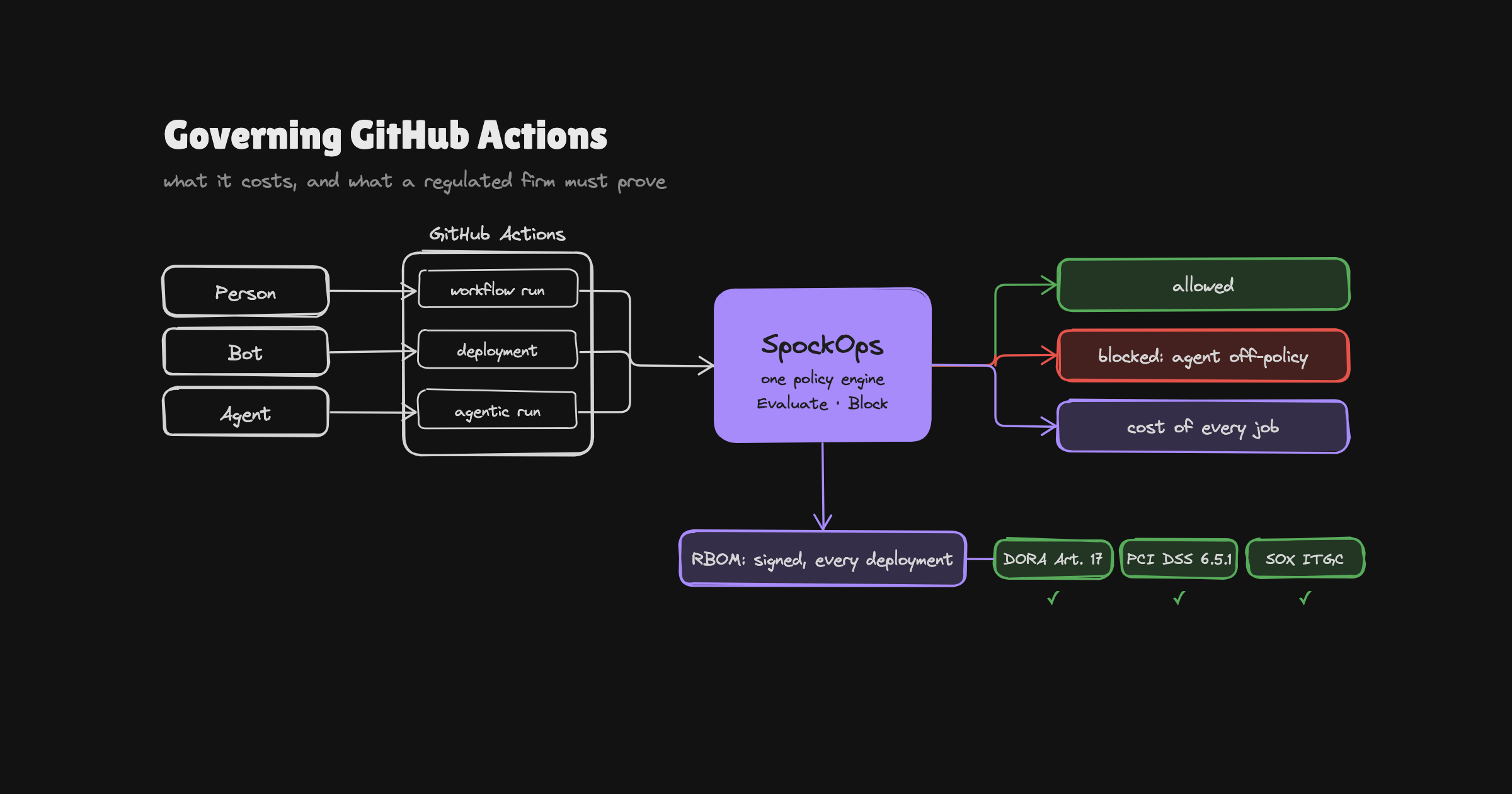
What GitHub Actions costs a regulated engineering team, and what it costs to govern it
What GitHub Actions, runners and agents cost a regulated engineering team, what DORA, PCI DSS and SOX require of a change, and how SpockOps governs all of it.
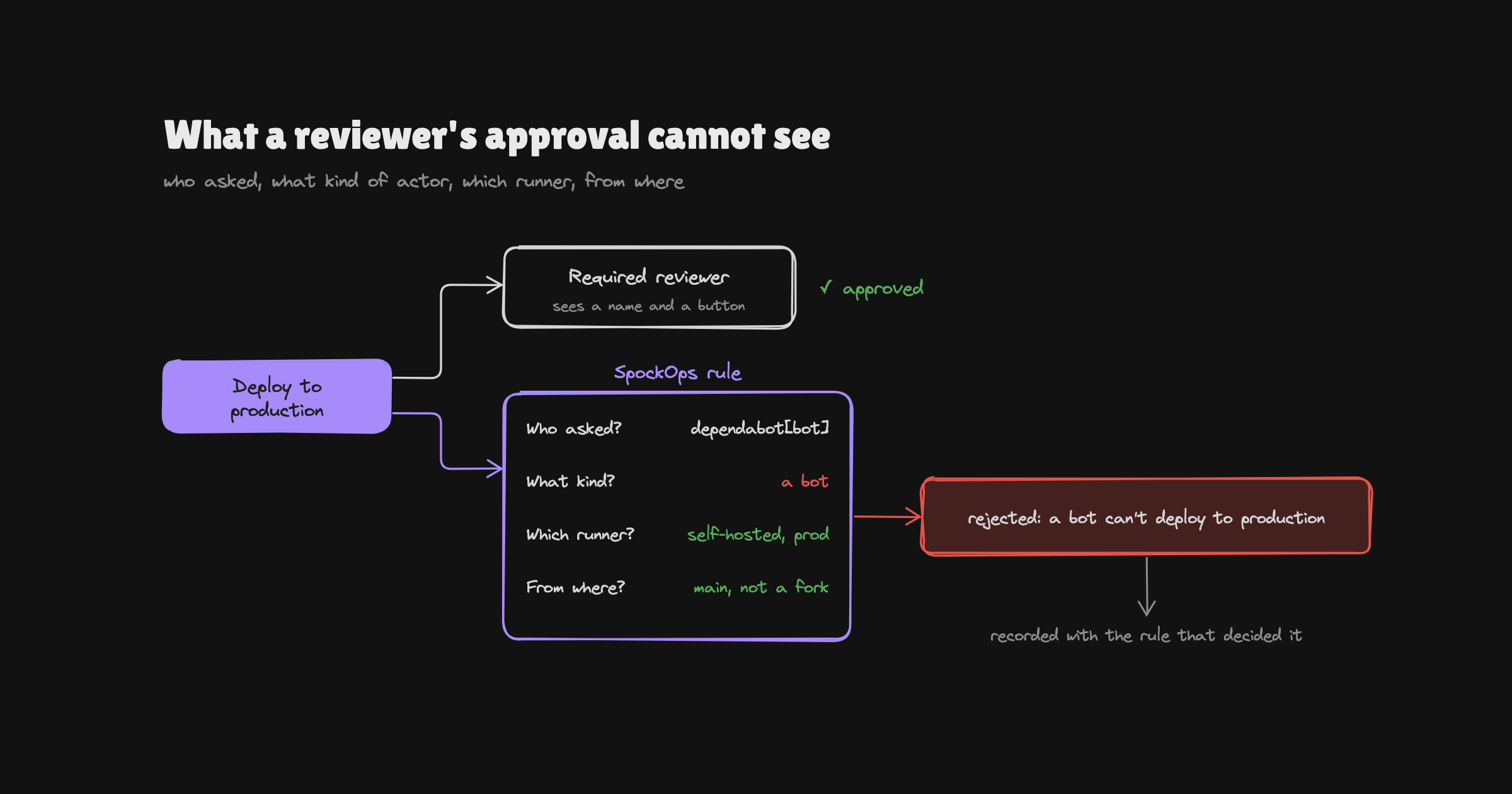
Deployment protection rules: what a reviewer's approval cannot see
How GitHub deployment protection rules work, what required reviewers cannot see, and how SpockOps approves each deployment by actor, runner, kind and origin.