 SpockOps
The Release Bill of Materials: a signed record of every deployment
An RBOM is a signed, chained record of one deployment: what shipped, who asked, which rules were checked, who approved it and how it ended.
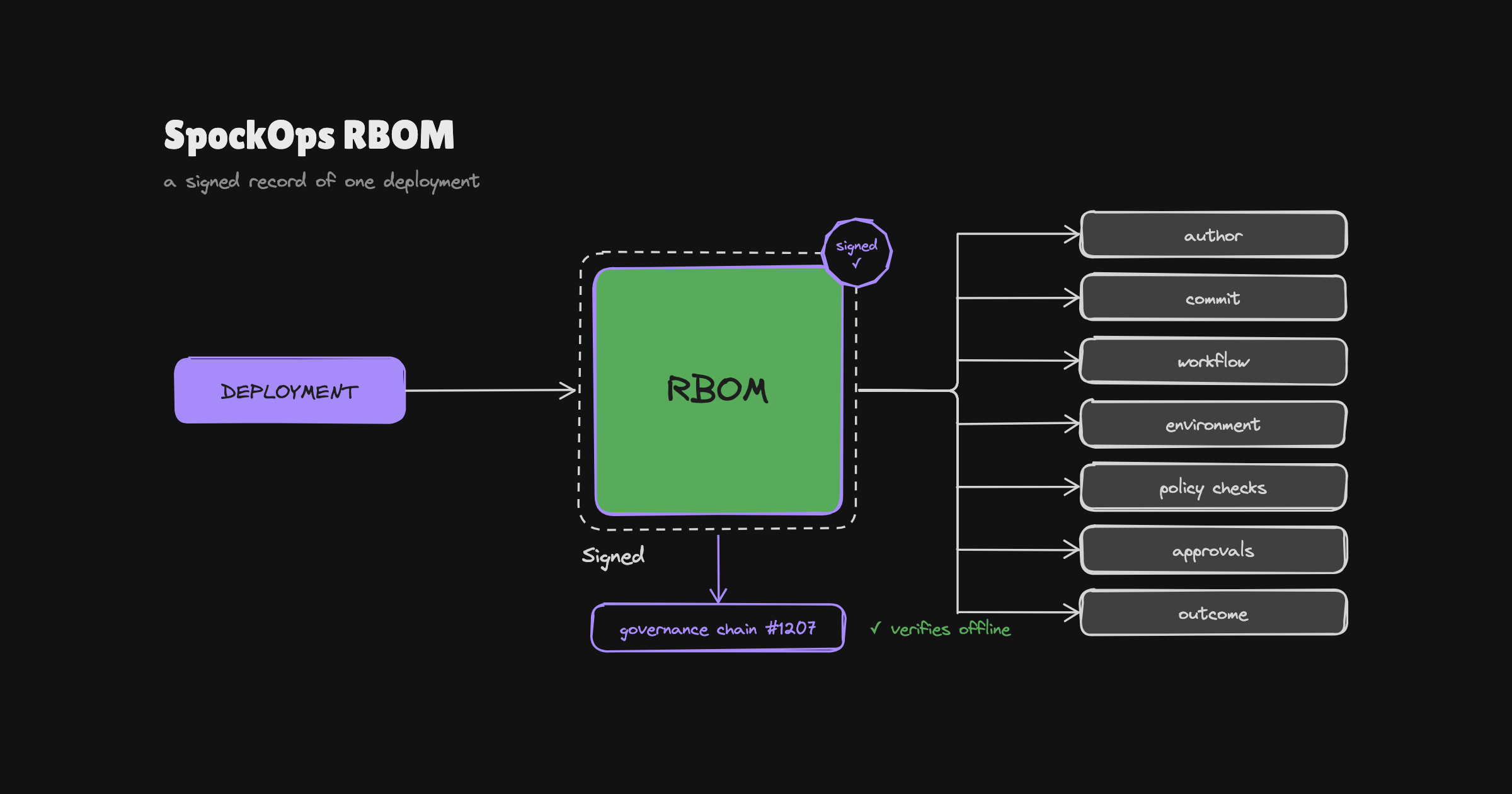

A Release Bill of Materials, or RBOM, is a signed record of one deployment: what was released and to where, who requested it, which rules were checked, who approved it and how it ended. It is built from an audit trail in which each record is chained to the one before it, and anyone with SpockOps' public key can verify it offline. SpockOps issues an RBOM for every deployment that passes through its deployment protection rule.
An RBOM is meant to be read by people outside the team that produced it: auditors, risk officers, regulators. Its value depends on their being able to understand exactly what it records and what it does not, so this post sets out both.
What does an auditor ask about a deployment? #
Two questions, in essence: what happened, and was it allowed? Answering them for a single production release is usually harder than it should be.
The evidence for one deployment typically lives in five places. The commit and the workflow are in the repository. The run and its logs are in GitHub Actions. The approval is a click recorded on the environment. The rules that applied are in a policy document, or in someone's memory of what the policy said at the time. The outcome is in a monitoring tool or an incident channel. Assembling these into a coherent account means screenshots, exports and a spreadsheet, prepared weeks or months after the fact.
Even then, the account has two weaknesses an auditor will notice. It is a reconstruction: nothing in it proves that it matches what actually happened. And it reflects the present state of each system, not the state at the time; if a policy has been edited since, the record cannot show what was actually checked. Regulations such as the EU's Digital Operational Resilience Act, PCI DSS and SOX all ask for exactly the things a reconstruction struggles to provide: independent approval, documented change details and a trail that can be relied upon.
How is an RBOM different from an SBOM? #
An SBOM describes what is inside an artifact. An RBOM describes what happened when a commit was deployed, and whether it was allowed. The two answer different questions and are designed to sit side by side.
| Software Bill of Materials (SBOM) | Release Bill of Materials (RBOM) | |
|---|---|---|
| Answers | What is in this artifact? | What happened when this commit was deployed, and was it allowed? |
| Subject | A package or container image | A commit deployed to an environment |
| Materials | Dependencies and their versions | The workflow file, the pinned actions and the runner |
| Decision | None | The policies, each rule's result, the reviewers and the verdict |
| Produced | When the artifact is built | From the decision, the reviews and the outcome, recorded as each happens |
A team that already produces SBOMs knows what its software contains. The RBOM adds the account of how that software reached production, under which controls, and on whose authority.
What does an RBOM record? #
Everything needed to answer the auditor's two questions, captured as each step happens.
- The deployment. The repository, the environment, the branch and commit, and the run that performed it.
- Where the change came from. The commit's author and message, and the pull request it arrived through, with who opened it.
- The requester. Who asked for the deployment, and whether that was a person, a bot or an AI agent, named as such: "dependabot[bot] deployed to production".
- What actually ran. The workflow file at its exact commit, how many of its actions were pinned in the lockfile, and the runner, including whether it was hosted by GitHub or by the firm.
- The rules. Every policy that applied, stored exactly as it stood when it was evaluated, with each rule's required value, its actual value and whether it was enforced or only observed.
- The people. Each reviewer, their decision, their message and how long the deployment waited for them.
- The decision. Approved, rejected or skipped, and exactly what SpockOps told GitHub, including GitHub's reply.
- The outcome. Whether the deployment succeeded or failed, and how long it took.
One detail matters more than it may appear. When no policy applies to a deployment, the RBOM records it as skipped, even though GitHub is told to proceed. The record never presents an unchecked deployment as a passed one. Equally, when a policy covers an environment but GitHub never asked SpockOps, because SpockOps is not registered as that environment's protection rule, the RBOM says so plainly.
Why can an RBOM be trusted? #
Because its integrity does not depend on trusting SpockOps' interface. Four design choices make that possible.
It is signed. Each RBOM file is signed by SpockOps with an Ed25519 key, identified by a key id. The public keys are published at a fixed address, /.well-known/rbom-keys.json, so anyone can check a signature without a SpockOps account. The signature records when the file was issued.
It uses a standard format. The record is an in-toto statement inside a DSSE envelope, the same structure GitHub uses for its own artifact attestations and the one the SLSA framework describes. Existing supply chain tooling can read it, and the signature covers a canonical form of the data, with sorted keys and no whitespace, so every language reproduces exactly the same bytes.
It is chained. Every decision, review, final status and policy change is written to an append-only deployments audit trail, and every record carries the fingerprint of the record before it in the same workspace. The database refuses to change or delete a record, and if history were altered anyway, the chain would break at that point, visibly. Each RBOM names the audit trail records it was built from.
It is frozen at decision time. The policies are stored as they were when evaluated, with their own fingerprints, so editing a policy later cannot change what an old decision appears to have checked.
Records are not deleted when the GitHub App is uninstalled: the audit trail holds its own copy of every decision.
How does an RBOM answer DORA, PCI DSS and SOX? #
By recording, for each deployment, the specific things these regimes ask a firm to demonstrate.
- EU DORA. The change-management standard, Delegated Regulation (EU) 2024/1774, Article 17, asks for "mechanisms to ensure the independence of the functions that approve changes" and "the documentation and communication of change details". An RBOM records the requester and the approver separately, the controls applied and the full change details, and it can be shared as it is.
- PCI DSS v4.0. Requirement 6.5.1 asks for "documented change approval by authorized parties". An RBOM is that documentation, with the approval tied to the exact commit and environment.
- SOX IT general controls. Auditors expect, in one industry summary's words, "complete audit trails with timestamps and user identifiers", retained for years. An RBOM carries both, and its chain shows that the trail is complete.
The practical effect is that evidence no longer has to be assembled after the event. It exists from the moment each deployment is decided, and it can be attached to a change ticket, a release record or an auditor's evidence folder.
What does an RBOM not prove? #
Evidence is only useful if its limits are stated plainly, so here are the limits of this one.
- That the deployed code is safe. An RBOM records which checks ran and how they concluded, not that those checks were sufficient.
- Anything SpockOps did not see. A deployment to an environment without SpockOps' protection rule is recorded, but it was not checked, and its RBOM says so.
- That GitHub's own data was accurate. An RBOM attests what GitHub reported to SpockOps and what SpockOps decided.
- Anything after a key compromise. If a signing key were compromised, every record signed with it would lose its value, which is why the key is kept in a key vault and supplied only to SpockOps' servers.
These limits are deliberate. An RBOM is a precise account of one deployment, and it is most useful to an auditor when it claims no more than that.
How is an RBOM verified? #
Offline, with only the file and SpockOps' published public key. The signature is standard Ed25519 over DSSE's pre-authentication encoding, so a few lines in any language with an Ed25519 library are enough. In Python, with the cryptography package:
import base64, json, sys, urllib.request
from cryptography.hazmat.primitives.asymmetric.ed25519 import Ed25519PublicKey

envelope = json.load(open(sys.argv[1]))
keys = json.load(urllib.request.urlopen("https://spockops.com/.well-known/rbom-keys.json"))
public = {k["keyid"]: Ed25519PublicKey.from_public_bytes(base64.b64decode(k["public_key"])) for k in keys["keys"]}

payload = base64.b64decode(envelope["payload"])
kind = envelope["payloadType"].encode()
signed = b"DSSEv1 %d %s %d %s" % (len(kind), kind, len(payload), payload)
signature = envelope["signatures"][0]
public[signature["keyid"]].verify(base64.b64decode(signature["sig"]), signed)   # raises if anything was changed
print("verified:", json.loads(payload)["predicate"]["decision"]["verdict"])
Change a single character of the file and verification fails. An auditor can run this on their own machine, against files handed over by the firm, without an account or any access to SpockOps.
Coming shortly: the open rbom command-line tool, which wraps this check and verifies a folder of records and the chain between them, and a reusable GitHub Action that verifies RBOMs inside a pipeline.
Where are RBOMs in SpockOps? #
On every deployment. Open a day on the deployments page and each deployment shows its RBOM as a card above its run: the verdict, the rules that ran, the reviewer's message, where the change came from, what ran and how it ended, and the audit trail record it rests on. A download menu gives the signed RBOM file and the card itself as an image.
The deployments audit trail lists every record, newest first, with filters by target, kind of event and environment, and shows whether the chain is intact. The workspace audit log records each decision alongside the rest of the workspace's activity.
RBOMs are issued for deployments that pass through SpockOps' deployment protection rule, so the first step is to enable it on the environments that matter.
- Install the SpockOps GitHub App on each organization.
- Enable SpockOps as a deployment protection rule on production.
- Write the policies your auditors expect: no deployments from forks, production only from protected branches, production only on approved runners, bots and agents under their own rules.
Further reading: Deployment protection rules: what a reviewer's approval cannot see and What GitHub Actions costs a regulated engineering team, and what it costs to govern it.
Questions
What is a Release Bill of Materials?
A Release Bill of Materials, or RBOM, is a signed record of one deployment: what was released and to where, who requested it, which rules were checked, who approved it and how it ended. It is built from an audit trail in which each record is chained to the one before it.
How is an RBOM different from an SBOM?
An SBOM lists what is inside a software artifact. An RBOM records what happened when a commit was deployed, and whether the deployment was allowed under the firm's policies.
Can an auditor verify an RBOM without access to SpockOps?
Yes. Each RBOM is signed with an Ed25519 key whose public half SpockOps publishes, so a signature can be checked offline with any Ed25519 library. An open rbom command-line tool and a reusable GitHub Action for verification are coming shortly.
What format does an RBOM use?
An in-toto statement in a DSSE envelope, the same structure GitHub uses for its artifact attestations, signed over a canonical JSON form so that any language reproduces the same bytes.
What happens if a policy changes after a deployment?
Nothing changes in the record. Each decision stores the policies exactly as they stood when they were evaluated, with their own fingerprints.
Is RBOM available today?
Yes. SpockOps issues an RBOM for every deployment that passes through its deployment protection rule, records each decision in a chained audit trail, and signs every RBOM file it issues. The rbom command-line tool and reusable GitHub Action for verifying them are coming shortly.
Related posts
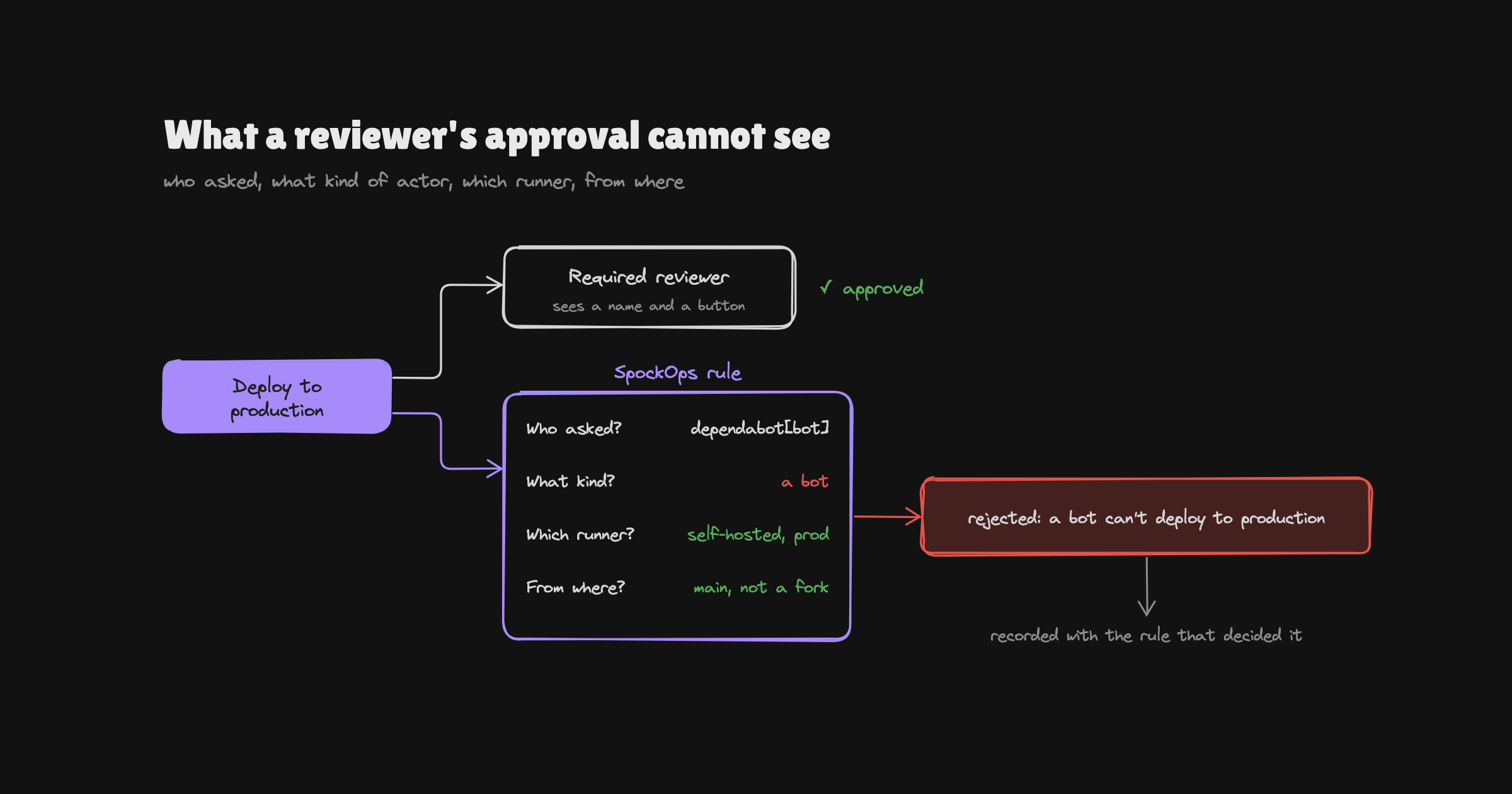
Deployment protection rules: what a reviewer's approval cannot see
How GitHub deployment protection rules work, what required reviewers cannot see, and how SpockOps approves each deployment by actor, runner, kind and origin.
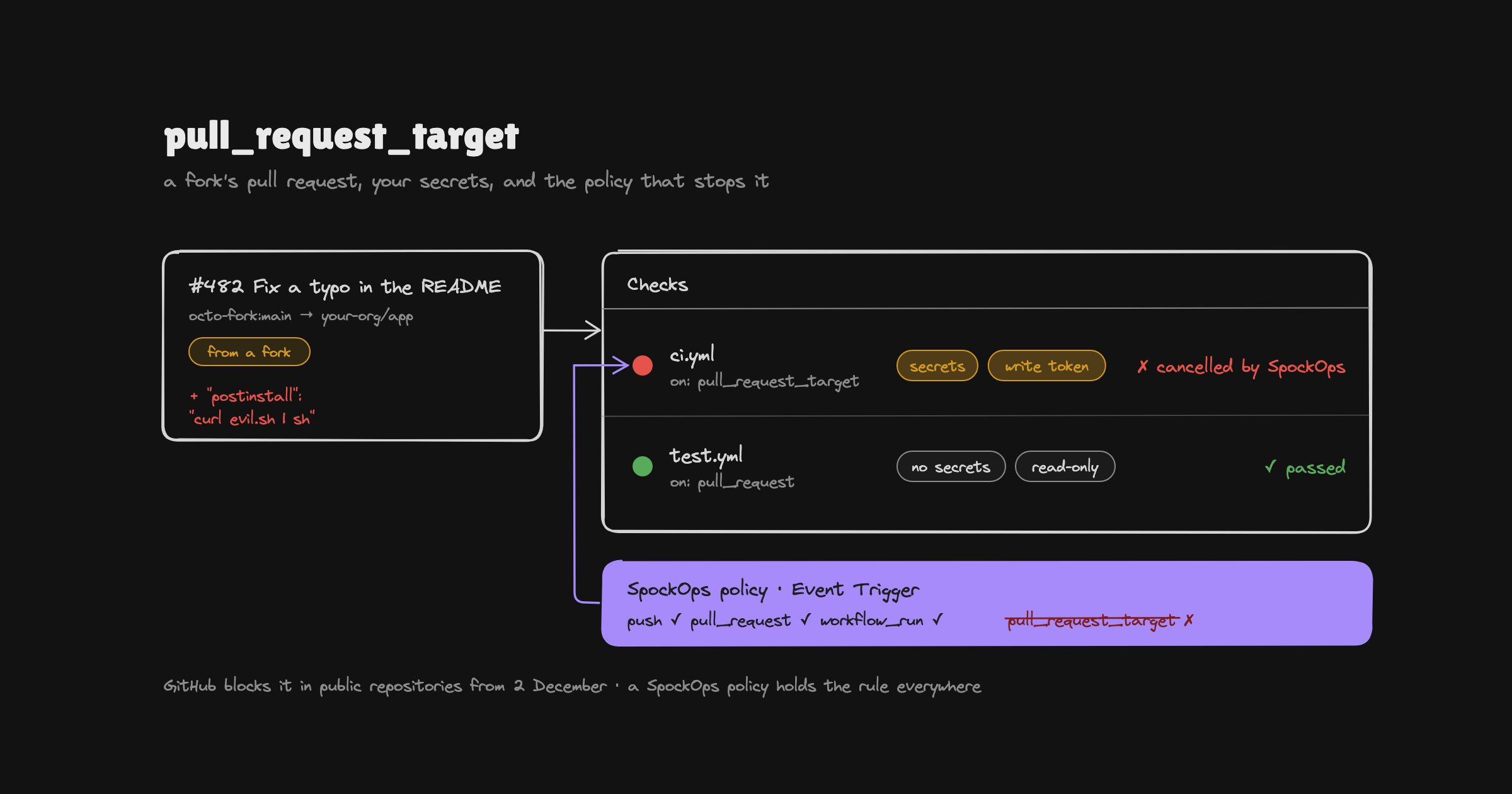
pull_request_target: why to stop using it, and what to use instead
GitHub blocks pull_request_target by default from 2 December. Why the trigger is dangerous, the simple two-workflow pattern to use instead, and how to keep it out of every repository.
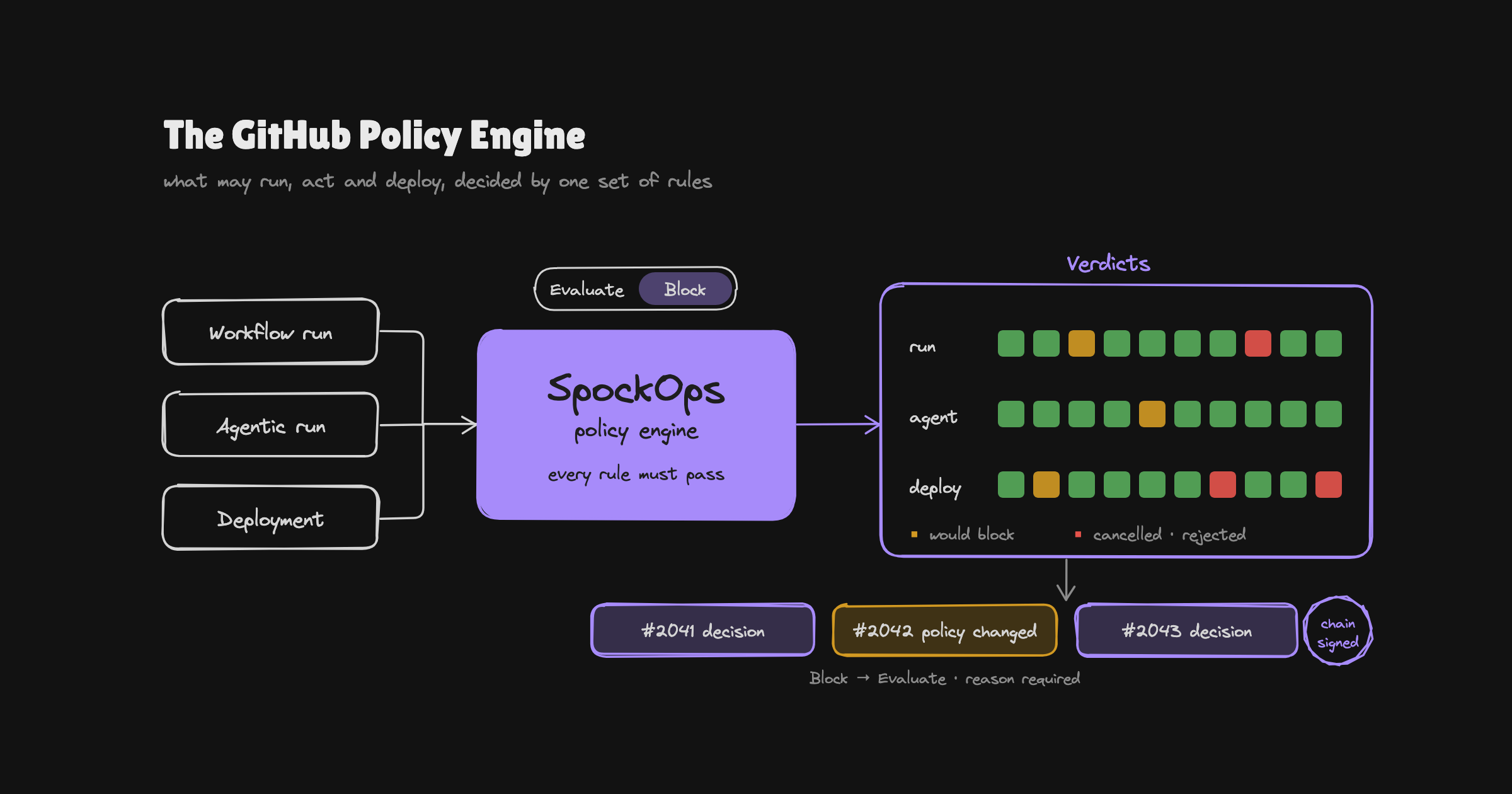
The GitHub policy engine: how SpockOps decides what may run, act and deploy
A policy engine for GitHub Actions: one set of rules for workflow runs, agentic workflows and deployments, tried in Evaluate, enforced in Block and recorded.
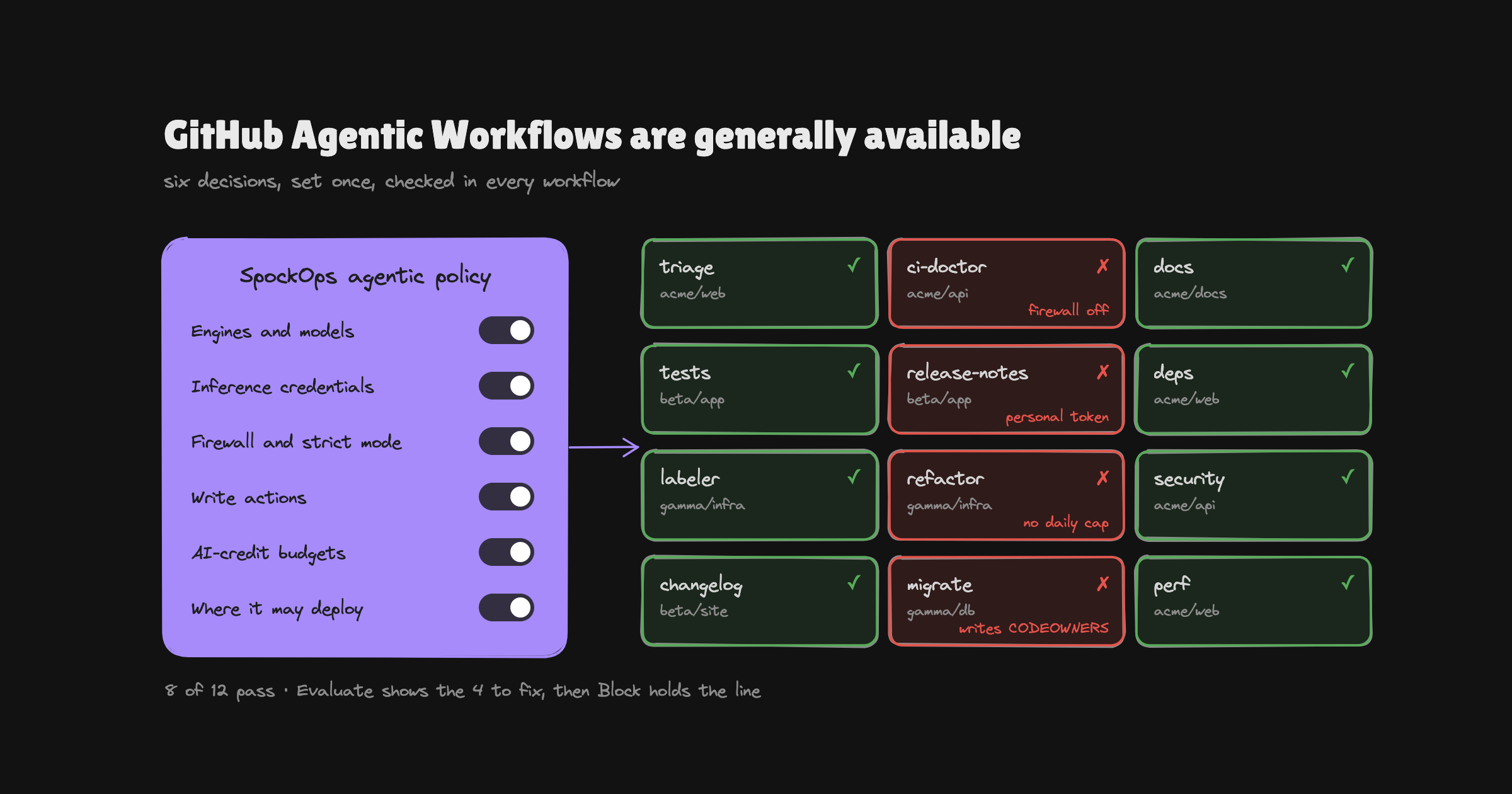
GitHub Agentic Workflows are generally available: six decisions before your teams turn them on
GitHub Agentic Workflows are generally available. The six decisions an enterprise should make first: engines, credentials, isolation, writes, spend and deployments.
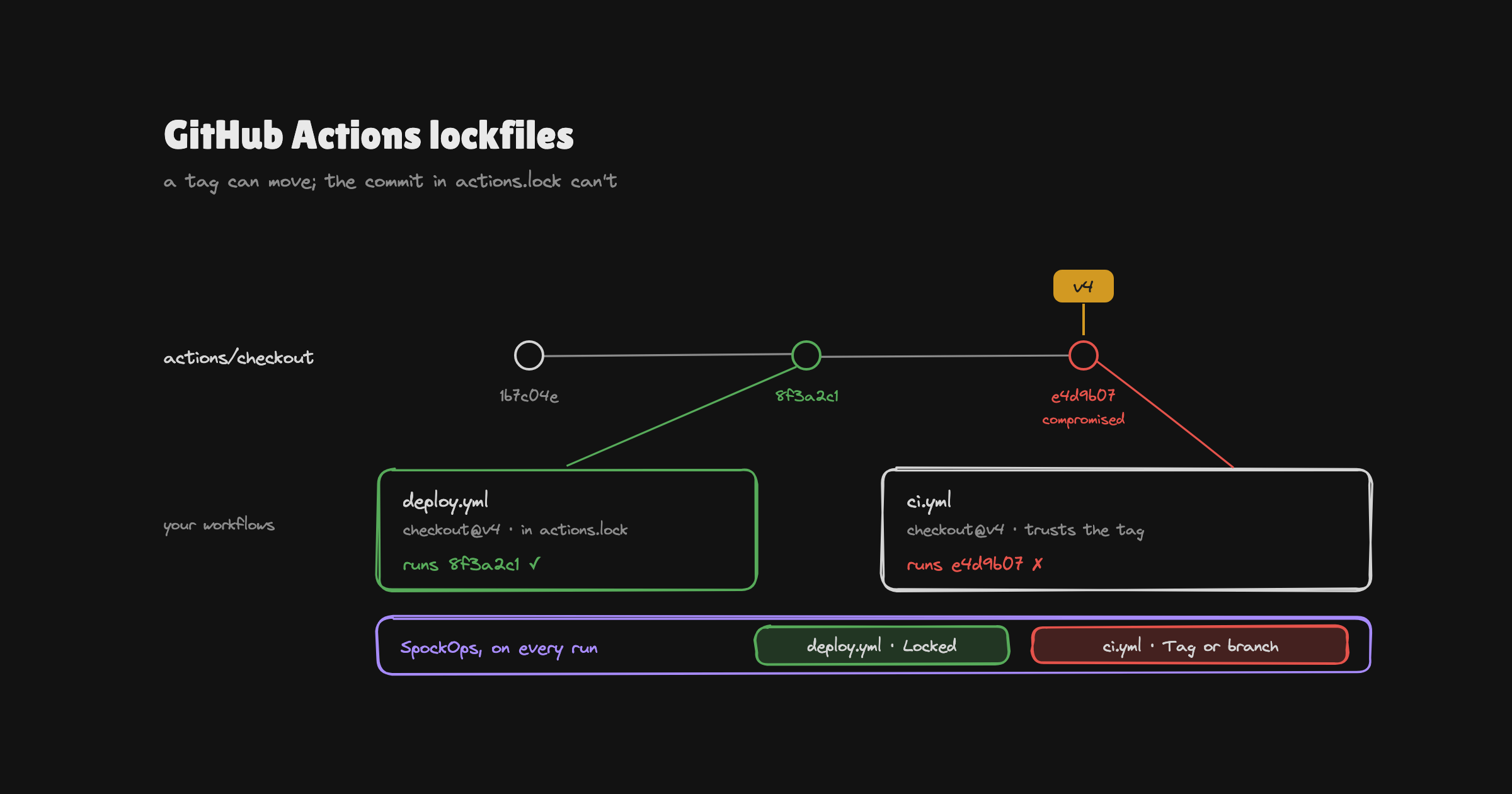
GitHub Actions lockfiles are generally available: what they fix, and what to watch across every repository
GitHub Actions workflow lockfiles pin every action, transitive dependency and reusable workflow to a commit. What they fix, what they don't, and how to start using one today.
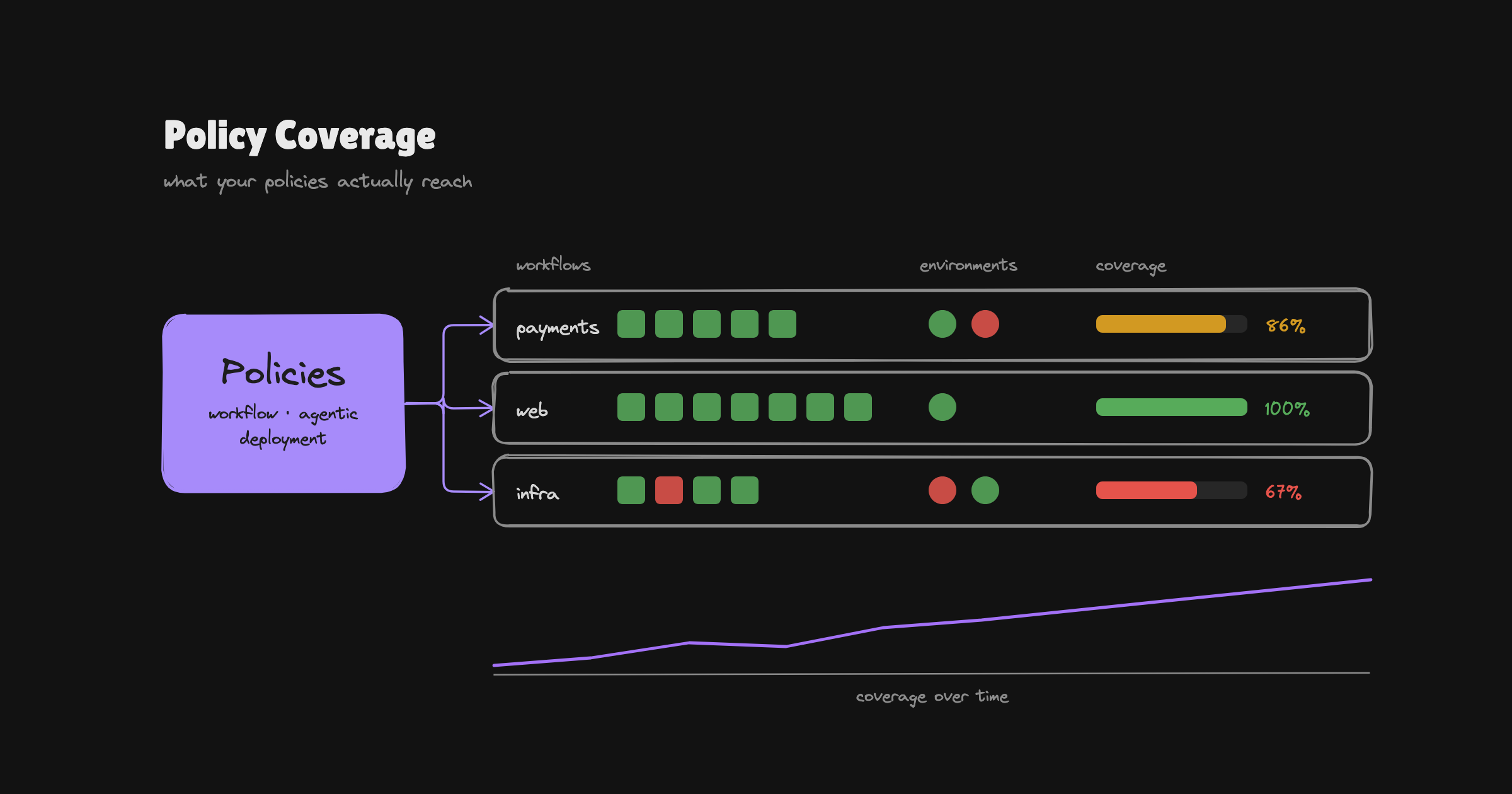
Policy coverage: what your GitHub Actions policies actually reach
Policies only govern what they match. SpockOps' coverage shows every workflow that ran and every environment, and whether a policy would check it.