 SpockOps
Bots and agents on GitHub Actions
Let the agents in. Keep the rules.
Dependabot, Renovate, Copilot and agentic workflows now open pull requests, run CI and deploy. SpockOps shows what each one did and what it cost, and holds it to the same rules as your people.
Who's shipping now
More of your changes don't come from a person
Bots and agents do real work now. In GitHub they look like any other account, and their safeguards live in each workflow, set by whoever wrote it.
-
Hard to see
They blend in
A bot's runs sit among your team's, one repository at a time. Nobody can say how many there are, what they run, or how much they ship.
-
Hard to hold
Each sets its own rules
An agentic workflow's engine, model, network and write access are chosen by its author, in its own file. Dependabot even runs where your Actions policies would stop it.
-
Hard to cost
Their bill is elsewhere
An agent's AI credits sit on another bill, often most of what a run costs. A bot's pull requests run CI nobody asked for.
See them
What your bots and agents did, and what it cost
Dependabot, Renovate, the Copilot coding agent and GitHub Agentic Workflows on one page: their runs, their engines, and the model spend set beside their runner minutes.
- botdependabot[bot]dependency updates312runs$640runner minutes
- botrenovate[bot]dependency updates88runs$96runner minutes
- agentcopilotcoding agent, assigned issues41runs$238of which AI credits $186
- agentissue-triage.mdagentic workflow · copilot engine97runs$63of which AI credits $59
- agentdocs-updater.mdagentic workflow · claude engine23runs$34of which AI credits $31
WARP
72/ 100
Warp 3 of 4 · Managed
- Workload80
- Autonomy64
- Reliability78
- Posture70
- Efficiency68
One score for how well your bots and agents are run, and what the next tier needs.
Connect the rules
One policy for every agent, in every repository
Instead of trusting each workflow's author to set its safeguards, write them once. SpockOps checks every agentic workflow against them as each agent run starts, in Evaluate first, then in Block.
- Which engine and modelCopilot or Claude, and the models you've approved, with the inference credentials you expect.
- How it's builtCompiled in strict mode, with the gh-aw compiler version you trust.
- Where it can reachBehind the agent firewall, with threat detection before anything is written.
- What it may changeOnly the write actions you allow: comments and labels, say, but not pushes.
- How much it may spendA daily ceiling on the AI credits it may spend, so a loop can't run up the bill.
- Where
- Every agentic workflow
- Engines
- Copilot or Claude only
- Build
- Compiled in strict mode
- Network
- Behind the agent firewall
- Writes
- Comments and labels only
- Credits
- At most 200 a day
And at the gate
A bot may ship to staging. Production waits for a person.
SpockOps' deployment rule knows the kind of actor behind every deployment, a person, a bot or an AI agent, and decides by it. A merged dependency update can flow on its own, right up to the environments where you want a human in the loop.
- Who started itThe account behind the deployment, and whether it's a person, a bot or an agent.
- Where it's goingStaging can take a bot's update straight away; production can require a person's approval.
- Held, not lostA held deployment waits at the gate until someone approves it, with the reason on the check.
- RecordedEvery decision, and who approved it, kept in the governance chain.
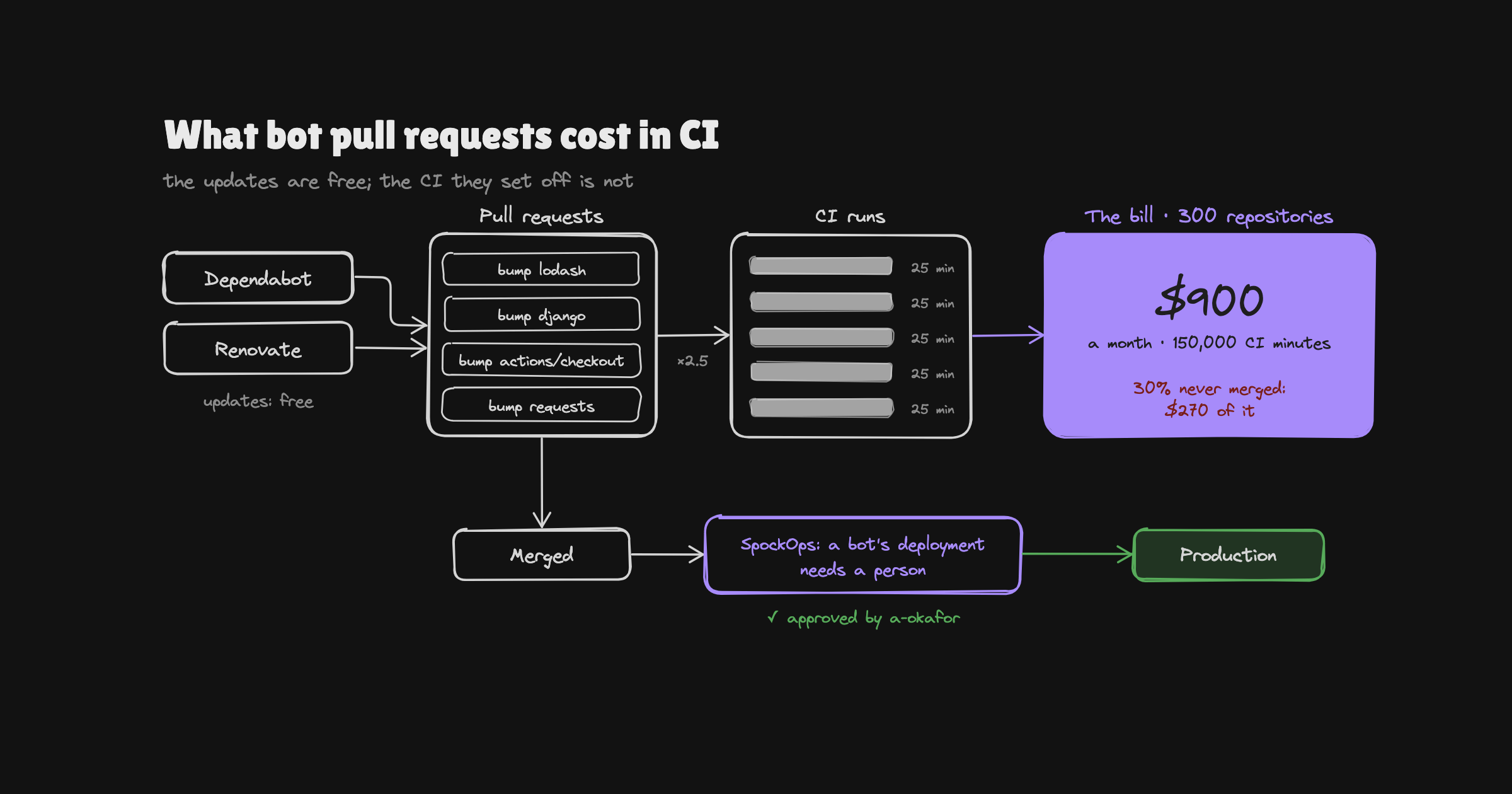
Follow one
From the update to every run it caused
Each bot or agent event becomes a tree: what it opened, every CI run that followed, and what it all cost. So "what did that update set off?" has an answer.
- bot dependabot[bot] · npm update run1 run$0.00
- Pull request #812 · bump lodashCI 3 runs$1.14
- Pull request #813 · bump react-domCI 5 runs, 1 retried$2.06
- merged · deploy to stagingallowed$0.31
- deploy to productionheld for a person—
- Pull request #814 · bump eslintclosed, never merged$0.59
- The update, and everything it set off9 runs$4.10
Further reading
Agents and bots, in more detail
-
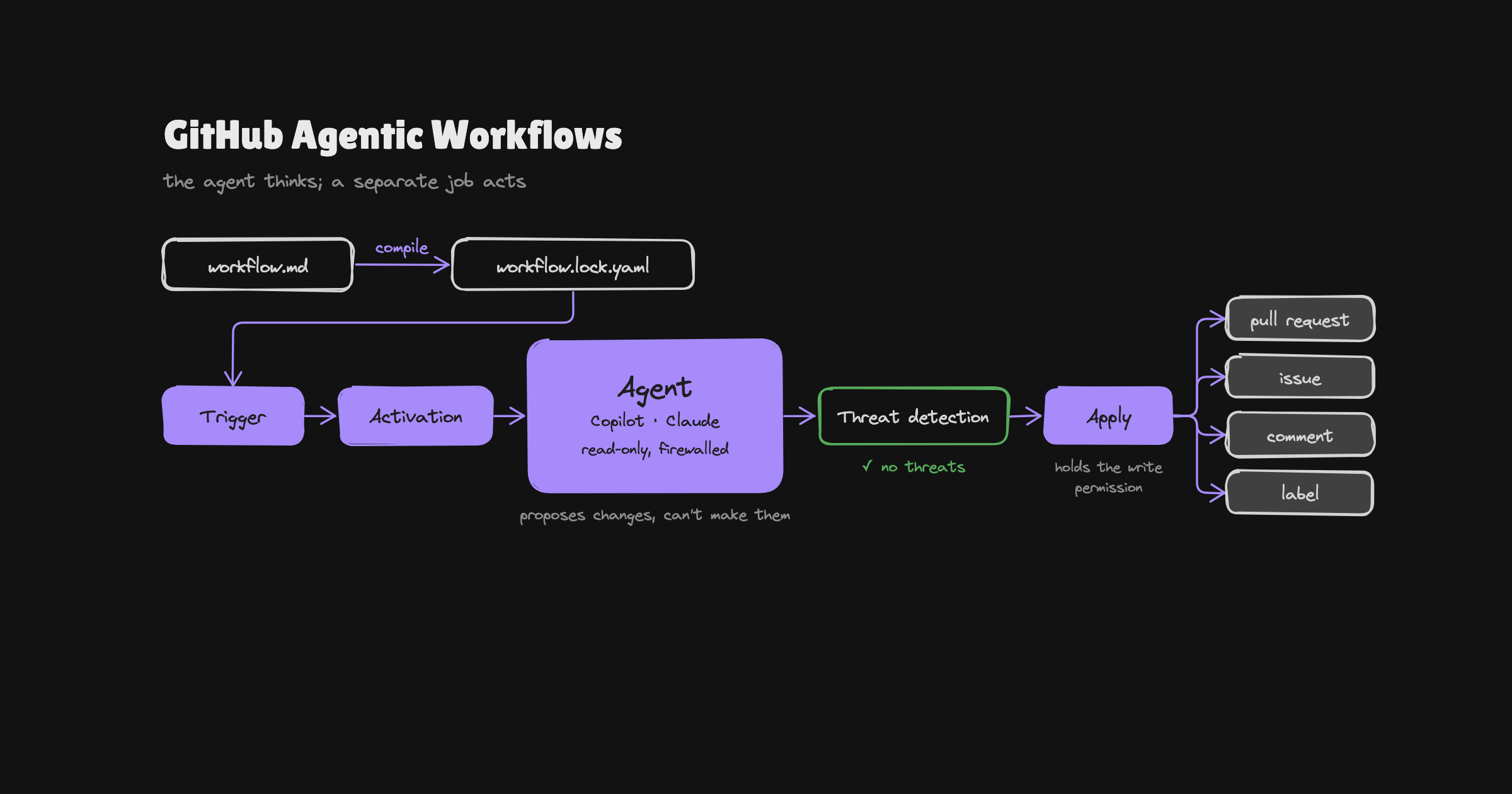
How GitHub Agentic Workflows work
A plain introduction to GitHub Agentic Workflows: how they are written, what happens when one runs, how agents are kept safe, and what they …
-
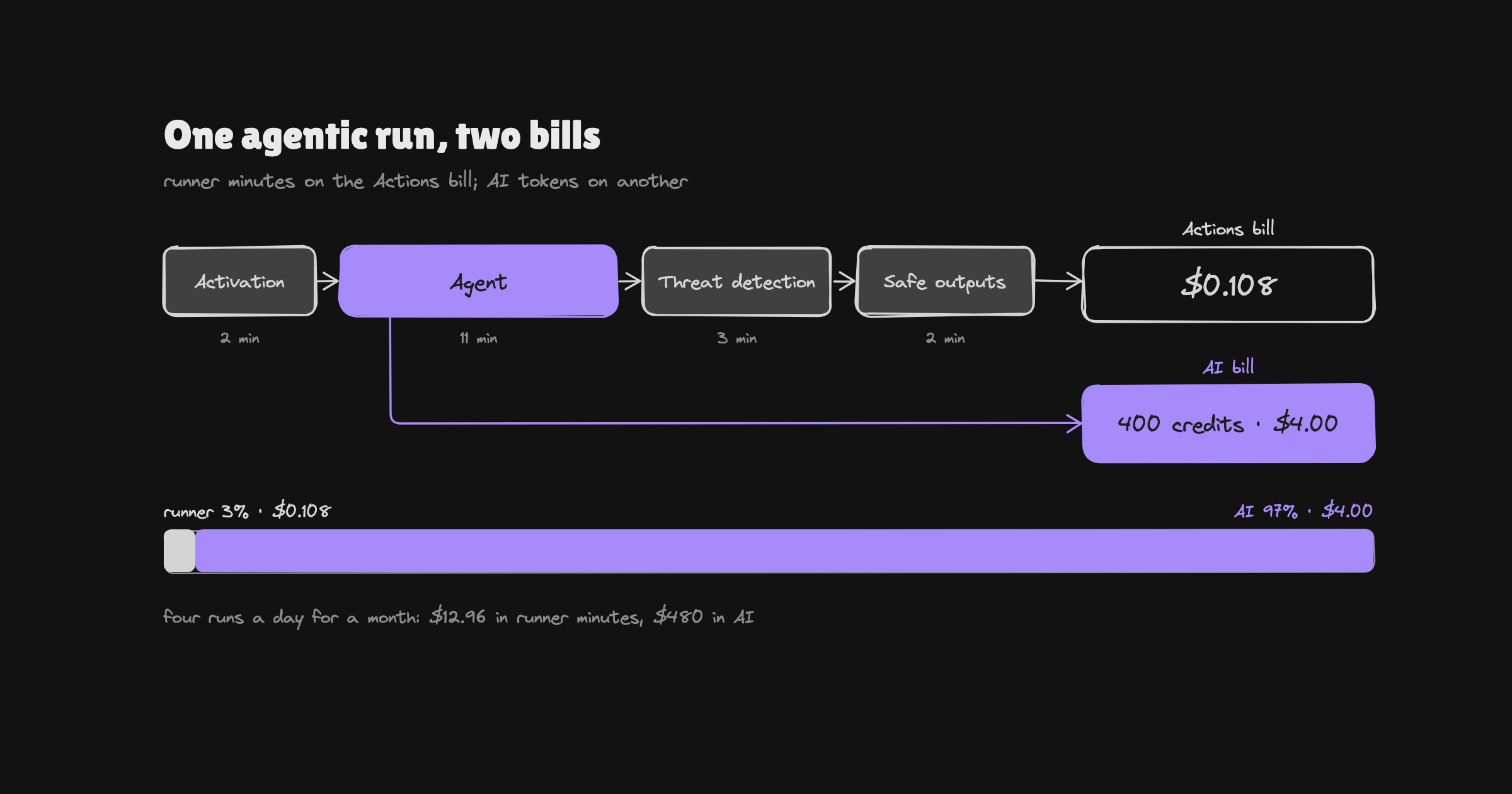
What does an agentic workflow cost? Runner minutes vs. AI tokens
Every GitHub agentic workflow run has two bills: Actions minutes and AI tokens. See a priced example and how SpockOps splits compute from agent …
-
What do Dependabot and Renovate really cost in CI?
Dependabot and Renovate are free. The CI their pull requests set off is not. What dependency bots cost in GitHub Actions, and how to …
Before you let them in
Which bots and agents does it see?
Every actor that runs work on GitHub Actions: dependency bots like Dependabot and Renovate, the Copilot coding agent, GitHub Agentic Workflows on any engine, and any other bot or app account. Each is told apart from people, with its own runs, cost and history.
Can a bot deploy to production on its own?
Only if you let it. A deployment policy can decide by kind of actor: a dependency bot may deploy to staging, but a deployment to production started by a bot or an agent waits for a person's approval, and the decision is recorded.
What do agentic policies check?
Every GitHub Agentic Workflow's engine and model, its inference credentials, the gh-aw compiler version, strict compilation, the agent firewall, threat detection before writes, the write actions it may take and its daily AI credits, across every repository, in Evaluate or Block.
What does an agent cost?
An agentic run has two bills: runner minutes and AI credits. SpockOps puts both on the agent's row, AI credits at the payer's rate, so you can see that most of what a run costs is often the model.
Get started
Meet the agents
already shipping.
Install the App on one organization and see every bot and agent from the last 90 days, what each ran and what it cost. Then write their first policy, in Evaluate. No changes to any workflow or repository.