 SpockOps
What do Dependabot and Renovate really cost in CI?
Dependabot and Renovate are free. The CI their pull requests set off is not. What dependency bots cost in GitHub Actions, and how to govern what they deploy.
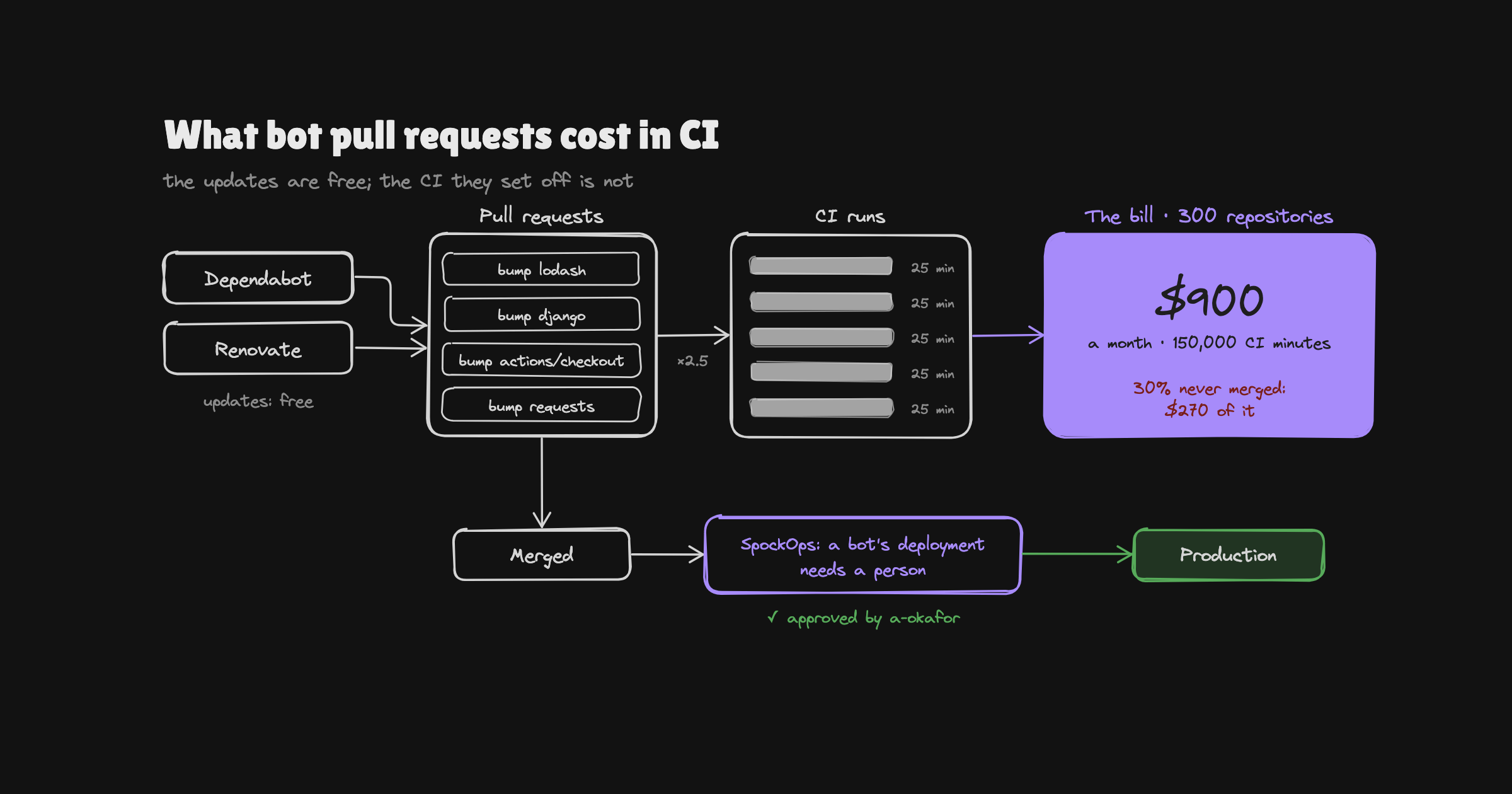

Dependabot's update jobs are free on standard runners, and Renovate's hosted app is free from Mend. The CI their pull requests set off is not. Every pull request, every rebase and every update closed without merging runs your workflows in full. Across a large organization that adds up, and GitHub shows it nowhere as one figure.
It is worth saying first that both bots are among the most valuable automation a team can switch on. Keeping dependencies current is tedious work that people postpone, and postponed updates are how known vulnerabilities stay in production. Dependabot is built into GitHub, and the Renovate app lists more than 82,000 installs on GitHub Marketplace. Nothing in this post argues for running them less carefully. It argues for seeing what they set in motion.
This post asks three questions of each bot, the same three we ask of any automation in CI: what does it run, what does it cost, and what may it do, including deploy?
What do Dependabot and Renovate run? #
Each bot does its work in two stages. First an update job reads your manifests, checks for newer versions and opens or updates pull requests. Then those pull requests set off your own CI, exactly as a person's would. The two bots differ in where the first stage runs.
| Dependabot | Renovate (Mend-hosted app) | |
|---|---|---|
| Where the update job runs | On GitHub Actions, as a workflow GitHub manages for you | On Mend's infrastructure, outside your Actions bill. Teams can also self-host it or run it as a GitHub Action |
| Cost of the update job | Free on standard GitHub-hosted and self-hosted runners; billed at the regular rate on larger runners | Free with the hosted app. Self-hosted, it costs whatever its own runs cost |
| Cost of the CI its pull requests set off | Billed like any other run | Billed like any other run |
The second stage is where the minutes go, and it is the same for both. A dependency update that touches a busy repository runs its full test suite, its builds and any other workflows triggered by pull requests, and runs them again whenever the bot updates its branch.
Is Dependabot free? #
Its own work is, on standard runners. Since moving Dependabot's compute onto GitHub Actions, GitHub has been clear that there are "no charges for standard Dependabot usage". Its documentation adds that running Dependabot on standard GitHub-hosted or self-hosted runners "does not count towards your included GitHub Actions minutes". On larger runners, GitHub bills it at the regular rate.
What Dependabot sets off is a different matter. When it opens a pull request, the workflows that run on pull requests in that repository run, on whatever runners they normally use, and they are billed like any other run. The same is true each time Dependabot pushes to its branch, for example to rebase onto a newer main branch or to move to a newer version.
So the honest answer is in two parts: the update is free, and the CI it sets off is not.
What does the CI they set off cost? #
The cost of one bot pull request is small. The cost of all of them, across a large organization, is not, and it is hard to see because it is spread across hundreds of repositories and thousands of runs that look like any others.
Consider an illustrative organization with 300 active repositories. Each receives 8 dependency pull requests a month, 2,400 in all. Each pull request runs its workflows 2.5 times on average, once when it opens and again for rebases and re-runs, and a full run takes 25 minutes. Those are assumptions, not measurements; your own figures will differ.
| Standard Linux, 2-core ($0.006 a minute) | Larger Linux, 8-core ($0.022 a minute) | |
|---|---|---|
| CI per bot pull request | 62.5 minutes, $0.38 | 62.5 minutes, $1.38 |
| CI per month | 150,000 minutes, $900 | 150,000 minutes, $3,300 |
| If 30% of the pull requests close without merging | $270 of it spent on updates that never merged | $990 of it spent on updates that never merged |
The figure for a single pull request is trivial, and nobody should be alarmed by it. The monthly figure, the share spent on updates that never merge, and the jump on larger runners are what deserve attention. They also scale with the things that make an organization mature: more repositories, longer test suites, and faster runners.
How SpockOps traces the cost. For Dependabot, SpockOps links each pull request, and each push to its branch, back to the update run that created it. One tree then holds the update and every CI run it caused, so the cost can be read per update, per ecosystem (npm, pip, Docker and so on), per repository and per month. Renovate's update job runs outside GitHub Actions, so there is no update run to trace from; SpockOps recognizes Renovate's pull requests by its bot account instead and attributes their CI to it, per repository and per month.
Would grouped updates help? #
Often, yes. Both bots can combine several dependency updates into one pull request: Dependabot through the groups setting in its configuration file, and Renovate through its grouping options and presets. One pull request for ten minor updates runs CI once instead of ten times, and is reviewed once instead of ten times.
Grouping is not free of trade-offs. A grouped update that fails is harder to diagnose, because any of its dependencies may be the cause, and a single problem can hold back the others. A common middle path is to group minor and patch updates and leave major versions on their own.
Other settings help too, and are worth reviewing alongside grouping:
- Schedules. Running updates weekly rather than daily reduces how often pull requests are opened and rebased.
- Limits on open pull requests. Both bots can cap how many update pull requests are open at once.
- Rebase behavior. Renovate in particular lets teams choose when it rebases its branches, which directly affects how often CI runs again.
- Which workflows run. Some expensive workflows, such as long end-to-end suites or deployment previews, may not need to run on every dependency update. Decide this deliberately, since a skipped check is also a skipped safeguard.
How much human time does a bot pull request take? #
More than the word "bot" suggests. An automated pull request still needs people: someone approves it, re-runs a flaky check, or pushes a fix when the update breaks something. That time can easily cost more than the minutes.
SpockOps counts these human touches on each bot pull request before it merges: approvals, re-runs and fix-up commits. Read across repositories, it shows which ones absorb bot updates easily and which need attention every time. A repository where every Dependabot update needs a fix-up commit is telling you something about its tests, or about the dependencies it relies on.
It also gives a fair way to judge configuration changes. If grouping minor updates halves the number of pull requests but doubles the fix-ups on each, the CI bill and the human bill move in opposite directions, and both are visible.
Can a bot's pull request reach production without a person? #
It depends on how your repositories are set up, and many teams have never checked.
GitHub already takes sensible precautions. Workflows started by Dependabot's pull requests run with a read-only token and without access to the repository's ordinary secrets, which limits what a malicious or compromised update could do during CI. That protection covers the pull request, not what happens after it merges.
The path to production usually opens at merge. Many teams let dependency updates merge automatically once checks pass, and many deploy every merge to the main branch. Put those together, and a dependency update can travel from a bot's branch to production with no person looking at it. For patch releases of well-tested libraries that may be exactly what a team wants. For a payments service it may not be, and the decision should be deliberate rather than accidental.
There is one more point that surprises teams. GitHub's documentation states that Dependabot "will always run on GitHub Actions, bypassing both Actions policy checks and disablement at the repository or organization level". The Actions policies an organization sets do not hold Dependabot back. That is a reasonable design for a security tool, but it means control over what Dependabot sets in motion has to come from somewhere else.
SpockOps provides it at the point that matters most: deployment. Its deployment protection rule records the kind of actor behind every deployment, whether a person, a bot or an AI agent, and a deployment policy can apply by actor kind or by a list of named actors. A rule such as "deployments started by a bot need a human approval before production" is a few clicks to write, can run in Evaluate mode first to see what it would catch, and records every decision in SpockOps' chained audit trail. The ledger and the receipt explains how that record serves an audit.
Where to begin #
Install the App, and within a month you will see what your dependency bots cost in CI, repository by repository, and which deployments a bot started.
Further reading: What does an agentic workflow cost?, Deployment protection rules: what a reviewer's approval cannot see and GitHub Actions workflow governance.
Questions
Is Dependabot free?
Its update jobs are free on standard GitHub-hosted and self-hosted runners, and billed at the regular rate on larger runners. The CI its pull requests set off is billed like any other run.
Does Dependabot use my GitHub Actions minutes?
Its own update jobs do not count toward your included minutes on standard runners. The workflows its pull requests trigger do use minutes, every time they run.
Is Renovate cheaper than Dependabot in CI?
Not inherently. The CI their pull requests set off costs the same per run. The difference lies in how many pull requests and rebases each produces, which depends on how each is configured.
Can Dependabot deploy to production?
Only as far as your repositories allow. If updates merge automatically and every merge deploys, a dependency update can reach production without a person. SpockOps can require a human approval for deployments started by a bot.
How do I reduce the CI cost of dependency updates?
Group minor and patch updates, run updates on a schedule, limit how many update pull requests are open at once, and decide deliberately which expensive workflows need to run on them.
Related posts
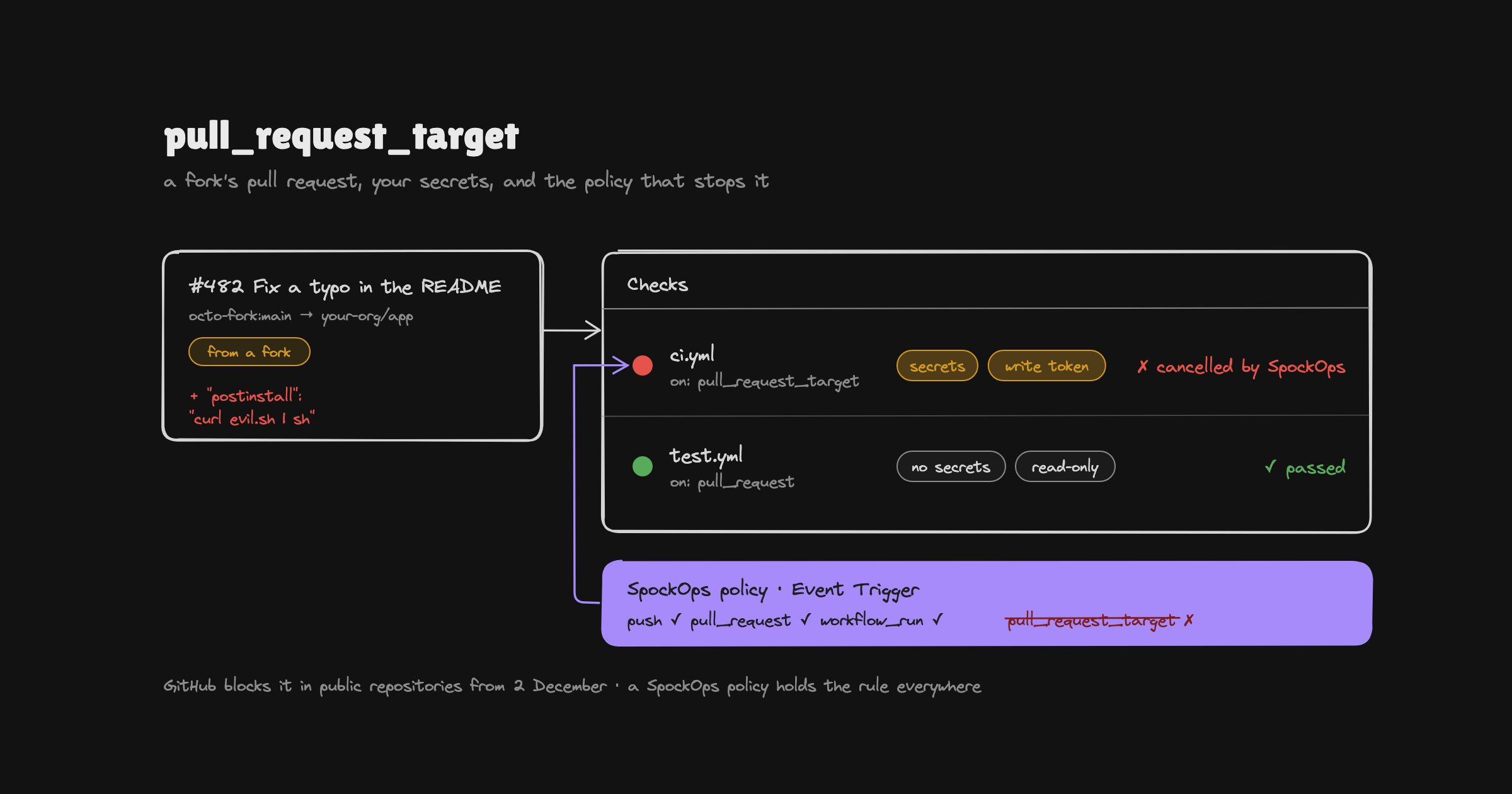
pull_request_target: why to stop using it, and what to use instead
GitHub blocks pull_request_target by default from 2 December. Why the trigger is dangerous, the simple two-workflow pattern to use instead, and how to keep it out of every repository.
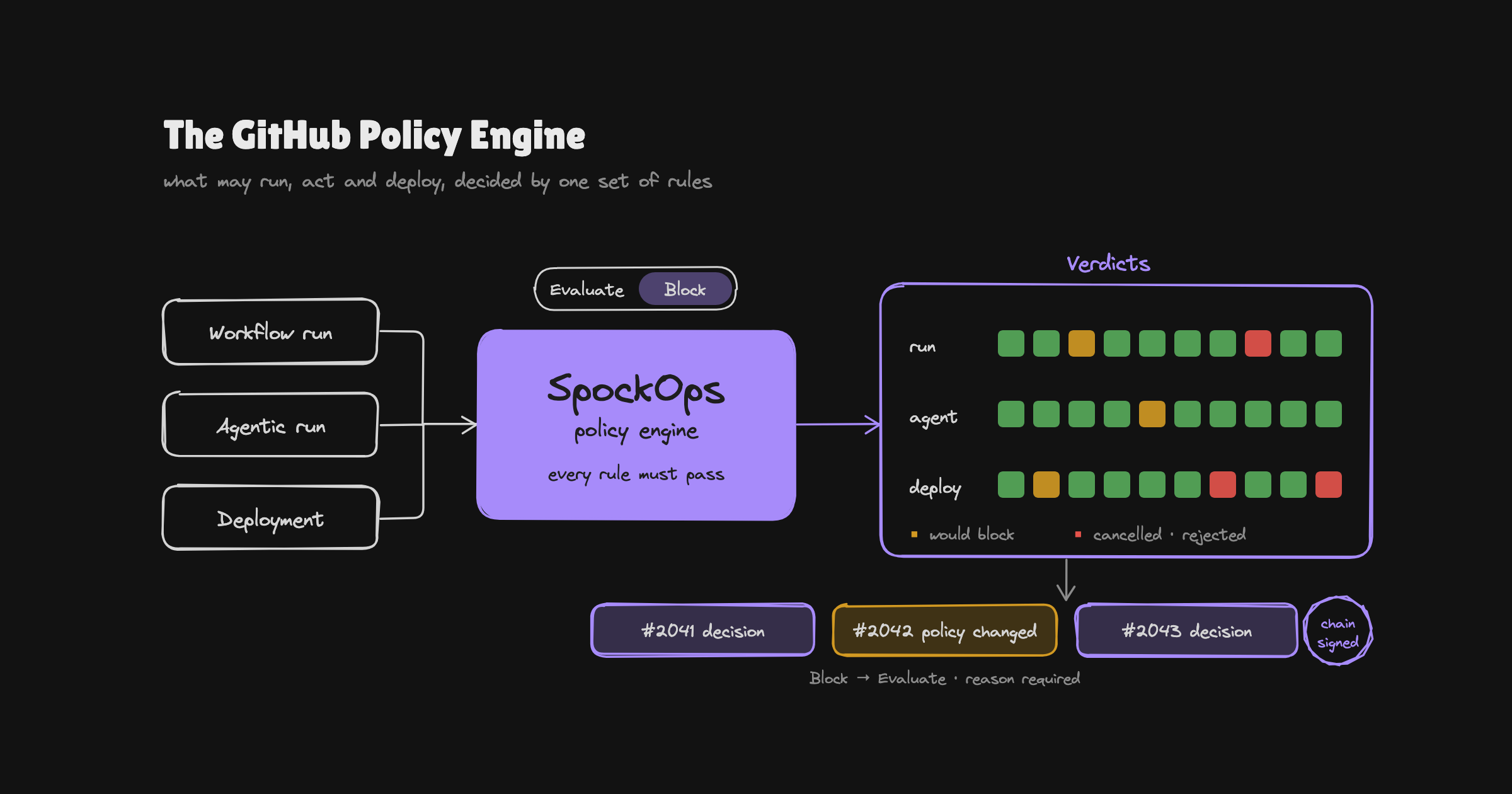
The GitHub policy engine: how SpockOps decides what may run, act and deploy
A policy engine for GitHub Actions: one set of rules for workflow runs, agentic workflows and deployments, tried in Evaluate, enforced in Block and recorded.
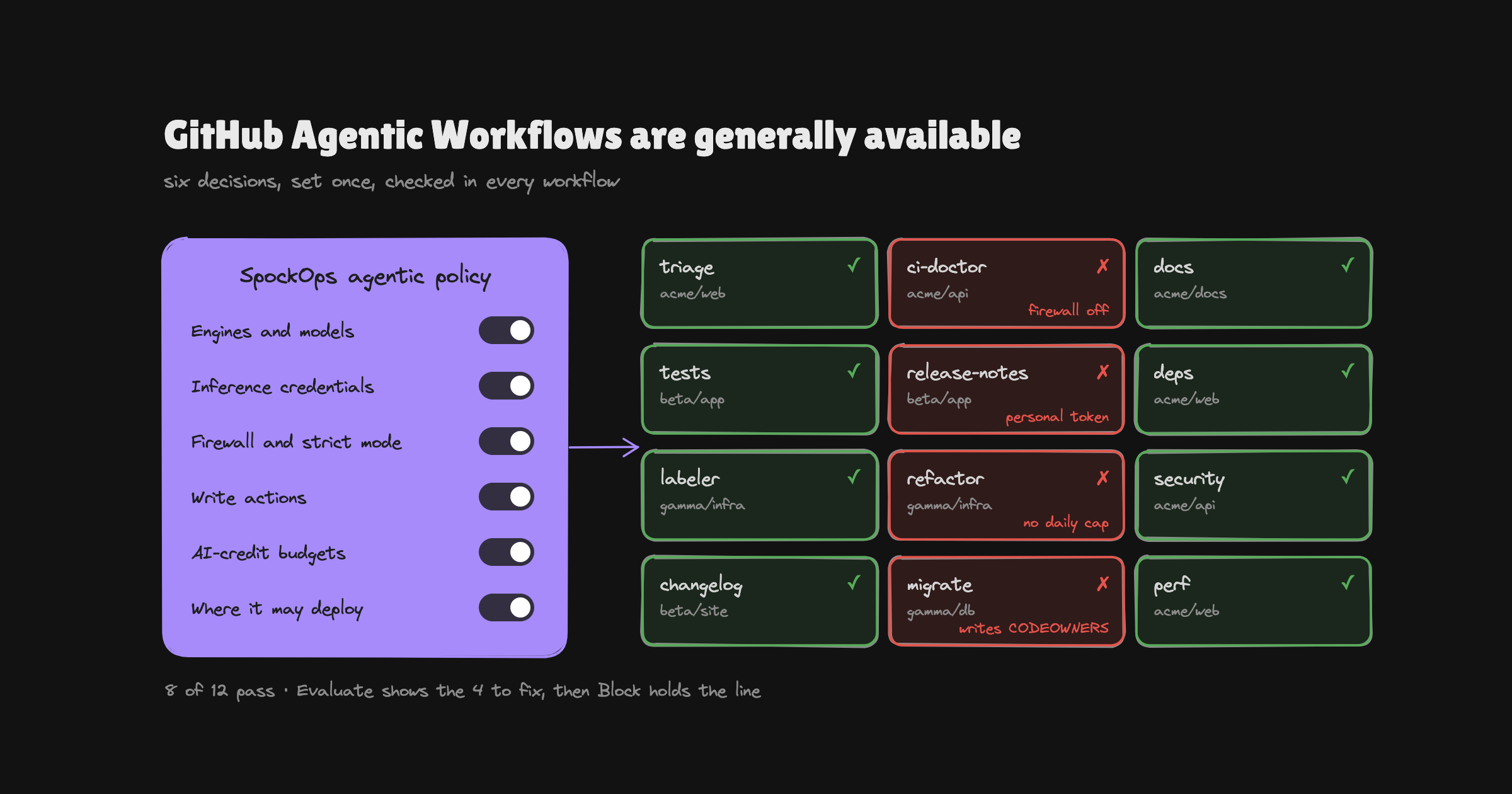
GitHub Agentic Workflows are generally available: six decisions before your teams turn them on
GitHub Agentic Workflows are generally available. The six decisions an enterprise should make first: engines, credentials, isolation, writes, spend and deployments.
GitHub Actions lockfiles are generally available: what they fix, and what to watch across every repository
GitHub Actions workflow lockfiles pin every action, transitive dependency and reusable workflow to a commit. What they fix, what they don't, and how to start using one today.
Policy coverage: what your GitHub Actions policies actually reach
Policies only govern what they match. SpockOps' coverage shows every workflow that ran and every environment, and whether a policy would check it.
Continuous controls monitoring: testing every change, every day
Change management is usually tested once a year on a sample. SpockOps tests seven change controls every day over every production deployment, from a signed record an auditor can check.