The SpockOps Blog

What we learn running, pricing and governing GitHub Actions, written down as we go.
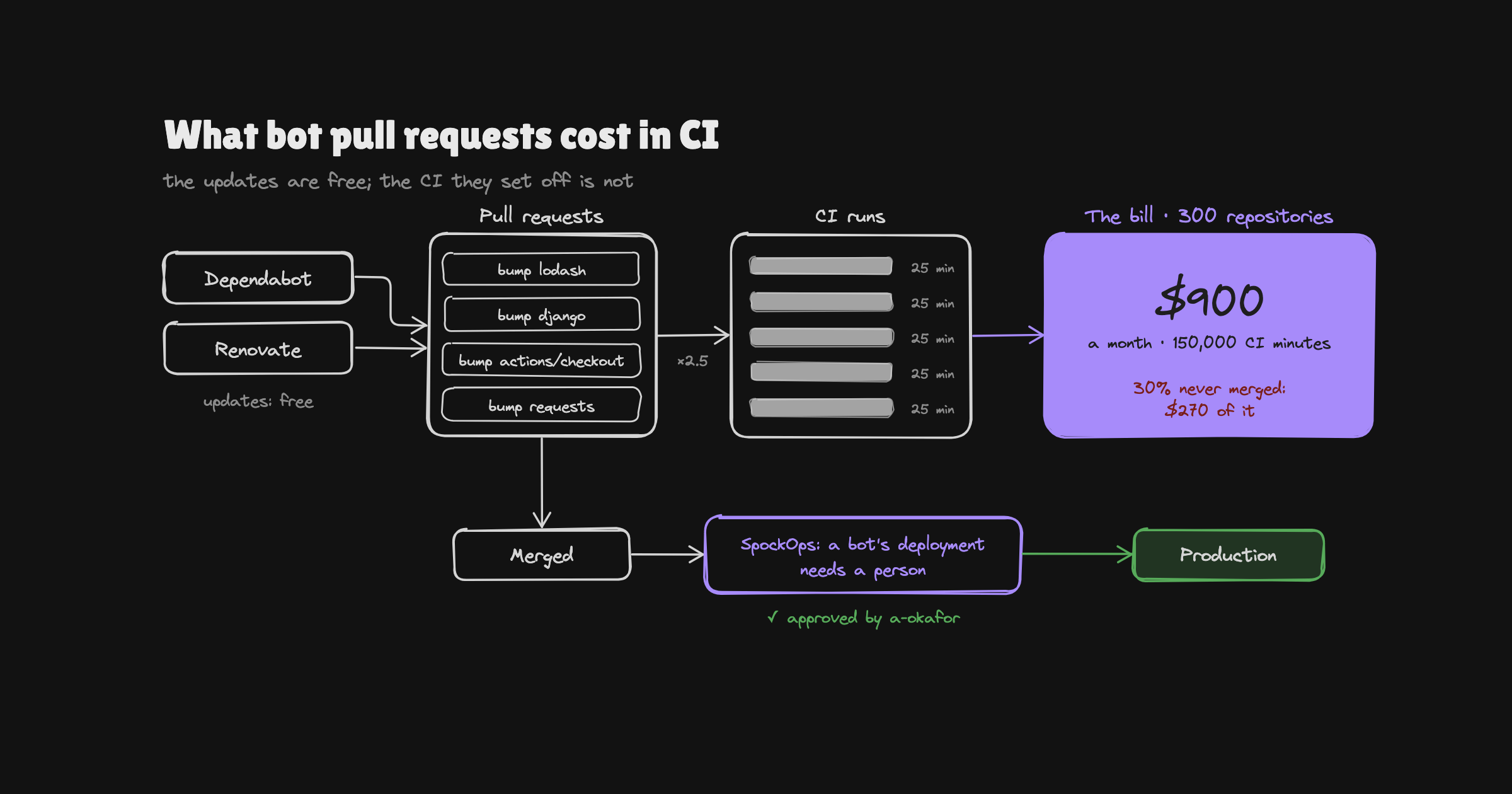
What bot pull requests cost in CIthe updates are free; the CI they set off is notDependabotRenovateupdates: freePull requestsbump lodashbump djangobump actions/checkoutbump requests×2.5CI runs25 min25 min25 min25 min25 minThe bill · 300 repositories$300$600$900$0a month · 150,000 CI minutes30% never merged:$270 of itMergedSpockOps: a bot's deploymentneeds a personProductionheld…✓ approved by a-okaforDependabot and Renovate open pull requests for free; each sets off CI runs that add up to a monthly bill, part of it on updates that never merge; a bot's merged update is held at SpockOps' deployment rule until a person approves it for production
costgovernance

What do Dependabot and Renovate really cost in CI?

Dependabot and Renovate are free. The CI their pull requests set off is not. What dependency bots cost in GitHub Actions, and how to govern what they deploy.

Sash7 min read

More tagged cost

4 posts
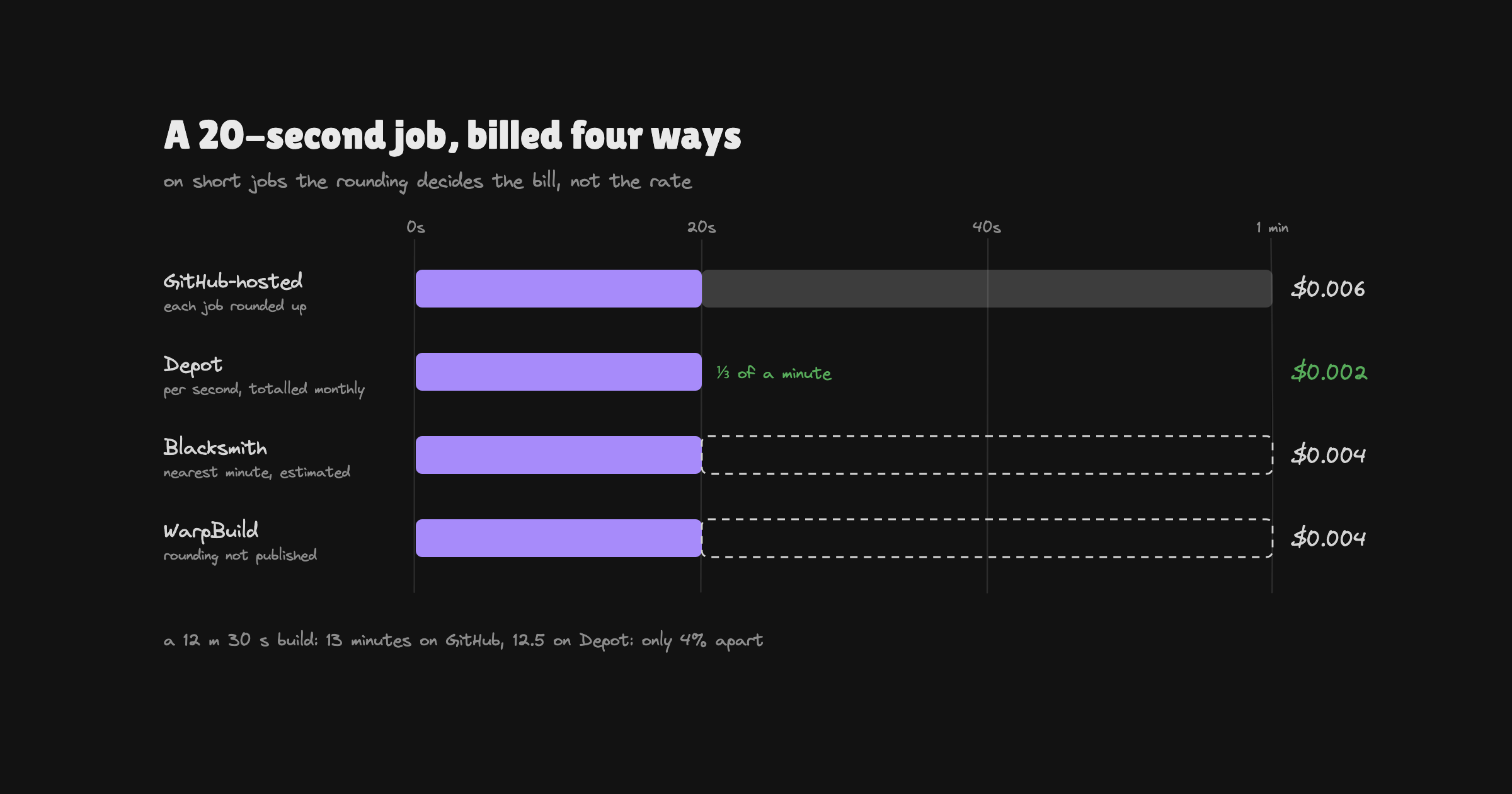
A 20-second job, billed four wayson short jobs the rounding decides the bill, not the rate0s20s40s1 minGitHub-hostedeach job rounded up$0.006Depotper second, totalled monthly⅓ of a minute$0.002Blacksmithnearest minute, estimated$0.004WarpBuildrounding not published$0.004a 12 m 30 s build: 13 minutes on GitHub, 12.5 on Depot: only 4% apartA 20-second job billed four ways: GitHub-hosted rounds it up to a full minute, Depot bills a third of a minute, and Blacksmith and WarpBuild bill about a minute, estimated; on short jobs the rounding, not the rate, decides the bill
cost

What a GitHub Actions minute really costs on Blacksmith, Depot and WarpBuild

The rate per minute is only part of a GitHub Actions bill. How each provider rounds a job, how far its free minutes go and how …
7 min read
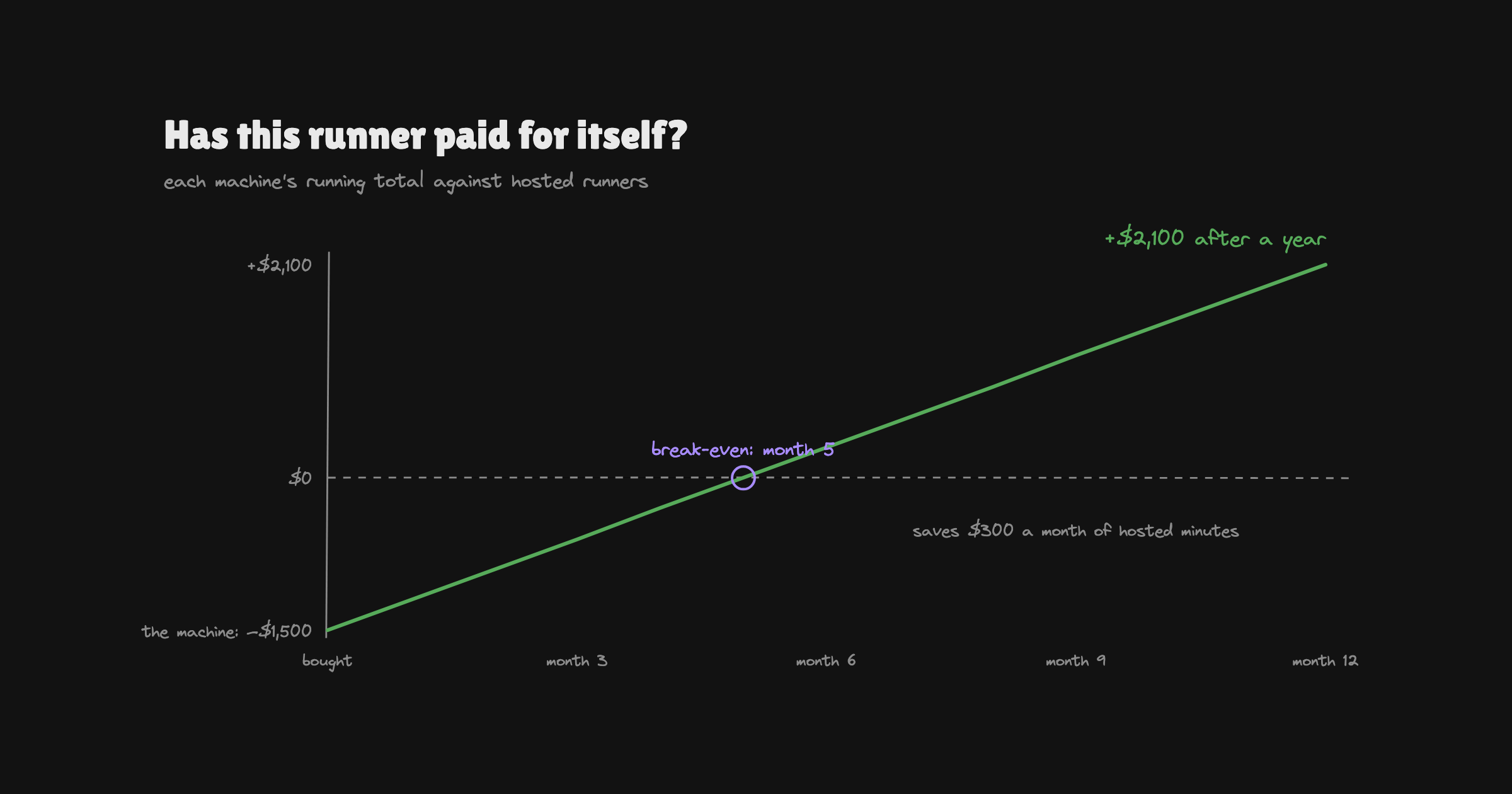
Has this runner paid for itself?each machine's running total against hosted runners$0the machine: −$1,500+$2,100boughtmonth 3month 6month 9month 12break-even: month 5+$2,100 after a yearsaves $300 a month of hosted minutesA self-hosted runner's payback: it starts $1,500 behind, saves $300 a month against hosted runners, breaks even in month five and is about $2,100 ahead after a year
runners

Have your self-hosted runners paid for themselves?

Self-hosted GitHub Actions runners look free because their minutes never reach the bill. A method, and a worked example, for finding each machine's break-even.
5 min read
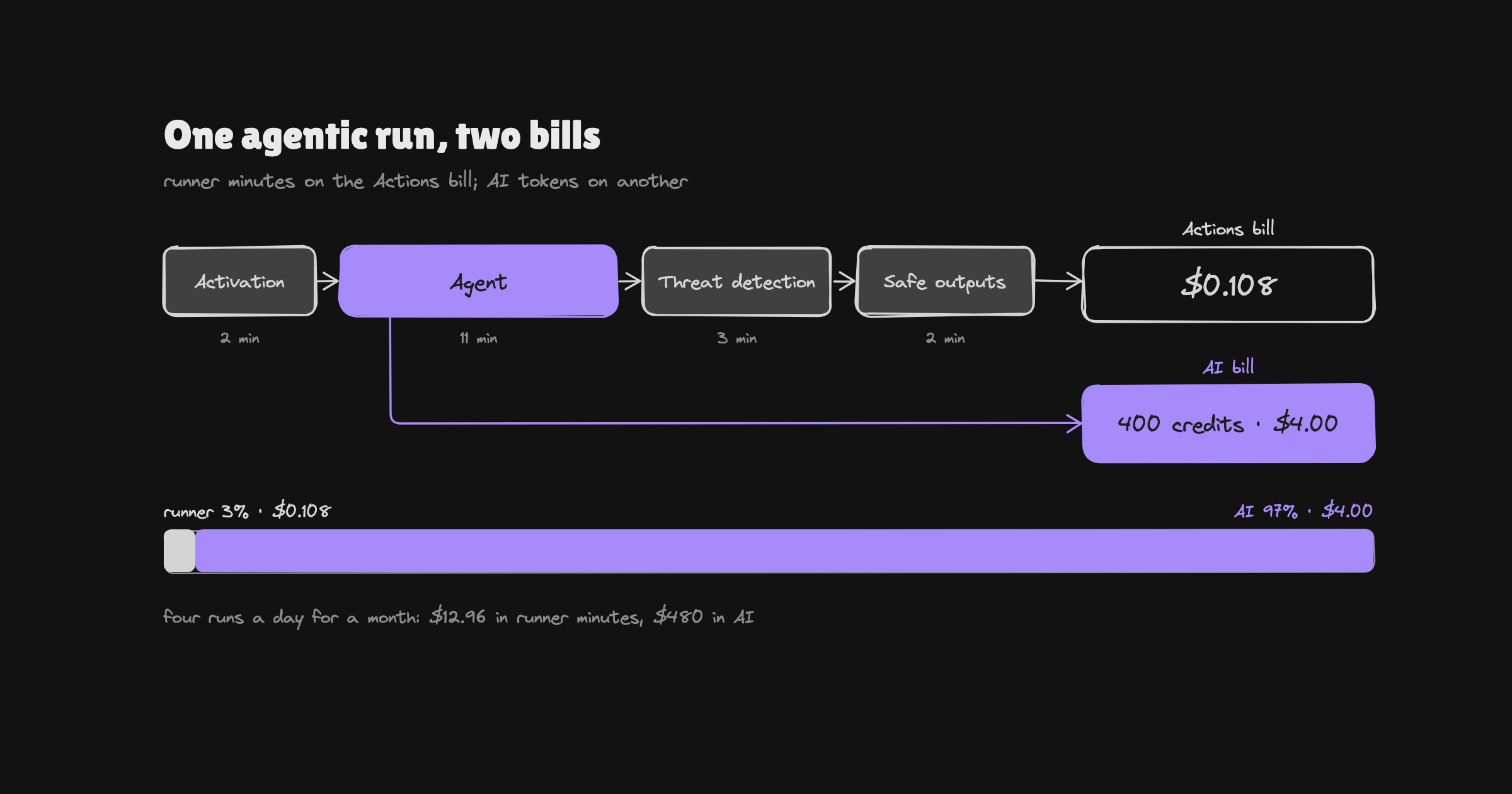
One agentic run, two billsrunner minutes on the Actions bill; AI tokens on anotherActivation2 minAgent11 minThreat detection3 minSafe outputs2 minActions bill$0.012$0.078$0.096$0.108AI bill100 credits · $1.00200 credits · $2.00300 credits · $3.00400 credits · $4.00runner 3% · $0.108AI 97% · $4.00four runs a day for a month: $12.96 in runner minutes, $480 in AIOne agentic workflow run has two bills: its four jobs use 18 runner minutes, $0.108, while the agent uses 400 AI Credits, $4.00, so AI is 97% of the run; four runs a day for a month cost $12.96 in runner minutes and $480 in AI
agentic

What does an agentic workflow cost? Runner minutes vs. AI tokens

Every GitHub agentic workflow run has two bills: Actions minutes and AI tokens. See a priced example and how SpockOps splits compute from agent cost per …

5 min read

Every run checked.
Every deployment decided.
Every decision signed.

One rulebook for people, bots and agents across your GitHub Actions estate. SpockOps checks every run as it starts, decides each deployment by who asked, what ran it and where it came from, and signs every decision into a record your auditors can re-run. Engineers see each verdict as a check beside their tests, and nothing in their workflows changes.

No changes to any workflow or repository: nothing runs inside your pipelines.