 SpockOps
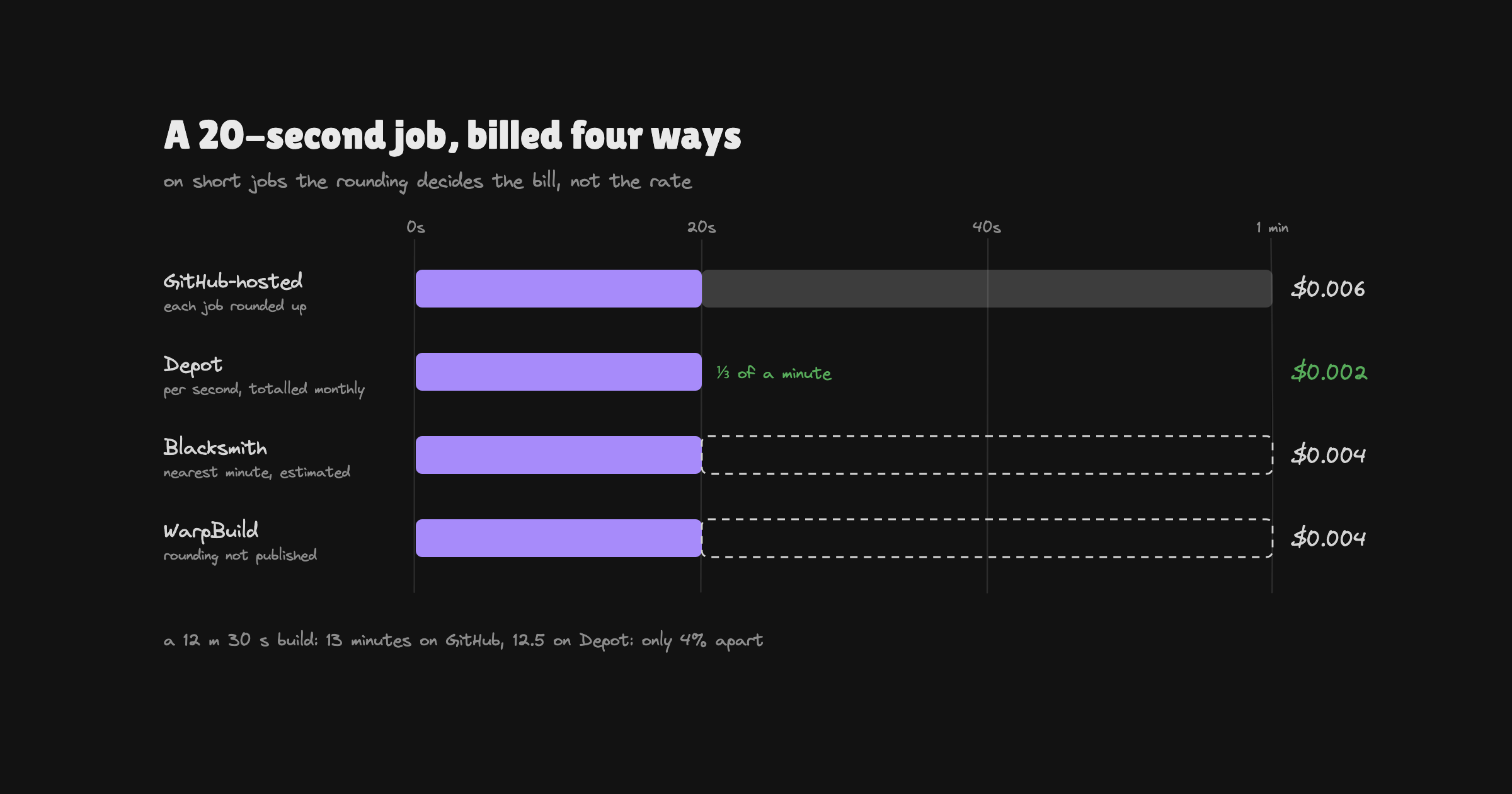

Short jobs are where the providers differ most: a 20-second check can cost a full minute on one and a third of a minute on another.
Blacksmith, Depot and WarpBuild have each made GitHub Actions faster and cheaper for a great many teams, and each publishes a clear comparison with GitHub-hosted runners. What none of them can offer is a neutral comparison with one another. This post sets the four billing models side by side, works through the same month of CI on each, and explains why a team that uses more than one of them needs a single view of what it spends.
How does each provider bill a GitHub Actions job? #
Four things decide the bill, and the headline rate is only the first:
- The rate per minute at the runner size you use.
- How a job's seconds are rounded.
- Free or included minutes, which each provider counts in its own units.
- GitHub's own platform charge, announced for runners outside GitHub and since postponed.
The first three, as each provider publishes them:
| Provider | Unit | Rounding | Free or included minutes |
|---|---|---|---|
| GitHub-hosted | Per minute | Each job rounded up to a whole minute | By plan: Free 2,000; Team 3,000; Enterprise Cloud 50,000. Standard runners only |
| Depot | Per second | None per job; whole minutes totaled at month end; no one-minute minimum | Developer plan, $20 a month with 2,000 minutes; Startup plan, $200 a month with 20,000 |
| Blacksmith | Per minute | Rounded to the nearest minute; whether per job or per month is not published | 3,000 x64 2 vCPU minutes per organization a month; no plan fee |
| WarpBuild | Per minute | Not published | Not published |
At the smallest Linux x64 size, the rates are $0.006 a minute on GitHub-hosted and Depot runners and $0.004 on Blacksmith and WarpBuild. The rates scale with size on every provider, and Windows and macOS cost more everywhere.
Why does rounding matter more than the rate for short jobs? #
Because many CI jobs are short, and rounding sets a floor under each one.
Take a lint check that runs for 20 seconds. GitHub rounds every job up to a whole minute, so it bills one minute. Depot tracks seconds and adds them up across the month, so it bills a third of a minute. At the same rate of $0.006, the same check costs three times as much on GitHub as on Depot.
The effect fades as jobs grow longer. A build of 12 minutes 30 seconds is billed as 13 minutes on GitHub and 12.5 on Depot, a difference of 4%. On long jobs the rate decides the bill; on short jobs the rounding does.
That makes the shape of a team's CI as important as the price list. A repository that runs dozens of quick checks on every pull request pays very differently from one that runs a few long builds, even on identical runners.
What does the same month of CI cost on each? #
Consider one month on 2 vCPU Linux x64 runners, at list prices, with no free minutes and the same job durations on every provider:
- A: 20,000 short jobs, such as lint and checks, of 20 seconds each.
- B: 2,000 builds of 12 minutes 30 seconds each.
| Rate per minute | A: short jobs | B: builds | Total | |
|---|---|---|---|---|
| GitHub-hosted | $0.006 | 20,000 min, $120.00 | 26,000 min, $156.00 | $276.00 |
| Depot | $0.006 | 6,667 min, $40.00 | 25,000 min, $150.00 | $190.00 |
| Blacksmith, if rounded up per job | $0.004 | 20,000 min, $80.00 | 26,000 min, $104.00 | $184.00 |
| WarpBuild, if rounded up per job | $0.004 | 20,000 min, $80.00 | 26,000 min, $104.00 | $184.00 |
Three things stand out.
Depot charges the same rate as GitHub, yet the month costs $86 less. Almost all of the difference is in line A: GitHub bills each 20-second job as a full minute, while Depot bills 20 seconds.
On the builds, the rate decides. Rounding adds half a minute to each build, and Blacksmith and WarpBuild's lower rate carries the result.
The Blacksmith and WarpBuild figures rest on an assumption. Neither publishes exactly how a short job is rounded, so the table rounds each job up, as GitHub does. If Blacksmith rounds each job to the nearest minute with no minimum, a 20-second job would round down to nothing and line A would cost very little. We have asked both providers and will update this post when they reply.
The example deliberately holds job duration equal. Each provider says its runners finish jobs faster than GitHub's, which would lower its total further; that is their claim to make, and it is worth testing on your own workloads. The example also leaves out free and included minutes and Depot's plan fee, which the next section covers.
How far do free and included minutes go? #
Further on some runners than others, because each provider counts them in its own units.
| Provider | Allowance | How larger or other runners use it |
|---|---|---|
| GitHub | By plan, from 2,000 to 50,000 minutes a month | Standard runners only. Larger runners, third-party runners and self-hosted runners do not draw on it |
| Blacksmith | 3,000 x64 2 vCPU minutes per organization a month | In proportion to vCPU. An ARM minute counts as 0.625 of an x64 minute of the same size; Windows at 2 vCPU counts double; macOS at 6 vCPU counts 20 times |
| Depot | 2,000 or 20,000 minutes, with the Developer or Startup plan | By a published multiplier: Linux from 1x at 2 vCPU to 32x at 64 vCPU; Windows from 2x at 2 vCPU to 64x |
| WarpBuild | None published | Not applicable |
Two consequences follow. First, an allowance quoted in minutes is worth very different amounts depending on which runners a team uses: 3,000 Blacksmith minutes cover 3,000 minutes of small Linux jobs but only 150 minutes of macOS. Second, the units do not always track the price. On Depot a 2 vCPU Windows minute uses two units of allowance, but once the allowance is spent it costs $0.008, not twice the Linux rate of $0.006.
A team that moves its Linux jobs to a provider while keeping macOS or larger runners on GitHub therefore ends up with two allowances, counted two ways, against two bills.
Will GitHub charge for third-party runners? #
Not today. GitHub proposed a charge and then postponed it, and it has not set a new date.
In December 2025, GitHub announced an "Actions cloud platform charge" of $0.002 a minute on self-hosted runner usage, to start on 1 March 2026. To GitHub, runners from Blacksmith, Depot and WarpBuild are self-hosted runners, so the charge would have applied to every minute they run. Within days GitHub postponed it "to re-evaluate our approach". As of October 2026 there is no new date, and GitHub's billing documentation still lists self-hosted usage as free. GitHub-hosted rates have included the charge since 1 January 2026.
Some sites report the charge as in force. It is not. Should it return, it would add $0.002 to every provider minute in the worked example above: about $63 on the Depot month and $92 on the Blacksmith and WarpBuild months. That would narrow the gap with GitHub-hosted runners without closing it.
Why does a mixed fleet need one view of the bill? #
Because few teams run on one provider alone, and no single dashboard sees them all.
A typical team that has adopted a runner provider still keeps some jobs elsewhere: macOS or larger runners on GitHub, a few machines of its own for special hardware, and increasingly agentic workflows that spend AI credits as well as minutes. Each provider's analytics are good, and Blacksmith, Depot and WarpBuild offer theirs at no extra cost, but each covers only the jobs on its own machines. GitHub's bill, for its part, treats every provider minute as self-hosted and free, so it shows nothing of what those minutes cost. The result is several partial views and no single answer to a simple question: what did this workflow cost last month?
That is the gap SpockOps fills. It prices each job and step on Blacksmith, Depot and WarpBuild runners by the provider's own rules: its rate on the day the job ran, its rounding and its free minutes, counted in its own units. Those sit alongside GitHub-hosted runners, your own machines and AI credits in one cost figure, across every GitHub organization in a workspace. Where a provider has not published how it rounds short jobs, SpockOps rounds up and marks the figure as an estimate.
The same view carries governance. SpockOps treats provider runners as hosted runners, so the workflow policies a team already writes, on who may run what, on which runners and operating systems, apply to them unchanged, and its deployment protection rule sees which runner each deployment ran on. Nothing changes in the workflows, and nothing is installed on the runners. Read more on Blacksmith, Depot and WarpBuild runners in SpockOps, or on how SpockOps tracks self-hosted runner payback.
Install the App, and the next month of CI will show what each workflow costs on every runner it uses.
Questions
Is Depot billed per second?
Yes. Depot tracks usage per second, with no one-minute minimum per job, and totals whole minutes at the end of the month. A 20-second job uses a third of a minute.
Does GitHub charge for jobs on Blacksmith, Depot or WarpBuild runners?
Not today. GitHub treats them as self-hosted runners, which are free. A proposed charge of $0.002 a minute on self-hosted usage was postponed in December 2025 and has no new date.
Do GitHub's free minutes cover third-party runners?
No. GitHub's included minutes apply to its standard hosted runners only, not to larger, third-party or self-hosted runners.
How do I see GitHub-hosted and provider runner costs together?
SpockOps prices every job and step at the rate of the runner it ran on, whether GitHub-hosted, Blacksmith, Depot, WarpBuild or your own machine, and shows them with AI credits in one cost figure.
Can I apply the same workflow policies to provider runners?
Yes. SpockOps treats provider runners as hosted runners, so policies on who may run what, and on which runners and operating systems, apply to them unchanged.
Related posts
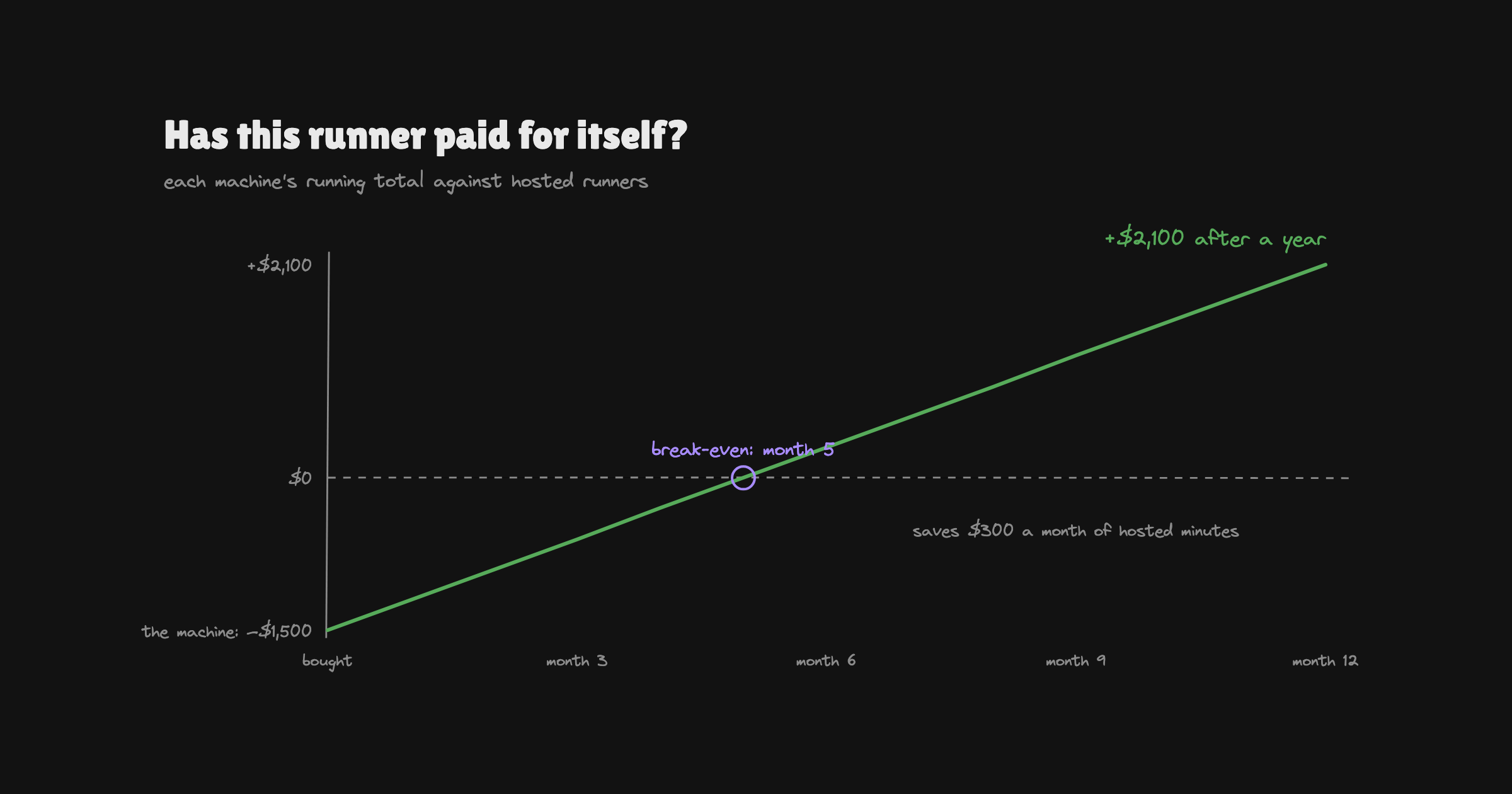
Have your self-hosted runners paid for themselves?
Self-hosted GitHub Actions runners look free because their minutes never reach the bill. A method, and a worked example, for finding each machine's break-even.
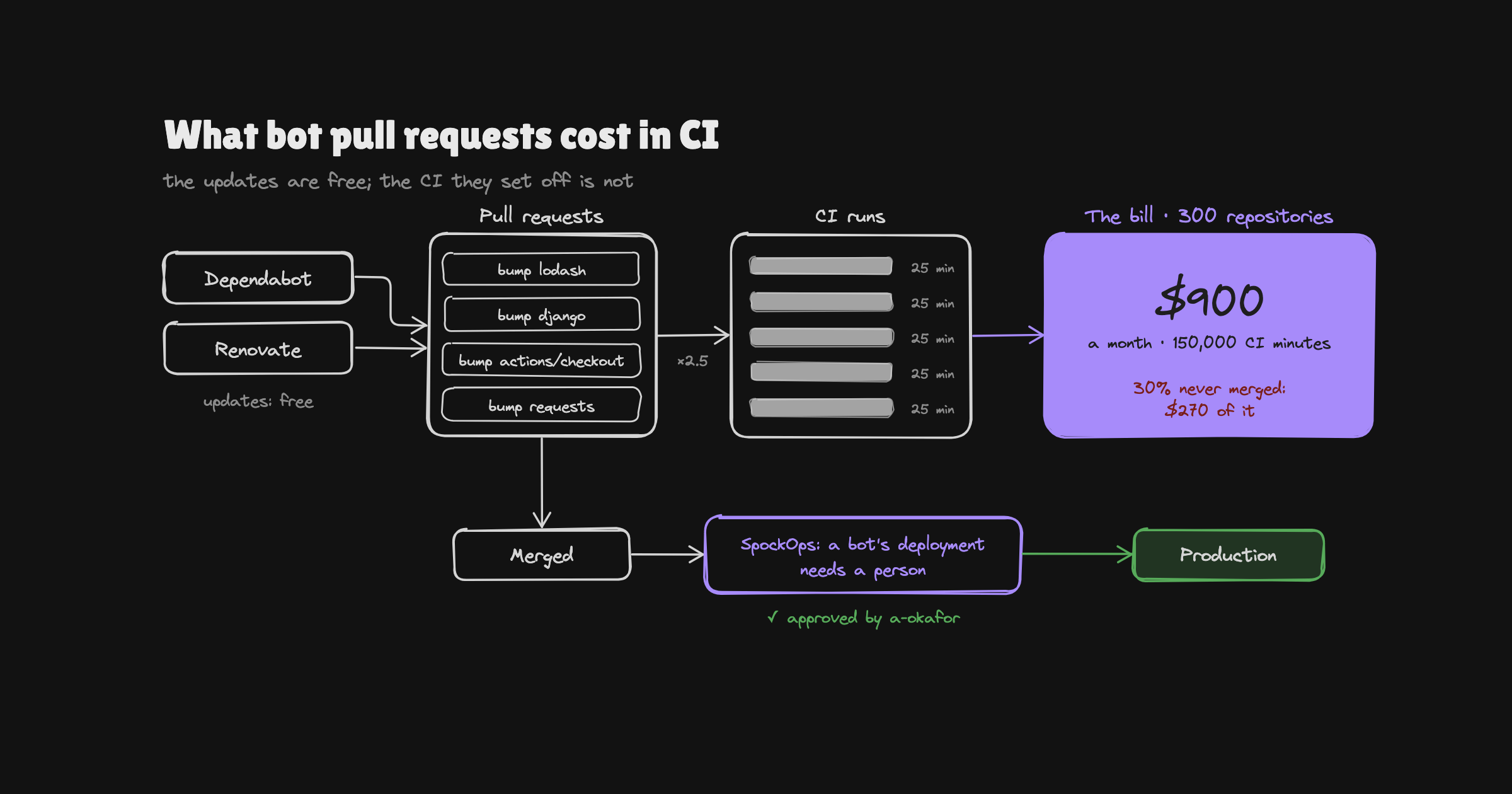
What do Dependabot and Renovate really cost in CI?
Dependabot and Renovate are free. The CI their pull requests set off is not. What dependency bots cost in GitHub Actions, and how to govern what they deploy.
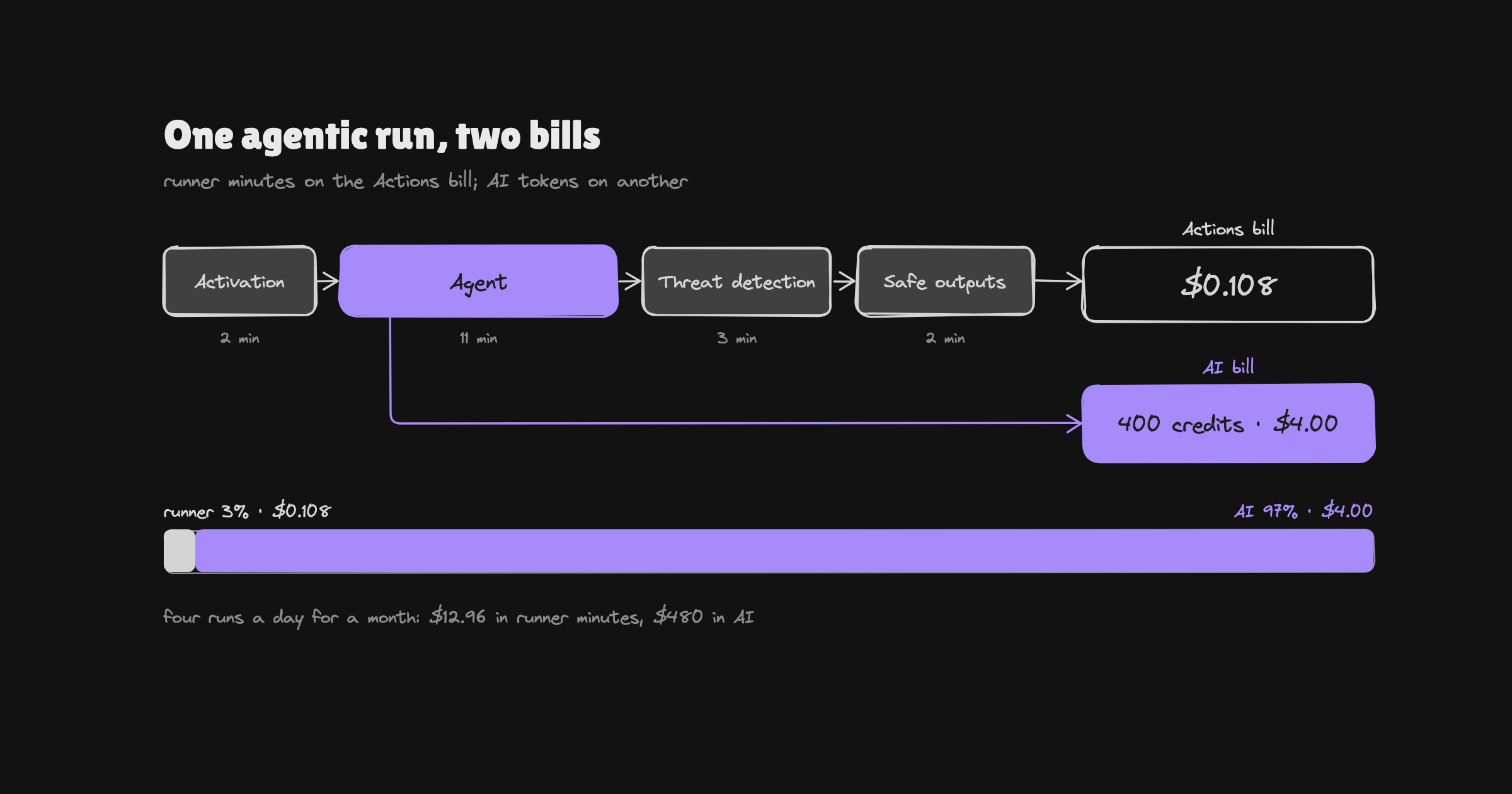
What does an agentic workflow cost? Runner minutes vs. AI tokens
Every GitHub agentic workflow run has two bills: Actions minutes and AI tokens. See a priced example and how SpockOps splits compute from agent cost per run.