 SpockOps
Continuous controls monitoring: testing every change, every day
Change management is usually tested once a year on a sample. SpockOps tests seven change controls every day over every production deployment, from a signed record an auditor can check.
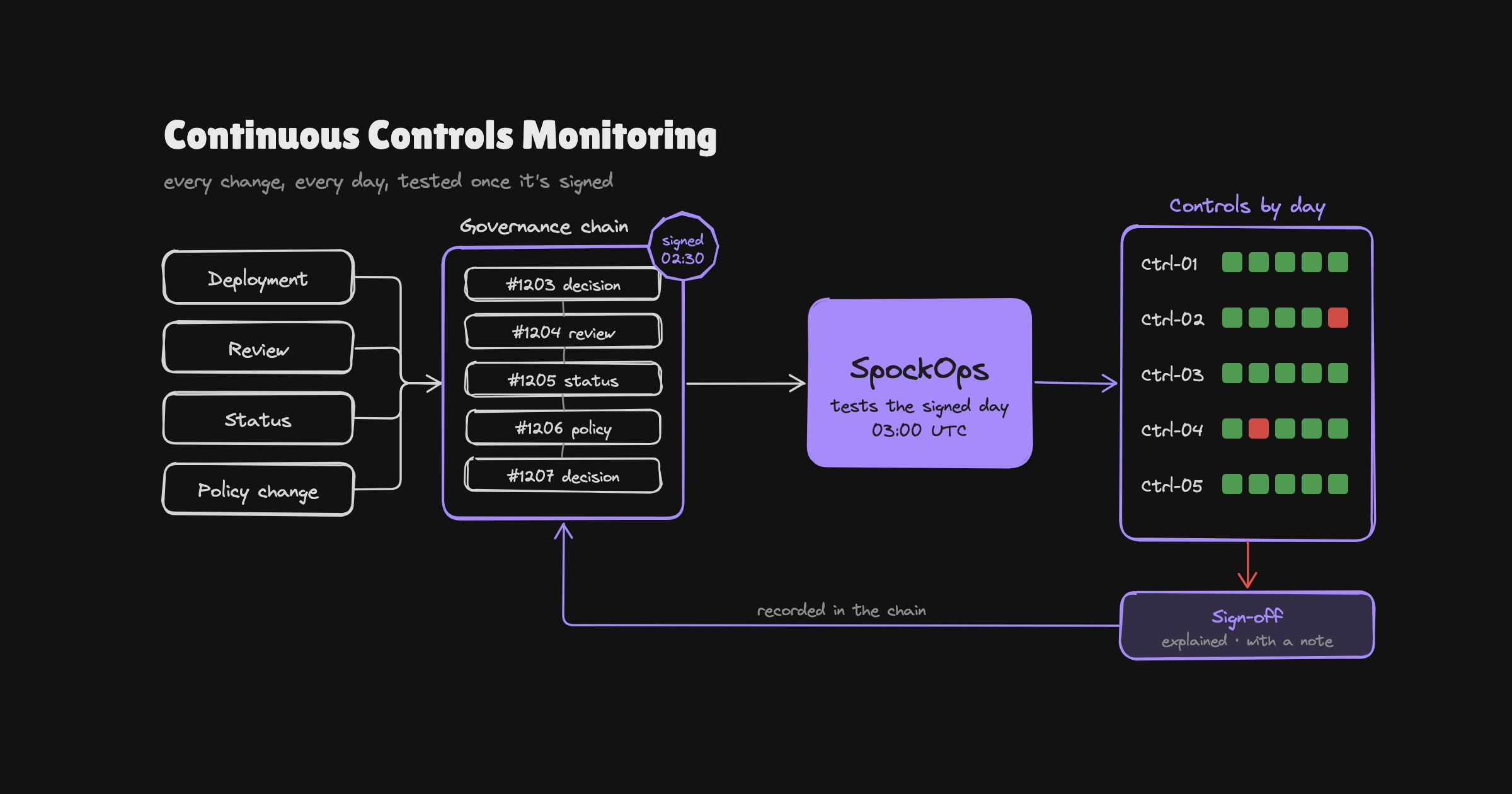

Change management is tested once a year, on a sample, from evidence assembled after the fact. Continuous controls monitoring tests it every day, on every change, from a record kept as changes happen. This post explains how SpockOps does that for software deployments, what it asks of a team, and what an auditor receives at the end of a period.
What does an annual change-management audit actually test? #
It tests a sample. An auditor asks for a population of production changes, selects twenty-five or so, and asks the firm to show that each was authorised, reviewed and released as policy requires. The conclusion about the year rests on that sample, and on how well the firm can reconstruct each change months later.
The reconstruction is the difficult part. GitHub records a great deal: pull request reviews, deployment approvals on protected environments, and an audit log of changes to settings. What it does not hold in one place is the account an auditor needs for each change: which policy applied, whether it was enforced or only watched, who approved, and whether any rule had been loosened beforehand. So an engineer assembles that account by hand, from several systems, for each item in the sample.
Two weaknesses follow. A sample cannot show that a control operated on the changes outside it. And evidence assembled after the fact is only as reliable as the systems it was drawn from, none of which was built to serve as evidence.
What is continuous controls monitoring? #
It is the practice of testing a control automatically, on a schedule, over the whole population it governs, and keeping each result as evidence. Instead of asking at year end whether a control worked on a sample, it records every day whether the control held on every relevant change, and what happened to each exception.
In SpockOps, the population comes from the governance chain: the record of every deployment decision, review and outcome, and of every change to the policies behind them. Each record is written in order, can only be added to, and carries a fingerprint of the one before it, so altering or removing any record is detectable. We describe the chain itself in the ledger and the receipt. Continuous controls monitoring is a set of tests over that record.
A control in SpockOps is a rule and a test. The rule is a statement the firm makes, such as "Changes to the environments in scope are approved by someone other than whoever started them". The test reads the chain and decides, for each record in its population, whether the rule was met, with a one-line reason when it was not.
Which controls does SpockOps test? #
Seven, covering how production change is authorised, decided and recorded. A firm adopts them as a starter set for PCI DSS, SOX IT general controls or the DORA regulatory technical standards, chooses the environments they apply to, and names an owner for each. SpockOps then tests every evaluation its policy engine makes within that scope.
| Control | Holds when |
|---|---|
| Independent approval | Each successful production deployment was approved by a person other than whoever started it |
| Decided under policy | Each successful production deployment was decided by SpockOps' policy engine, so none bypassed it |
| No rules failing in watch mode | No production deployment went through with a rule failing because its policy was only watching (Evaluate) |
| Machine changes reviewed | Each production deployment by a bot or an AI agent was approved by a person |
| Relaxations explained | Each change that weakened or widened a policy gave a reason |
| Decisions delivered | Every decision SpockOps made reached GitHub, with none failing or lost |
| Record intact | The day's records verify, and a signed checkpoint covers them |
The first five concern the change itself. The last two concern the evidence: that the policy engine's decisions took effect, and that the record of them is complete and unaltered. An auditor relying on the first five will want assurance on the last two.
The environments a control covers are part of its definition. Most controls are scoped to patterns such as prod*, so their population is the records for those environments. Adopting, changing or retiring a control is itself written to the chain, and narrowing a control's environments counts as weakening it, so it requires a reason. A change applies from the next untested day and never rewrites earlier results.
Why are only signed days tested? #
Because a result should be a claim about records that can no longer change. Each night, SpockOps signs the latest point in the chain, which fixes every record before it. Only then are the controls tested for that day. Until the day is signed, it has no result, and the page says so plainly.
The order matters for an auditor. A result computed over unsigned records could be undermined by changing those records afterwards. A result computed over signed records refers to a fixed set that anyone can obtain and check against the published keys. That is what allows an auditor to re-perform a test independently, months later, and arrive at the same answer.
The same discipline applies to gaps and revisions. If a deployment's final status arrives late and changes a day's answer, a new result is recorded that names the one it revises; the original remains. A day that cannot be tested within seven days receives an explicit "not tested" result with the reason, so a gap is never silent. When a firm first adopts a control, its earlier history is tested once and marked retrospective: those results show how the test would have gone, not that the control was operating at the time.
What happens when a control fails? #
The failure appears the next morning, linked to the deployment that caused it, and stays open until a person resolves it. Each resolution is written to the chain with its reason. The day's result does not change: a day on which a control did not hold remains a day on which it did not hold, with its failure accounted for.
In practice, the work looks like this. On Tuesday, an engineer starts a production deployment of a payments service and the deployment is approved by the same engineer, which the environment's settings allowed. Wednesday's results show the independent approval control as not held for Tuesday, with one failure: the deployment, the person who started it, the person who approved it, and the sentence "Approved by the person who started the deployment".
The control's owner reviews it the same day, while the facts are known, and records one of three outcomes:
- Explained: the failure was legitimate, for example an emergency fix during an incident, with a reference to the incident record.
- Remediated: the cause has been corrected, for example the environment now prevents self-approval.
- Risk accepted: the firm knowingly accepts the exposure, with the reason and the person accepting it.
Two constraints keep the sign-off itself sound. A note is required, and whoever started the failing deployment cannot resolve its failure. The resolution becomes a record in the chain, covered by the next signature like everything else, so an auditor sees not only that a control failed but who dealt with it, how and when.
For the risk lead, the effect is that exceptions are handled within a day rather than discovered months later, by the people who understood them at the time.
What does a quarter look like to a risk lead and an auditor? #
A grid of controls against days, each day held, not held, no activity or not tested, with totals for the period. Behind every figure is the population it was drawn from and the records that support it. The question an auditor asks, whether the control operated throughout the period over the whole population, is answered directly rather than inferred from a sample.
For each control and period, the evidence covers:
- the result for every day, including days with no activity and any day that could not be tested, with the reason;
- the population behind each result, downloadable, so an auditor can select samples from it or check it against other sources;
- every failure with its resolution, who signed it off and the note they gave;
- every change to the control during the period, such as an environment removed from scope, with who made it and why;
- a reconciliation of the successful deployments in the chain against the successful deployments GitHub reported, shown whenever the two differ. It is an observation, not part of pass or fail, but it is the completeness check auditors otherwise perform by hand.
Because the results are built from the chain alone, an auditor does not have to accept SpockOps' summary. They can export the chain, verify it against the published keys and re-run the tests themselves. We describe that kind of evidence in automating DevOps audits.
What does it not cover? #
It covers what passes through SpockOps, and only that. Within its scope nothing is sampled, but a framework's change-management requirements reach beyond deployments, and some change can reach production without meeting SpockOps at all. Both limits are shown in the product rather than left for an auditor to discover.
The controls can only test what is in the chain. Change that never reaches SpockOps falls outside them:
- production environments without SpockOps' protection rule;
- environments where administrators can bypass the rule;
- releases that never pass through a GitHub environment.
SpockOps lists these as outside its view on the setup page and in each framework's summary. The same is true of framework requirements that concern other parts of change management, such as how test data is handled or how pre-production systems are separated. A starter set maps each control to the requirements it supports in part, and says which it does not address. The firm evidences those elsewhere, as it does today.
It is also not a replacement for the firm's own judgement. SpockOps reports whether the controls held and records how exceptions were resolved. Whether a resolution was adequate remains a matter for the control owner, the risk function and the auditor.
Where to begin #
With the framework the firm is next audited against. Adopt its starter set, choose the environments that count as production, and name an owner for each control. SpockOps tests earlier history once, marked as retrospective, so the first view shows how the controls would have fared before monitoring began.
The first useful review is usually the retrospective one. It shows where the controls would have failed in recent months, which typically points to a small number of settings or habits: an environment that allows self-approval, a policy left watching rather than enforcing, a bot exempt from review. Correcting those before the period under audit begins means the period itself starts clean.
From then on, the work is daily and small: the owner reviews the morning's failures and resolves each one with a reason. The broader context for these controls, and what regulators expect of a software change, is in what regulators require. A firm that also sends the chain to its SIEM can follow the same records there through audit streaming.
Questions
What is continuous controls monitoring?
Testing a control automatically, on a schedule, over the whole population it governs, and keeping each result as evidence, instead of testing a sample once a year.
Which frameworks do SpockOps' controls map to?
PCI DSS, SOX IT general controls and the DORA regulatory technical standards. Each control supports change-management requirements in part, and SpockOps lists those it does not address.
Does SpockOps sample deployments?
No. Within the environments a control covers, every deployment decision is tested every day.
When are results produced?
Each night, after the day's records have been signed. A day that cannot be tested within seven days is recorded as not tested, with the reason.
What happens to a failure?
It stays open until a person resolves it as explained, remediated or risk accepted, with a note. Whoever started the failing deployment cannot resolve it, and each resolution is recorded.
Can an auditor check the results independently?
Yes. Results are built only from the governance chain, which an auditor can export, verify against SpockOps' published keys and test again.
What does it not cover?
Change that never reaches SpockOps, such as production environments without its protection rule, and framework requirements beyond deployment approval. SpockOps lists these explicitly.
Related posts
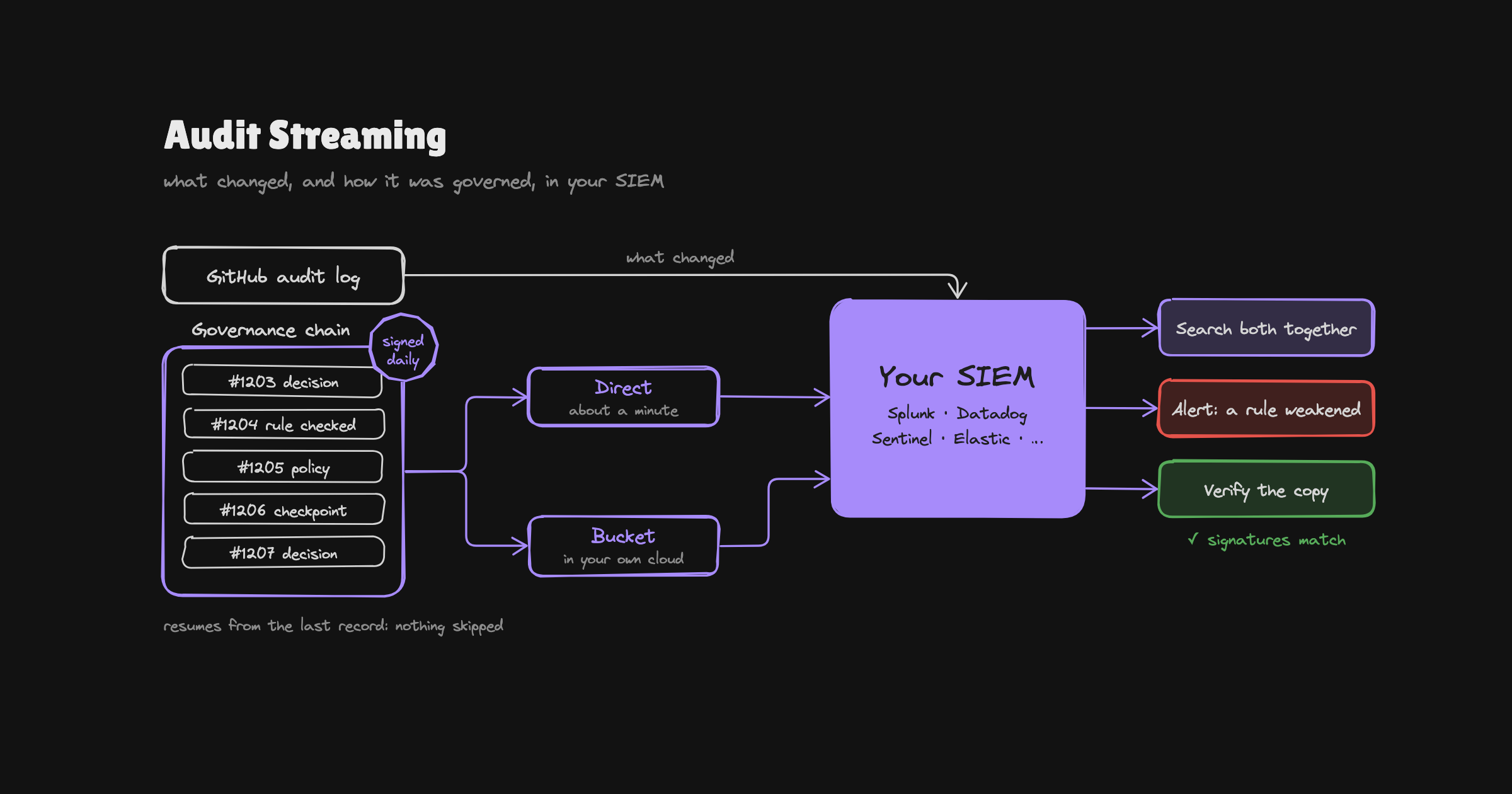
Audit streaming: what GitHub's audit log cannot tell your SIEM
GitHub's audit log shows what changed. The governance chain shows how that change was governed, and audit streaming sends it to your SIEM in the same format, with a copy you can verify.
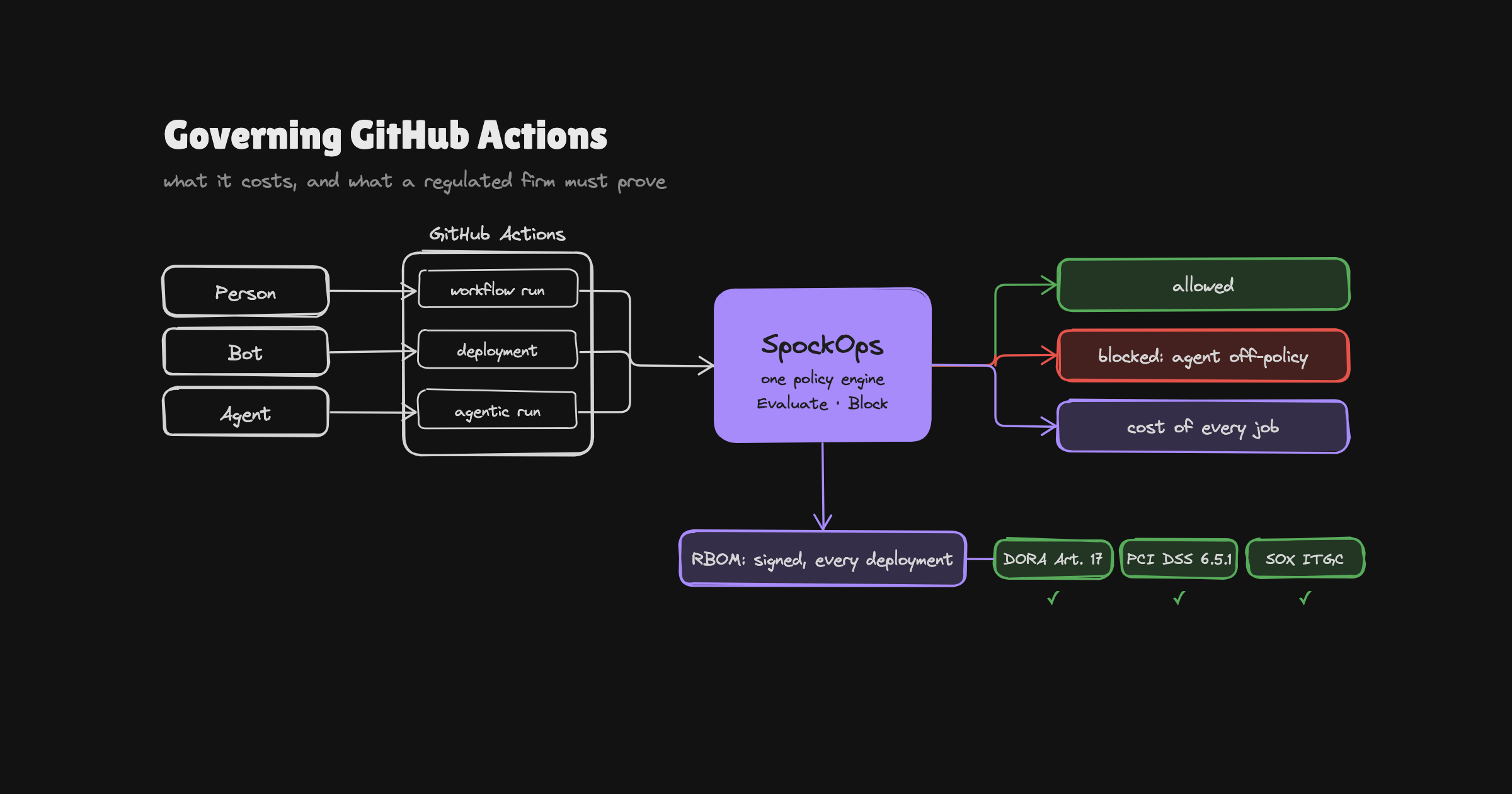
What GitHub Actions costs a regulated engineering team, and what it costs to govern it
What GitHub Actions, runners and agents cost a regulated engineering team, what DORA, PCI DSS and SOX require of a change, and how SpockOps governs all of it.
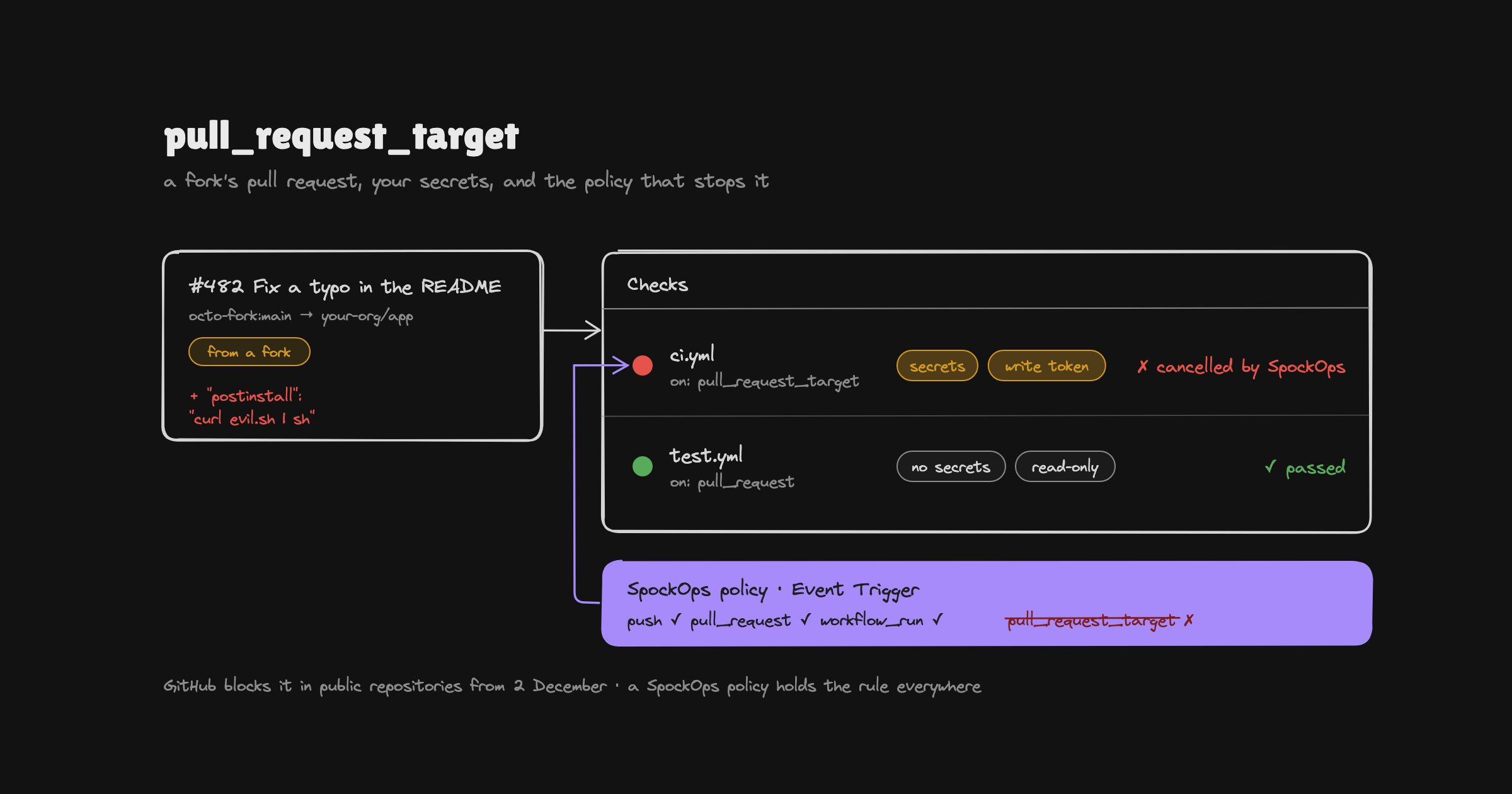
pull_request_target: why to stop using it, and what to use instead
GitHub blocks pull_request_target by default from 2 December. Why the trigger is dangerous, the simple two-workflow pattern to use instead, and how to keep it out of every repository.
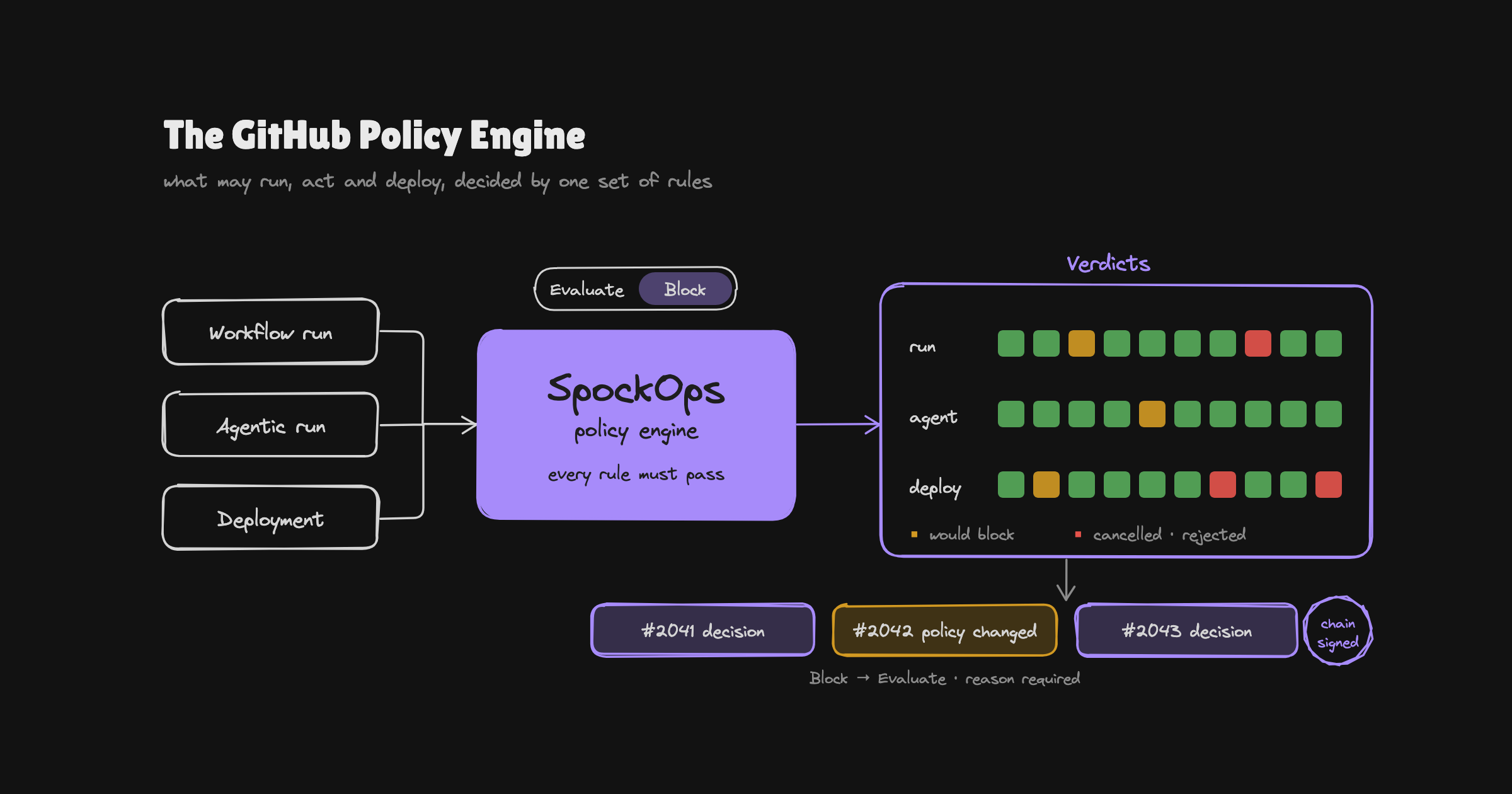
The GitHub policy engine: how SpockOps decides what may run, act and deploy
A policy engine for GitHub Actions: one set of rules for workflow runs, agentic workflows and deployments, tried in Evaluate, enforced in Block and recorded.
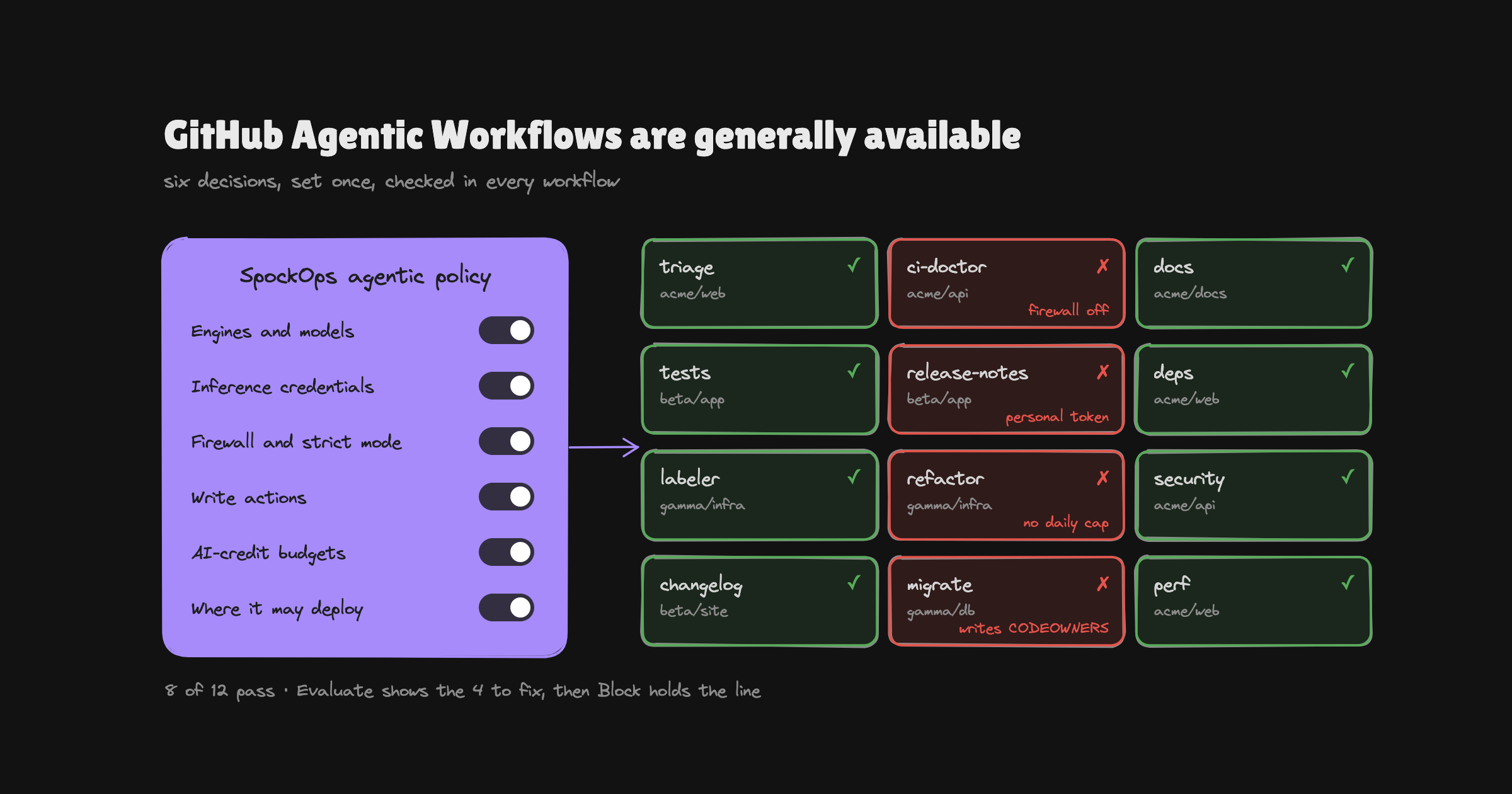
GitHub Agentic Workflows are generally available: six decisions before your teams turn them on
GitHub Agentic Workflows are generally available. The six decisions an enterprise should make first: engines, credentials, isolation, writes, spend and deployments.
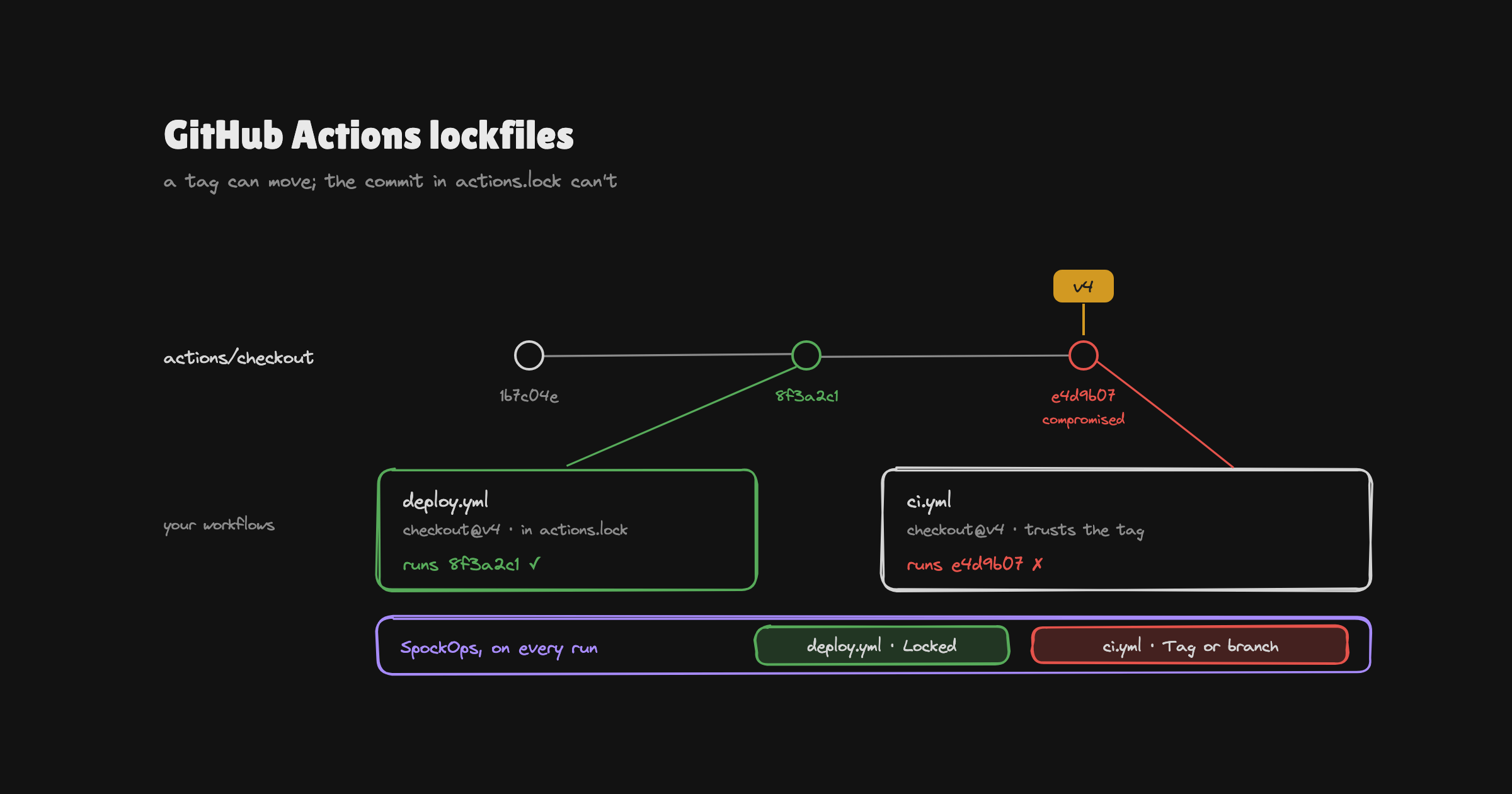
GitHub Actions lockfiles are generally available: what they fix, and what to watch across every repository
GitHub Actions workflow lockfiles pin every action, transitive dependency and reusable workflow to a commit. What they fix, what they don't, and how to start using one today.