 SpockOps
Audit streaming: what GitHub's audit log cannot tell your SIEM
GitHub's audit log shows what changed. The governance chain shows how that change was governed, and audit streaming sends it to your SIEM in the same format, with a copy you can verify.
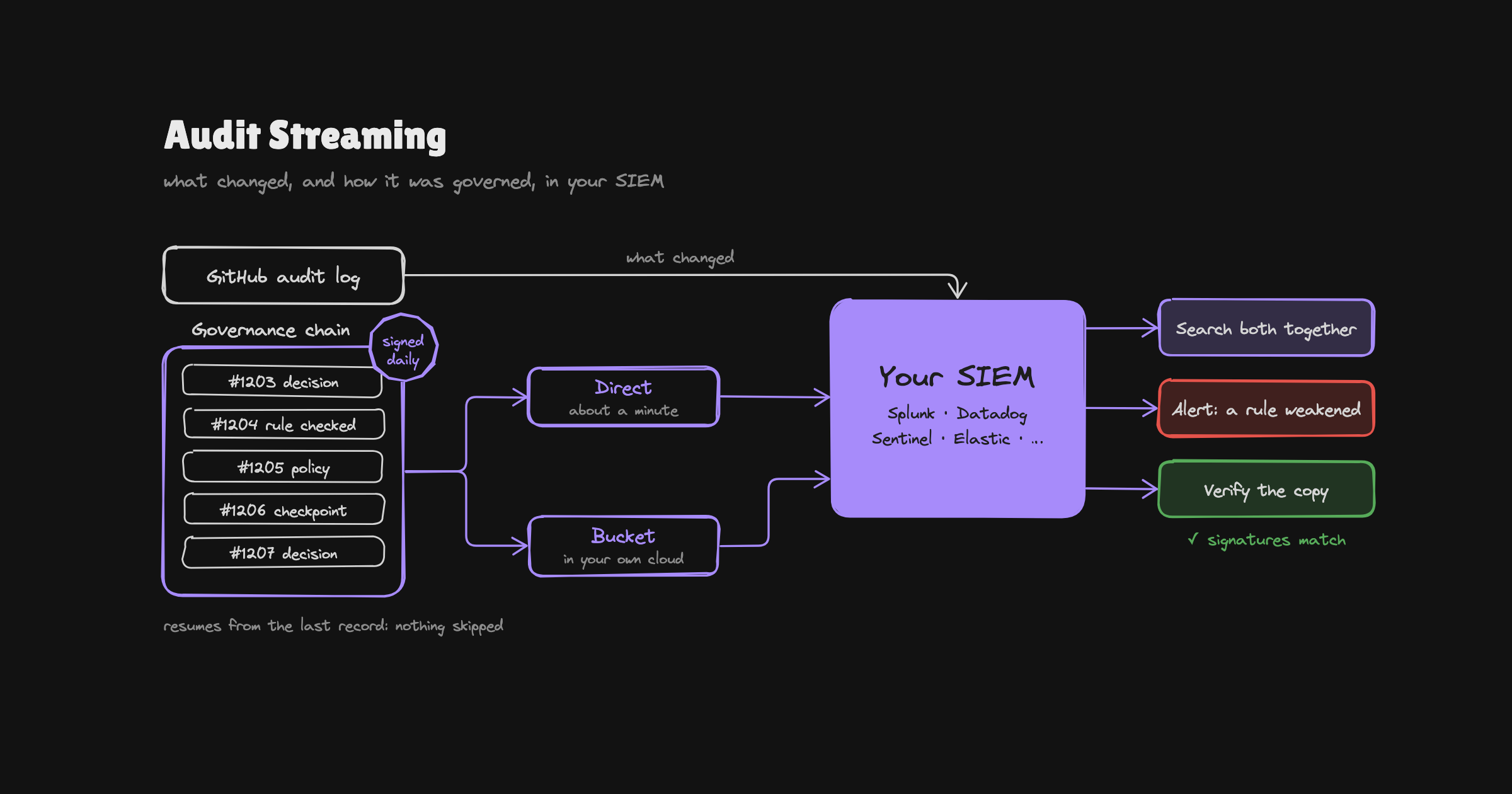

A security information and event management system, or SIEM, is where a security team gathers the logs of the whole firm, searches them and raises alerts. Splunk, Microsoft Sentinel and Datadog are familiar examples. At most regulated firms, GitHub's audit log already flows into one. It records who changed what in GitHub. It does not record how that change was governed.
That second record is what SpockOps keeps. Each deployment SpockOps checks, every rule it is checked against, each review and outcome, and every change to the policies themselves are written in order to one tamper-evident record: the governance chain. Audit streaming delivers that record to the same SIEM, in the same format as GitHub's own log, so that a security team can read the two together.
What does GitHub's audit log stream already give a security team? #
GitHub Enterprise Cloud streams its audit log to Splunk, Datadog, Amazon S3, Azure Blob Storage, Azure Event Hubs and Google Cloud Storage. It records who did what to the organization: membership, permissions, repository settings, secrets, environments and protection rules. As a record of change to GitHub itself, it is thorough and well supported.
Most SIEMs offer a GitHub integration that reads it, and many security teams have built searches and alerts on its fields: @timestamp, action, actor, org and repo. That work is worth keeping. Audit streaming is designed to sit beside GitHub's stream, in the same tool and the same shape, rather than to replace it.
What can a SIEM still not answer from it? #
GitHub's log records configuration, not judgment. When a deployment reaches production, it can show that an environment had rules and that a reviewer approved. It cannot show which policy the deployment was checked against, which rules passed or failed, whether a person, a bot or an AI agent asked for it, or whether those rules were loosened the day before.
These are the questions a security team is asked during an incident, and asked again during an audit:
- What reached production in the last day, and which rules was each deployment checked against?
- Which deployments went through although a rule failed, because the policy was set only to watch?
- Did a bot or an AI agent deploy to production without a person reviewing it?
- Who loosened a policy, when, and what reason did they give?
- Which rules governed this service on the day of the incident, and have they changed since?
- Is the record complete, or could an entry have been removed?
Today the answers sit in several places, and the last is rarely answered at all. A reviewer's approval, as we described in deployment protection rules, says that a person agreed; it does not say what they were shown.
What does the governance chain record? #
It records how change is governed, not only what was deployed. SpockOps checks each deployment against a team's policies and writes down the verdict with every rule behind it. It also records each review and outcome, every change to the policies themselves, every change to where the record is sent, and a signed checkpoint each day.
Some context helps here. SpockOps is a GitHub App, and a team uses it to write three kinds of policy: workflow policies, which govern who may run which workflow and on which machines; agentic policies, which govern what an AI agent may use and what it may write; and deployment policies, which govern who and what may deploy to an environment such as production. Each policy runs in one of two modes. Evaluate records a verdict and stops nothing, so a team can watch a rule before relying on it. Block enforces it.
When a workflow tries to deploy to a protected environment, GitHub asks SpockOps whether it may proceed, through GitHub's own deployment protection rules. That question, and everything that follows from it, is written to the chain:
| Record | Written when | What it holds |
|---|---|---|
| Decision | A workflow asks to deploy to a protected environment | The verdict; every policy and rule checked, with its result; the rules that failed; whether each policy was in Evaluate or Block; the runner; the commit, branch and workflow file; and who asked, with whether they are a person, a bot or an agent |
| Review | A reviewer approves or rejects the deployment | Who reviewed it, and which way |
| Outcome | The deployment finishes | Whether it succeeded or failed |
| Policy change | Anyone creates, changes or deletes a workflow, agentic or deployment policy | Who, when, each change in plain words, whether it strengthened, weakened or widened the policy, and the reason given |
| Policy baseline | Recording begins | Every policy in force at that moment, so the history has a known starting point |
| Stream change | Anyone adds, changes, pauses, resumes or removes a destination | The change itself, without any credentials, so that a change to where the evidence goes is itself evidence |
| Checkpoint | Once a day | A signature over every record so far |
Each record carries the hash of the one before it, so no record can be edited, removed or reordered without the break showing. The database refuses any edit or deletion once a record is written, and a policy cannot be saved at all unless its record is written with it. We explain why an auditor values this in the ledger and the receipt.
What does a deployment decision look like in a SIEM? #
Each record arrives as one event in GitHub's audit log format. The fields a SIEM already reads for GitHub, such as @timestamp, action, actor, org and repo, are filled in the same way. Everything SpockOps adds sits in one spockops object, so existing parsers keep working and new searches have one place to look.
Here is a decision, shortened. An AI coding agent tried to deploy a payments service to production straight from its own working branch, without a review. The policy allows production deployments only from main, and it is in Block, so SpockOps stopped the deployment and recorded why:
{
  "@timestamp": 1794912721950,
  "action": "spockops_deployment.decision",
  "actor": "copilot-swe-agent[bot]",
  "actor_is_bot": true,
  "org": "acme",
  "repo": "acme/payments-api",
  "spockops": {
    "seq": 1042,
    "prev_hash": "5b415e53d4bbd55a…",
    "record_hash": "49569c1eda4be252…",
    "actor_kind": "agent",
    "outcome": "rejected",
    "summary": "Rejected deploy to production · acme/payments-api@3f9c2a1",
    "environment": "production",
    "ref": "copilot/fix-retry-logic",
    "production": true,
    "mode": "block",
    "failed_rules": ["Production deploys › Branch"],
    "risk": ["agent_actor", "production", "rejected"],
    "record": { "…": "the full record, exactly as hashed" }
  }
}
One event answers the questions a security team would ask: what tried to ship, where it was going, which rule stopped it and why it counts as a risk. Had the policy been in Evaluate, the same event would read approved, and risk would carry failed_in_evaluate instead of rejected: the deployment would have gone through, and the record would show it should not have.
Four fields do most of the work:
actor_kindseparates people, bots and agents. GitHub'sactor_is_botmarks automation, but cannot tell a dependency bot from an AI agent.riskis a short list drawn from a fixed vocabulary, so a search can match on meaning rather than parse a sentence.seq,prev_hashandrecord_hashplace the event in the chain and let anyone check that nothing is missing.recordis the record exactly as it was hashed, so every convenient field above can be checked against the original.
What does a policy change look like? #
A policy change arrives as its own event, with who made it, what changed in plain words, a verdict on whether the change strengthened or loosened the policy, and the reason the person gave. A SIEM can therefore alert on the act of relaxing a control, not only on what happens after it has been relaxed.
Here an engineer moves a workflow policy from Block back to Evaluate, so that it records failures again instead of stopping them:
{
  "@timestamp": 1794912722018,
  "action": "spockops_policy.update",
  "actor": "m-okafor",
  "org": "acme",
  "spockops": {
    "seq": 1043,
    "actor_kind": "person",
    "summary": "Changed workflow policy Deploys · weakened",
    "policy": { "kind": "workflow", "name": "Deploys", "mode": "evaluate" },
    "verdict": "weakened",
    "changes": [{ "kind": "weakened", "text": "Mode: Block → Evaluate" }],
    "reason": "Rolling out again in Evaluate",
    "risk": ["policy_weakened"]
  }
}
The same shape covers agentic and deployment policies, and a policy's creation and deletion. Had no reason been given, the risk list would also carry relaxed_without_reason. Read beside the deployment decisions that follow it, a weakened policy becomes context: the next deployment that passed only because the rule was relaxed is one search away.
What can a security team do with it? #
It turns questions that once needed a meeting into saved searches. Because every event carries a risk list with fixed values, a search can be written once and run against every deployment and every policy change, not a sample. Each answer is current to within about a minute.
| Question | What the search matches |
|---|---|
| Did a bot or an AI agent deploy to production? | risk contains bot_actor or agent_actor, together with production |
| Did a deployment go through although a rule failed? | risk contains failed_in_evaluate |
| Which deployments did SpockOps or a reviewer reject? | risk contains rejected |
| Did a deployment run with no policy covering it? | risk contains no_policy_applied |
| Was a policy weakened, widened or deleted? | risk contains policy_weakened, policy_widened or policy_deleted |
| Was a policy loosened without a reason? | risk contains relaxed_without_reason |
| Is anything missing from the record? | A gap in seq, or a prev_hash that does not match the record before it |
The value is greatest beside the events the SIEM already holds. During an incident, the deployment that preceded a failure can be read in one timeline with the rules it was checked against, the person who approved it, the policy changes made that week and the GitHub settings changed the same morning. A policy weakened shortly before a bot deploys to production is a pattern that no single source shows on its own.
The distinction between people, bots and agents matters more each year. Dependency bots and AI agents now open pull requests and, in many organizations, deploy them. The chain keeps the three apart, so a team can hold agents to a stricter standard and show that it does.
How these signals add up to continuous monitoring of change controls is the subject of a later post.
How does it help in an audit? #
It lets a firm answer its auditor from its own systems. Change control is usually tested on a sample, because gathering evidence for each change is slow. With every decision, review and policy change already in the firm's SIEM or bucket, the whole population can be tested, and the auditor can check the copy independently.
The requests an auditor makes of change control map directly onto the chain:
| The auditor asks | The chain answers with |
|---|---|
| Every change to production in the period | The decisions and outcomes for the period, filtered to production |
| Evidence that each change was approved | The verdict and the rules behind it, and each reviewer's approval |
| The controls in force, and every change to them | The policy baseline, then each policy change with who made it, what it changed and why |
| Evidence that the record is complete and unaltered | The unbroken chain, the daily signed checkpoints and the verifier's result |
The frameworks regulated firms answer to, among them DORA, PCI DSS and SOX, ask for this kind of evidence in different words. We set out what each requires of a software change in what regulators require, and how testing the full population works in automating DevOps audits.
How does the chain reach your tools? #
By one of two routes. Direct: SpockOps sends each new batch of records straight to the tool's own intake, about a minute after they are written. Bucket: SpockOps writes a file a minute to a storage bucket in your own cloud account, in a folder layout modelled on GitHub's own stream, and the tool reads it from there.
Both routes end in the tool that already receives GitHub's stream, so the two records can be searched together. If a destination is unavailable for a time, SpockOps resumes from the last record it delivered, so nothing is skipped.
| Tool | Direct | Bucket |
|---|---|---|
| Splunk | HTTP Event Collector | Amazon S3, through the Splunk Add-on for AWS |
| Datadog | Log intake | Amazon S3, through the Datadog Forwarder |
| Microsoft Sentinel | Bucket only | Azure Blob Storage, read the way GitHub's stream is |
| Elastic Security | Elastic Agent's Custom HTTP Endpoint | Amazon S3, Azure Blob Storage or Google Cloud Storage |
| Panther | HTTP source | Amazon S3, Azure Blob Storage or Google Cloud Storage |
| Google SecOps | Bucket only | A feed reading Google Cloud Storage, Amazon S3 or Azure Blob Storage |
| Sumo Logic | Bucket only | An Amazon S3 source |
| Cribl Stream | Bucket only | An Amazon S3 source |
| Your own pipeline or archive | Bucket only | Amazon S3, Azure Blob Storage, Google Cloud Storage, or Cloudflare R2, Backblaze B2 and Wasabi |
Which route suits a regulated firm? #
For most regulated firms, the bucket is the better first route. The data stays in the firm's own account under its own retention rules, a complete copy exists outside SpockOps, and the SIEM reads it exactly as it reads GitHub's stream. Direct is quicker to set up and suits a team that wants events on a dashboard within the minute.
The two are not exclusive. A common arrangement is a bucket as the record of evidence and a direct stream for alerting. Datadog, for instance, accepts events no older than 18 hours through its intake, so a long history cannot be sent that way; a bucket beside it keeps the complete chain. Where retention is set by regulation, such as the twelve months of audit history that PCI DSS asks for, the bucket is the natural place to apply it.
What does setting up a stream involve? #
A few minutes of an administrator's time, and no change to any workflow or repository. The administrator chooses a tool and a route, gives SpockOps the access that route needs, confirms that the connection works and decides how much history to send. From then on, delivery runs on its own.
- Choose the tool and the route. In SpockOps, the Audit streaming page under Settings lists each tool with the routes it supports, along with a plain bucket for a firm's own pipeline or archive.
- Give SpockOps access. A direct route needs the tool's own credential: for Splunk, an HTTP Event Collector token; for Datadog, an API key. A bucket needs credentials that let SpockOps write to that bucket and nothing more; on Amazon S3, to one folder of it. Credentials are stored as secrets and never written to the chain; the chain records only that they changed.
- Confirm the connection. Before the stream is saved, SpockOps checks that it can reach the destination with the access it was given. The check sends no records: for a bucket it writes a small test file, and for a direct route it asks the tool to confirm the credential. If the check fails, the page shows what the tool replied.
- Choose how much history to send. Only what happens from now on, the whole chain from the day recording began, or everything from a chosen date. A firm preparing for an audit usually sends the whole chain, so the SIEM holds the full period under review.
- Leave it running. Each stream then shows whether it is up to date, how far it has delivered, when it last delivered and the last problem it met. If a destination refuses SpockOps' access, for example because a token has expired, the stream pauses and the workspace's administrators are emailed. Once the access is fixed, an administrator resumes it, and it picks up from where it stopped.
Creating, changing, pausing or removing a stream is itself written to the chain, so the record shows where the evidence was sent and by whom.
Why can the copy in your SIEM be trusted? #
Because it can be checked without trusting SpockOps. Each event carries its own hash and the hash of the record before it. Once a day, SpockOps signs the latest point in the chain with an Ed25519 key and adds that signature to the chain. A verifier we provide checks every hash, every link and every signature against our published keys.
Individual records are chained rather than signed; each signed checkpoint vouches for every record up to it. The verifier, spockops-verify, is a single script in Python or in Bash. It runs on a download from SpockOps without connecting to SpockOps, and exits with 0 when everything holds and 1 when anything does not, naming each failure. The checks rest on standard SHA-256 hashes and Ed25519 signatures, so a team can also write its own in any language. The public keys are published at /.well-known/rbom-keys.json, and the method is the one we describe for verifying an RBOM.
The copy in your own account matters as much as the signatures. Were history inside SpockOps ever rewritten, it would no longer match the copy you hold or the checkpoints already signed. That is the property an auditor looks for in trustworthy evidence: it does not depend on the good faith of the vendor that produced it.
What does audit streaming not do? #
It does not replace GitHub's audit log stream, and it does not decide what counts as a threat. GitHub's log remains the record of who changed the organization; the governance chain is the record of how change was governed. The searches and alerts remain the security team's to write.
Two further limits are worth knowing before planning around it:
- It covers what SpockOps governs. A deployment to an environment that does not use SpockOps' protection rule produces no decision. SpockOps shows, for each kind of policy, which environments and workflows are covered and which are not, so the gaps are visible rather than assumed.
- Every destination receives the whole chain. There is no filtering by record type yet. This keeps every copy complete enough to verify, at the cost of sending policy and stream records to a tool that may only want deployments.
Where to begin #
With a question the team can already answer: where does GitHub's audit log go today? Send the governance chain to the same place, by the same route, so that the two records arrive side by side and the existing GitHub integration keeps working unchanged.
Then write one search. Bots and agents deploying to production is a good first choice: it is short, and its answer is rarely what a team expects. If the first route is direct, add a bucket as the lasting record, and run the verifier against a day of files to see the chain hold.
For a team that would rather inspect the format before connecting anything, the same events are available as a one-off download from SpockOps, ending on a signed checkpoint.
Questions
What is a SIEM?
A security information and event management system: the tool where a security team gathers logs from across the firm, searches them and raises alerts. Splunk, Microsoft Sentinel and Datadog are common examples.
What does the governance chain record?
Every deployment decision with each policy and rule checked, each review and outcome, every change to a workflow, agentic or deployment policy with its reason, every change to where the chain is sent, and a signed checkpoint each day.
Does audit streaming replace GitHub's audit log streaming?
No. GitHub's stream records changes to the organization. Audit streaming adds the governance chain beside it, in the same format, and both can go to the same destination.
Which tools can receive the governance chain?
Splunk, Datadog, Microsoft Sentinel, Elastic Security, Panther, Google SecOps, Sumo Logic and Cribl Stream, or any Amazon S3, Azure Blob Storage, Google Cloud Storage, Cloudflare R2, Backblaze B2 or Wasabi bucket.
What format are the events in?
GitHub's audit log format: one JSON object per record, with GitHub's common fields and SpockOps' own fields in a spockops object. Buckets receive compressed JSON lines in a folder layout modelled on GitHub's own stream.
How quickly does an event arrive?
About a minute after it is recorded. If a destination is unavailable, delivery resumes from the last record sent once it returns.
Can past records be sent?
Yes. A stream can start now, from a chosen date or from the beginning of the chain. Datadog's intake accepts events up to 18 hours old, so a longer history should go to a bucket.
Are the records signed?
Each record is hash-chained to the one before it. Once a day SpockOps signs the latest point in the chain, and a verifier checks every hash, link and signature against SpockOps' public keys.
Related posts
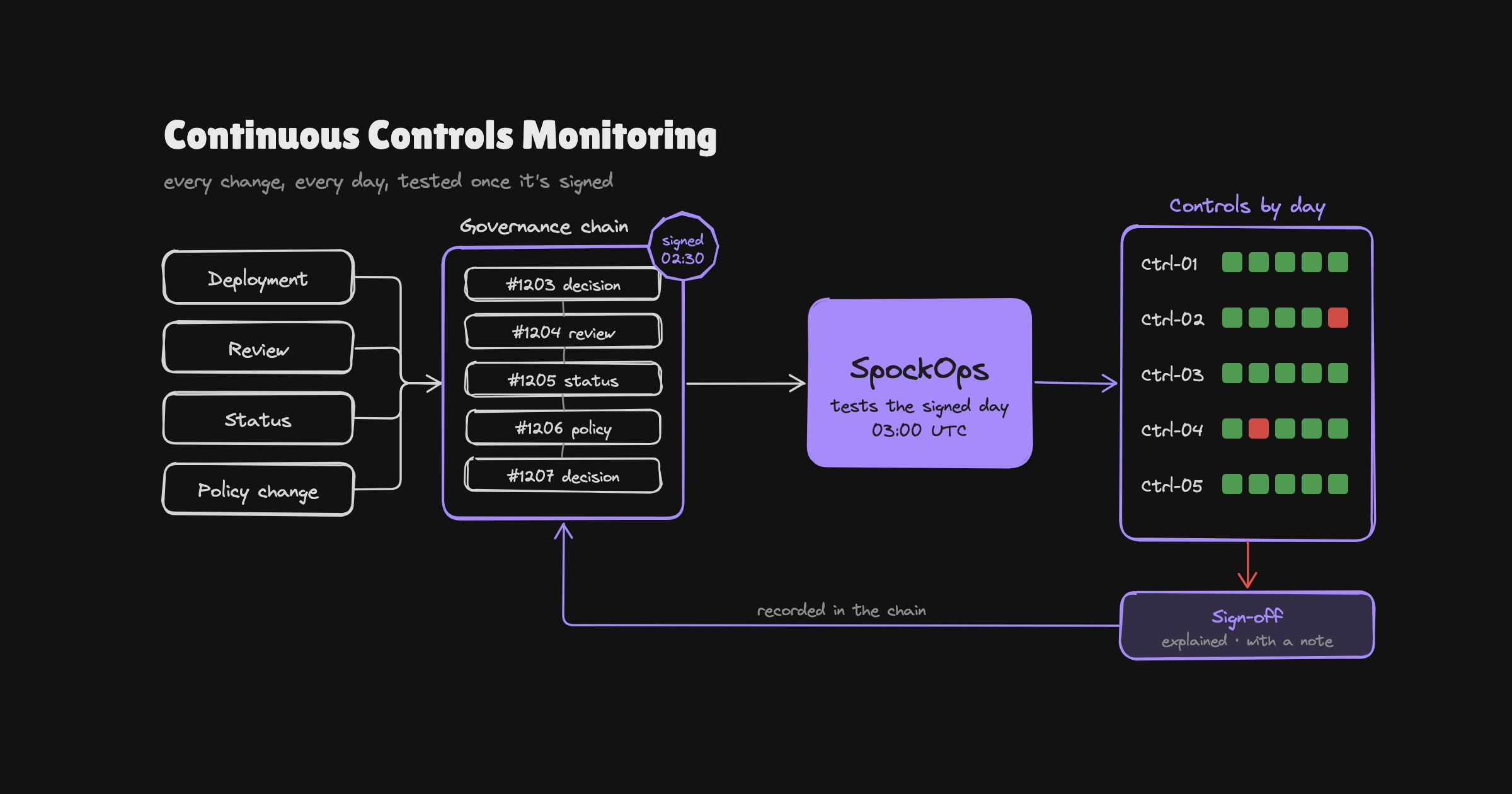
Continuous controls monitoring: testing every change, every day
Change management is usually tested once a year on a sample. SpockOps tests seven change controls every day over every production deployment, from a signed record an auditor can check.
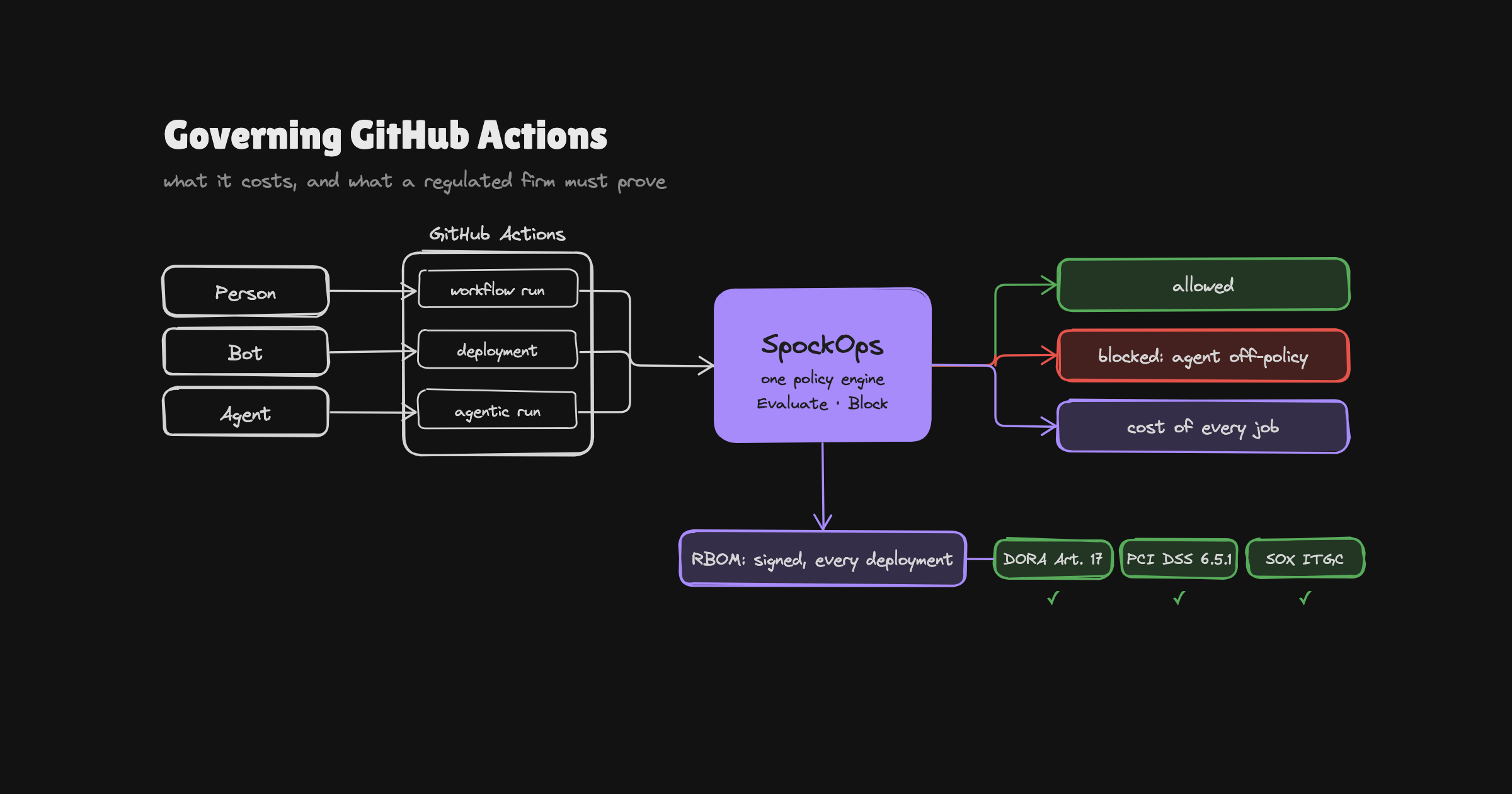
What GitHub Actions costs a regulated engineering team, and what it costs to govern it
What GitHub Actions, runners and agents cost a regulated engineering team, what DORA, PCI DSS and SOX require of a change, and how SpockOps governs all of it.
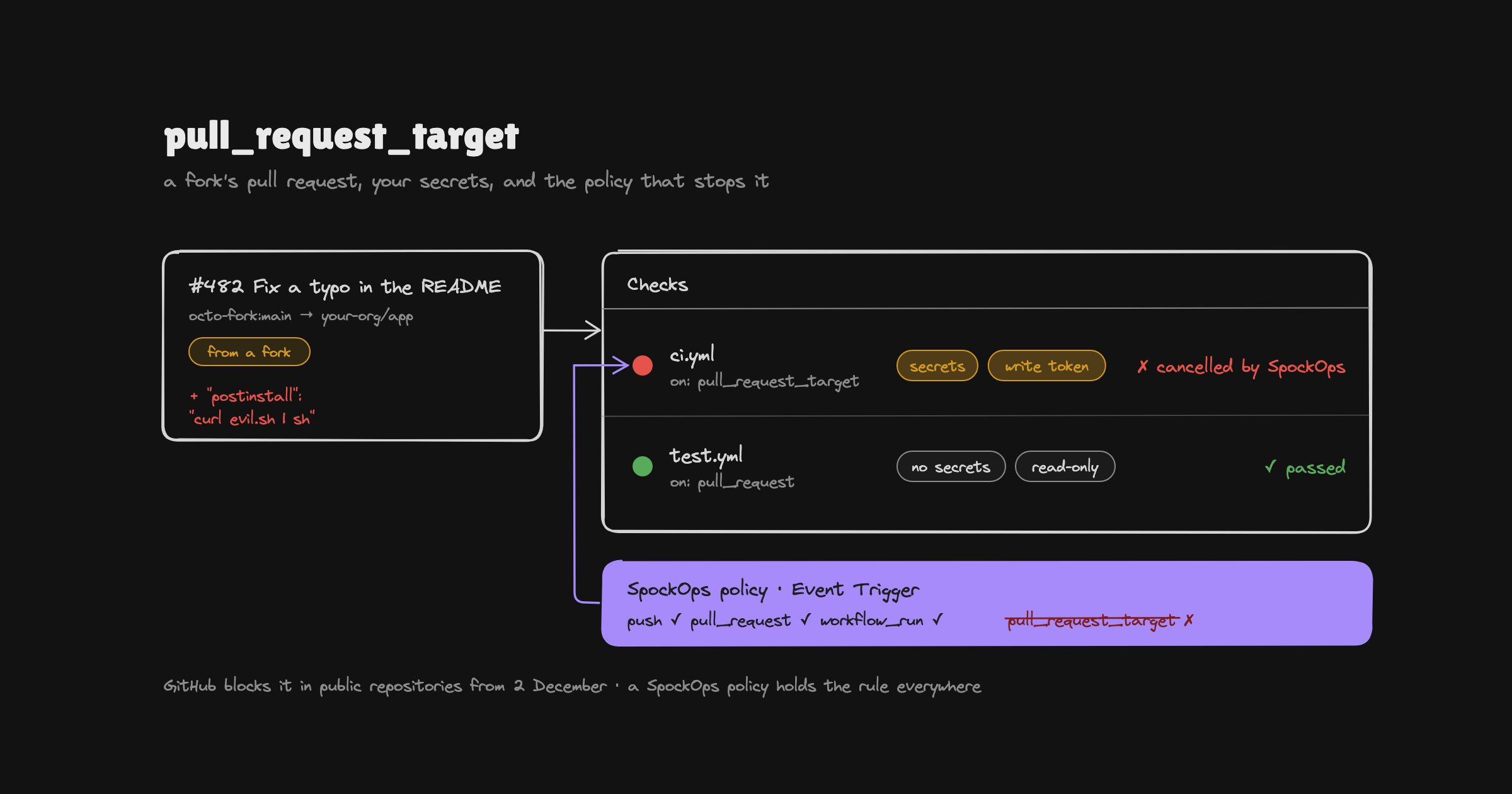
pull_request_target: why to stop using it, and what to use instead
GitHub blocks pull_request_target by default from 2 December. Why the trigger is dangerous, the simple two-workflow pattern to use instead, and how to keep it out of every repository.
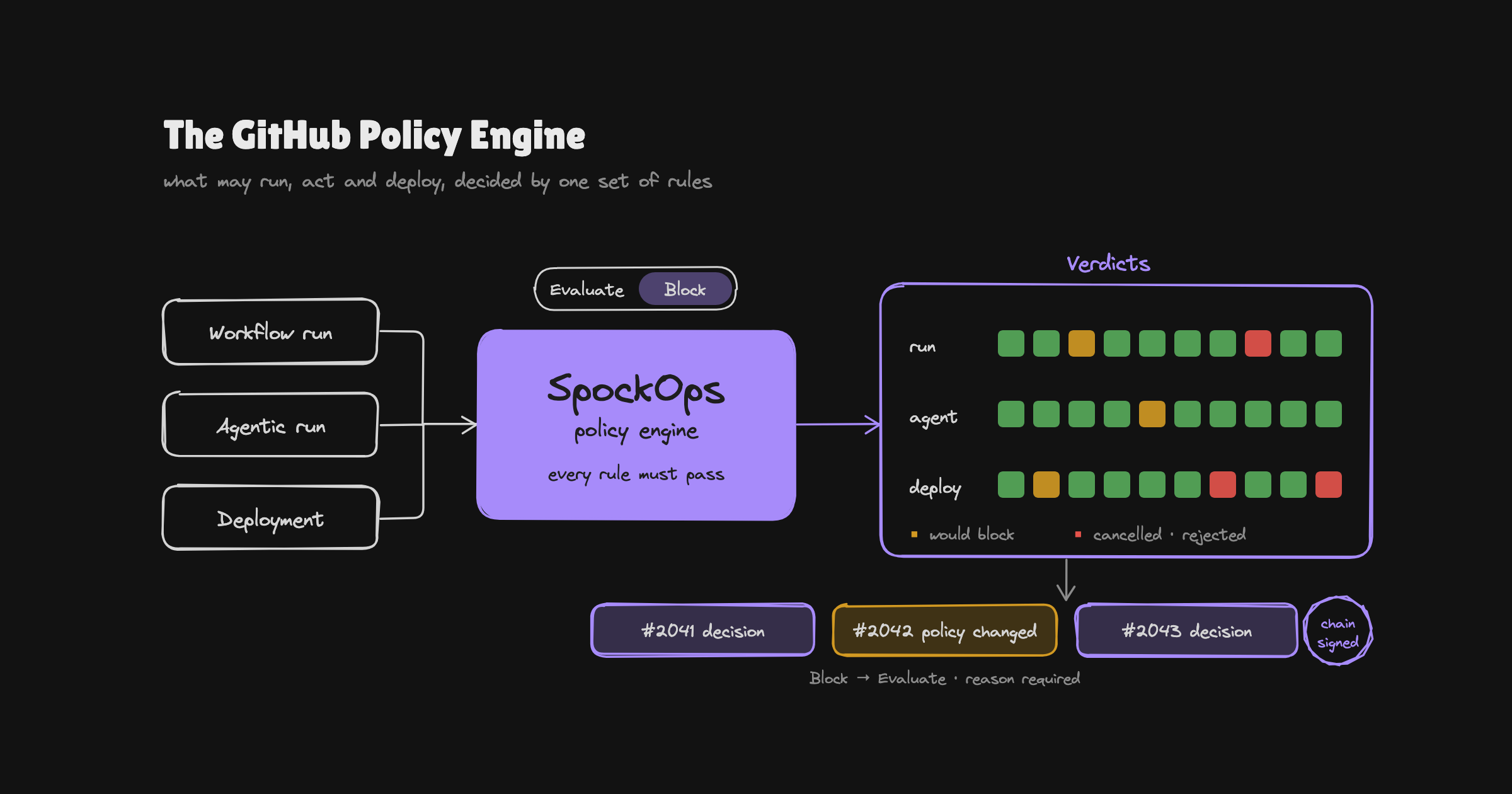
The GitHub policy engine: how SpockOps decides what may run, act and deploy
A policy engine for GitHub Actions: one set of rules for workflow runs, agentic workflows and deployments, tried in Evaluate, enforced in Block and recorded.
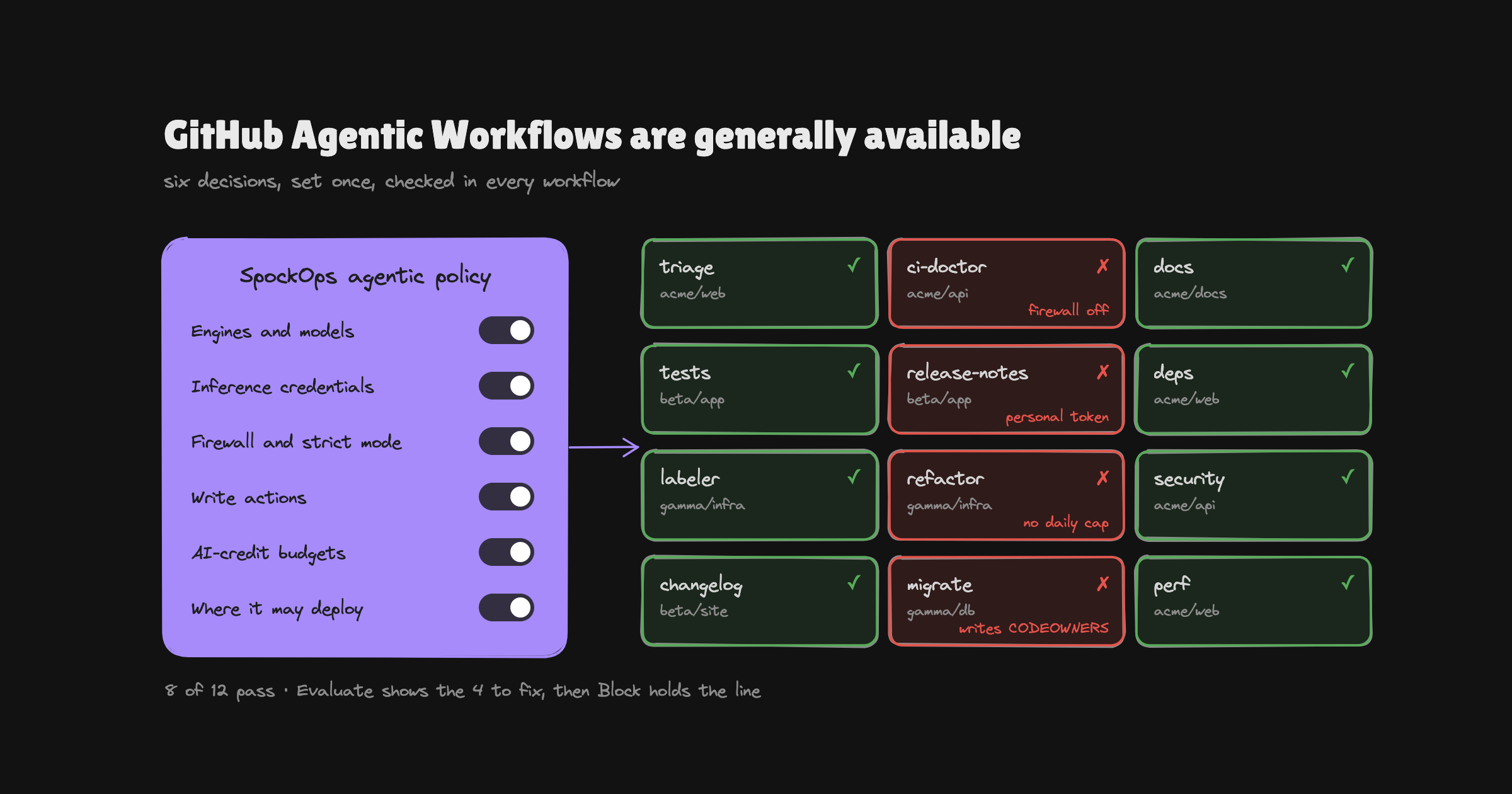
GitHub Agentic Workflows are generally available: six decisions before your teams turn them on
GitHub Agentic Workflows are generally available. The six decisions an enterprise should make first: engines, credentials, isolation, writes, spend and deployments.
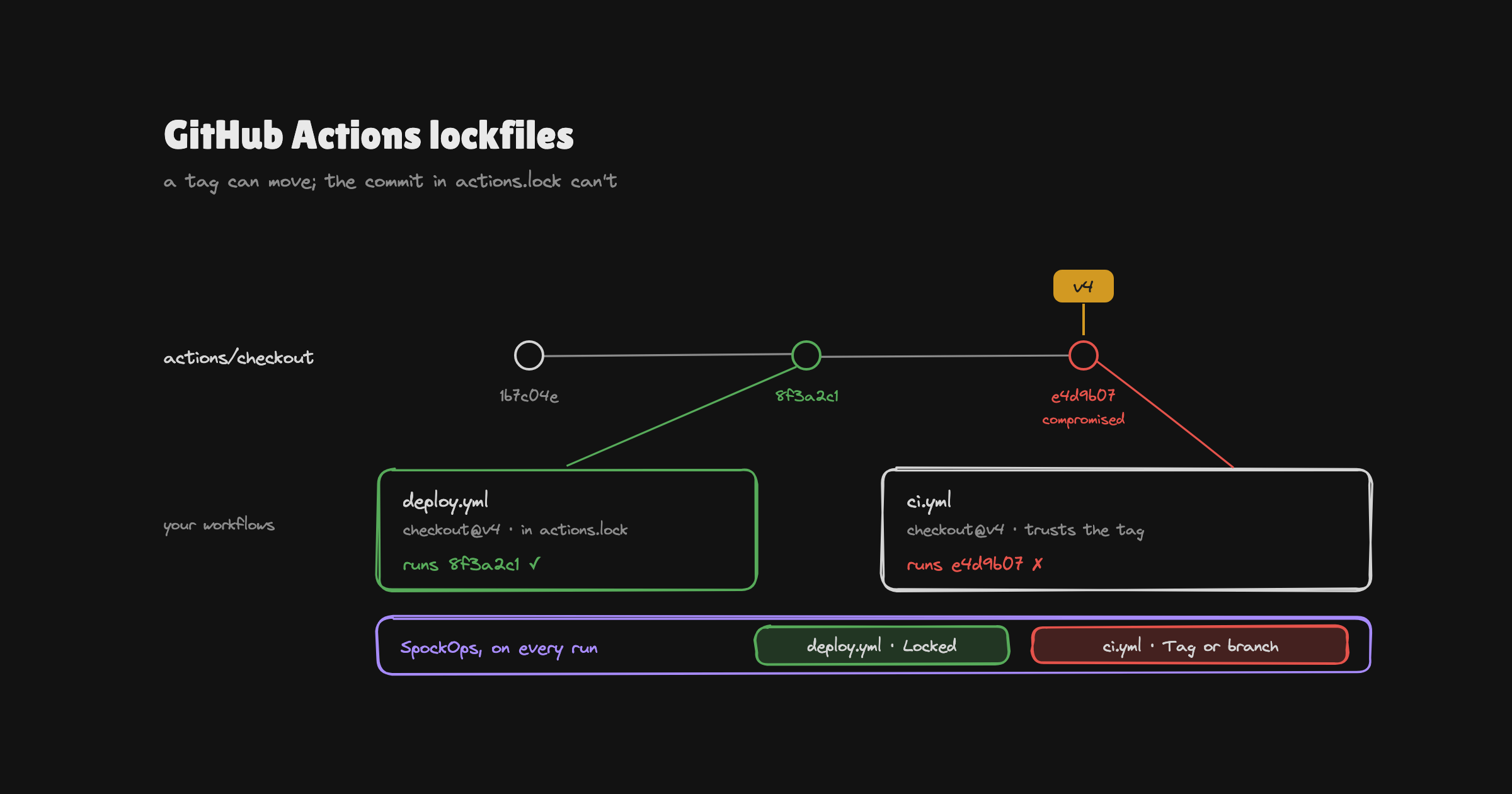
GitHub Actions lockfiles are generally available: what they fix, and what to watch across every repository
GitHub Actions workflow lockfiles pin every action, transitive dependency and reusable workflow to a commit. What they fix, what they don't, and how to start using one today.