 SpockOps
Automating DevOps audits: test every change, not a sample
Auditors sample changes because checking evidence is costly. Chained deployment records make it cheap, so every change can be tested, every day.
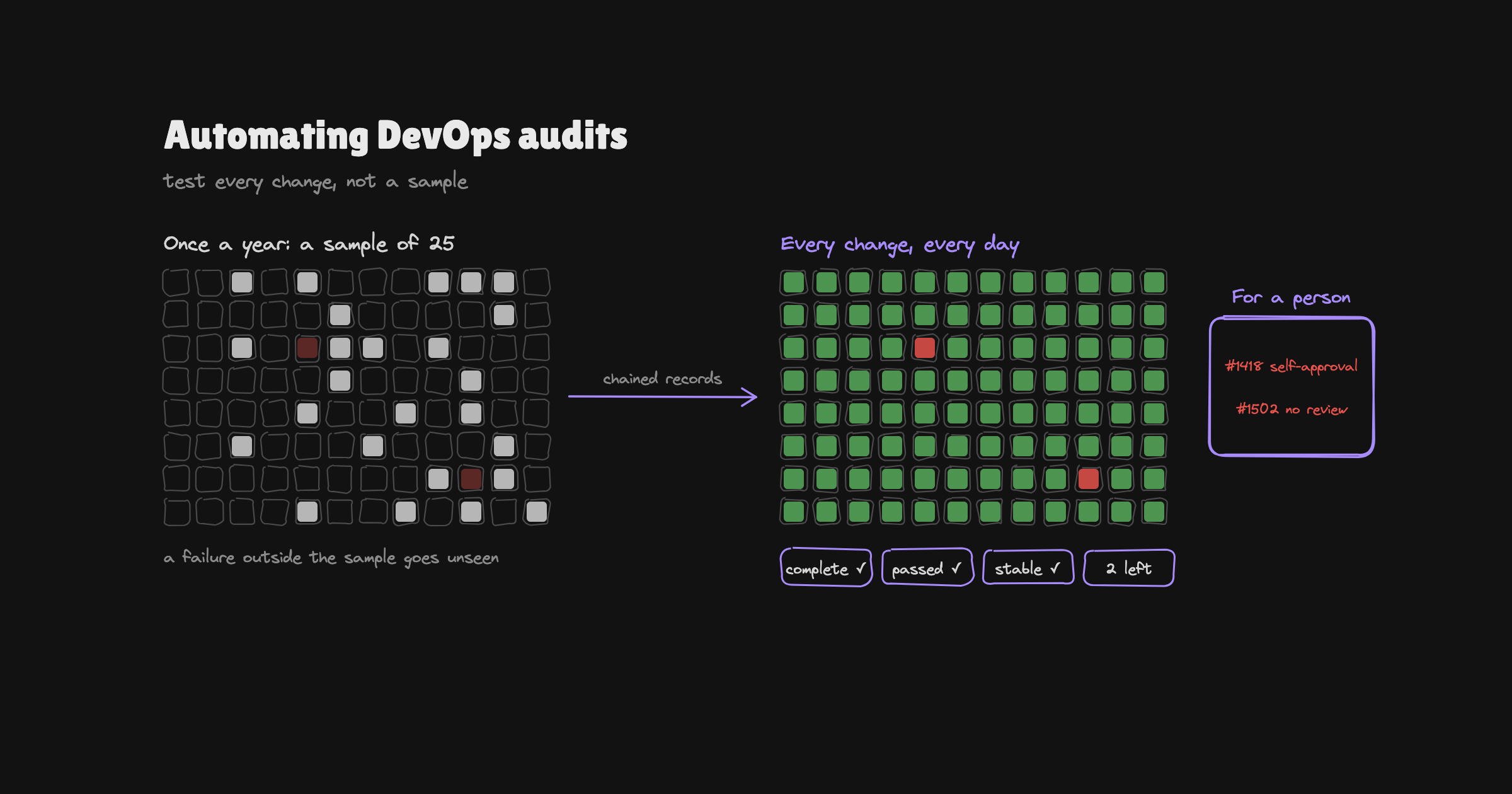

Auditors test a sample of software changes because checking evidence by hand is expensive. When every deployment produces a record at the moment it is decided, and the records are chained so that none can go missing or be altered unnoticed, checking evidence becomes cheap. Every change can then be tested, continuously, rather than 25 of them once a year.
Audit teams have a name for this: continuous controls monitoring. Finance functions have pursued it for years, testing every transaction rather than a sample. Software delivery has been slower to follow, not because the idea is new, but because the evidence has rarely been good enough to check by machine. This post explains what changes when it is, what an automated audit of deployments actually checks, and where risk intelligence fits.
How is change control audited today? #
In most firms, by hand, once a year, and on a sample.
The pattern is familiar to anyone who has sat through one. The auditor asks for every production change in the period. The engineering team exports deployment logs from several systems and reconciles them with change tickets until the list is believed to be complete. The auditor selects a sample, often around 25 changes, and asks for the evidence behind each: who requested it, who approved it, whether it was tested, and how it was released. The team gathers screenshots, ticket histories and pipeline logs, weeks or months after the changes happened, and the auditor checks them one by one.
Why do auditors sample at all? #
Because checking each piece of evidence takes a person's time. Sampling is a sound statistical answer to an economic problem: if every item must be examined by hand, examining all of them is unaffordable, so the auditor examines enough to draw a conclusion about the rest.
The weakness is what a sample cannot see. A control that fails once in two hundred changes will rarely appear in a sample of 25. Audit firms recognize this. An AICPA & CIMA article on a Grant Thornton paper describes control test automation "assessing the full population to identify deviations", and Grant Thornton notes that with automation "the full population of data can be tested, rather than just a sample", with "more frequent or continuous testing of controls".
The same article names the limit: what can be tested depends on access to the underlying data. Testing everything automatically is only worth doing if that data is complete and trustworthy. For software changes, that has been the hard part.
What does an automated audit of deployments check? #
Four questions, in order. Each one can be answered by a script rather than a person, provided the evidence is right.
1. Is the population complete? SpockOps records every deployment decision in an audit trail, and each record carries a fingerprint of the one before it. Recomputing the chain proves that no record has been removed, inserted or altered since it was written. Completeness, the question that usually takes days of reconciliation, becomes a check that runs in seconds.
2. Did every change pass its controls? Each record holds what an auditor would otherwise collect by hand: who requested the deployment and whether that was a person, a bot or an AI agent; the environment; the workflow and the event that triggered it; the policies that applied and the result of each rule; the reviewers; and the verdict. A script can test every record against the firm's rules, for example that every production deployment was approved, ran from a protected branch and was reviewed by someone other than the requester.
3. Were the controls themselves stable? A control is only as strong as the rules behind it. When any policy, workflow, agentic or deployment, is created or changed, SpockOps writes the policy as it then stands into the same chained audit trail, in sequence with the decisions it governs. The audit can show which rules were in force for any deployment and who changed them, and the chain check covers the rules as well as the changes.
4. What needs a person's judgment? What remains after the first three checks is a short list: deployments that failed a rule but proceeded because the policy was in Evaluate mode, deployments started by bots or agents, and changes made to the rules during the period. Those are the items worth an auditor's time.
| Audit question | Done by hand today | Automated with chained records |
|---|---|---|
| Is the list of changes complete? | Export from several systems and reconcile | Verify the chain |
| Did each change pass its controls? | Sample 25, gather screenshots for each | Test every record against the rules |
| Were the controls stable? | Interview, review configuration snapshots | Read the policy records in the same chain |
| What needs judgment? | Everything | Only the exceptions |
The auditor's work moves from collecting evidence to judging the few cases that warrant it.
What makes evidence trustworthy enough to automate? #
Automating a check on poor evidence only produces wrong answers faster. For an auditor to rely on an automated test, the evidence underneath it needs five properties.
- Recorded when the decision was made. Evidence assembled after the fact can be shaped, however honestly, by what people remember. SpockOps writes each record at the moment its deployment protection rule decides, not when someone prepares for an audit.
- Produced by the control itself. The record comes from the same system that allowed or blocked the deployment. There is no gap between what was enforced and what was recorded, because they are one event.
- Complete. The chain shows that no record is missing. A sample drawn from an incomplete population tells an auditor very little, and an automated test on one tells them nothing.
- Tamper-evident. Each record's fingerprint covers its contents and the record before it, and the database refuses to edit or delete a record, so any alteration breaks the chain. A checkpoint of the chain is signed every day, so its state on any date can be proven with SpockOps' public key.
- Portable. Evidence that can only be read inside the vendor's product asks the auditor to trust the vendor's screen. Each deployment's Release Bill of Materials (RBOM) is a signed file that anyone can verify offline with SpockOps' published public key, without access to SpockOps or to the firm's GitHub organizations. The full audit trail can be exported for the firm's own tools, in the same format as GitHub's audit log, and checked offline with SpockOps' verification script.
The ledger and the receipt describes how the audit trail and the RBOM divide this work: the trail proves the population, and each RBOM proves one item in it.
Where does risk intelligence fit? #
An audit asks whether controls worked over a period. Risk intelligence asks a more immediate question: which changes deserve attention now? The two draw on the same evidence.
Every deployment record carries signals that matter to a risk team, and none of them has to be inferred:
- Who or what started it: a person, a bot such as Dependabot, or an AI agent.
- Which rules it failed, even when it proceeded because a policy was in Evaluate mode.
- What triggered it: the workflow and the event that started it.
- Where it went: which environment, and whether it was production.
Read together, these signals separate the routine from the unusual. A reviewed deployment by a person, through every rule, is routine. An agent-started deployment to production that failed a rule in Evaluate mode is not, and it should reach someone the same day rather than at the year-end audit.
This is also where SpockOps meets the security team's existing tools. A SIEM such as Splunk or Microsoft Sentinel is built to correlate events from many systems and raise the ones that matter. What it needs from the software delivery side is a source of change records it can trust: complete, chained and specific about who did what under which rules. SpockOps does not replace that SIEM. It gives it better facts to work with: audit streaming sends the chain to it in GitHub's audit log format, beside GitHub's own stream.
What does automation not replace? #
Three things, and saying so is part of what makes the rest credible.
- The auditor's judgment. Automation tests every change against the rules; it does not decide whether the rules are the right ones, or what an acceptable rate of exceptions is. Audit firms make the same point: in the AICPA & CIMA article, Grant Thornton notes that the auditor must still decide what failure rate is acceptable and evaluate results on that basis.
- Controls outside GitHub Actions. SpockOps records deployments that pass through its deployment protection rule. A change made directly in a cloud console, or deployed through an environment without the rule, is outside the record. The population is complete for what SpockOps protects, which is why every production environment should be protected.
- The quality of the code. A record proves which controls ran and what they concluded. It does not prove that the tests were good or the change was safe.
Within those limits, automation does what it does best: it checks everything, every day, and leaves people the questions that need a person.
Where to begin #
The audit trail starts recording the day SpockOps protects an environment, so the history an automated audit can rely on starts then too. Install the App, protect your production environments, and by the next audit the population will already be complete.
Further reading: Continuous controls monitoring: testing every change, every day, The ledger and the receipt, The Release Bill of Materials and What GitHub Actions costs a regulated engineering team, and what it costs to govern it.
Questions
What is continuous controls monitoring?
Testing controls automatically and continuously, across every transaction or change, rather than examining a sample by hand once a year. For software delivery, it means testing every deployment against the firm's rules as it happens.
Why do auditors test a sample of changes?
Because checking evidence by hand takes time. Sampling lets an auditor draw a conclusion without examining everything. When evidence can be checked by machine, the whole population can be tested instead.
How does SpockOps prove that no deployment record is missing?
Each record in its audit trail carries a fingerprint of its own contents and of the record before it. Recomputing that chain shows whether any record has been removed, inserted or altered.
Does SpockOps replace a SIEM such as Splunk?
No. A SIEM correlates events from many systems. SpockOps supplies trustworthy records of software changes for a SIEM or an auditor to use.
Does automation replace the auditor?
No. It tests every change against the rules and leaves a short list of exceptions. The auditor still decides whether the rules are right and whether the exceptions are acceptable.
Related posts
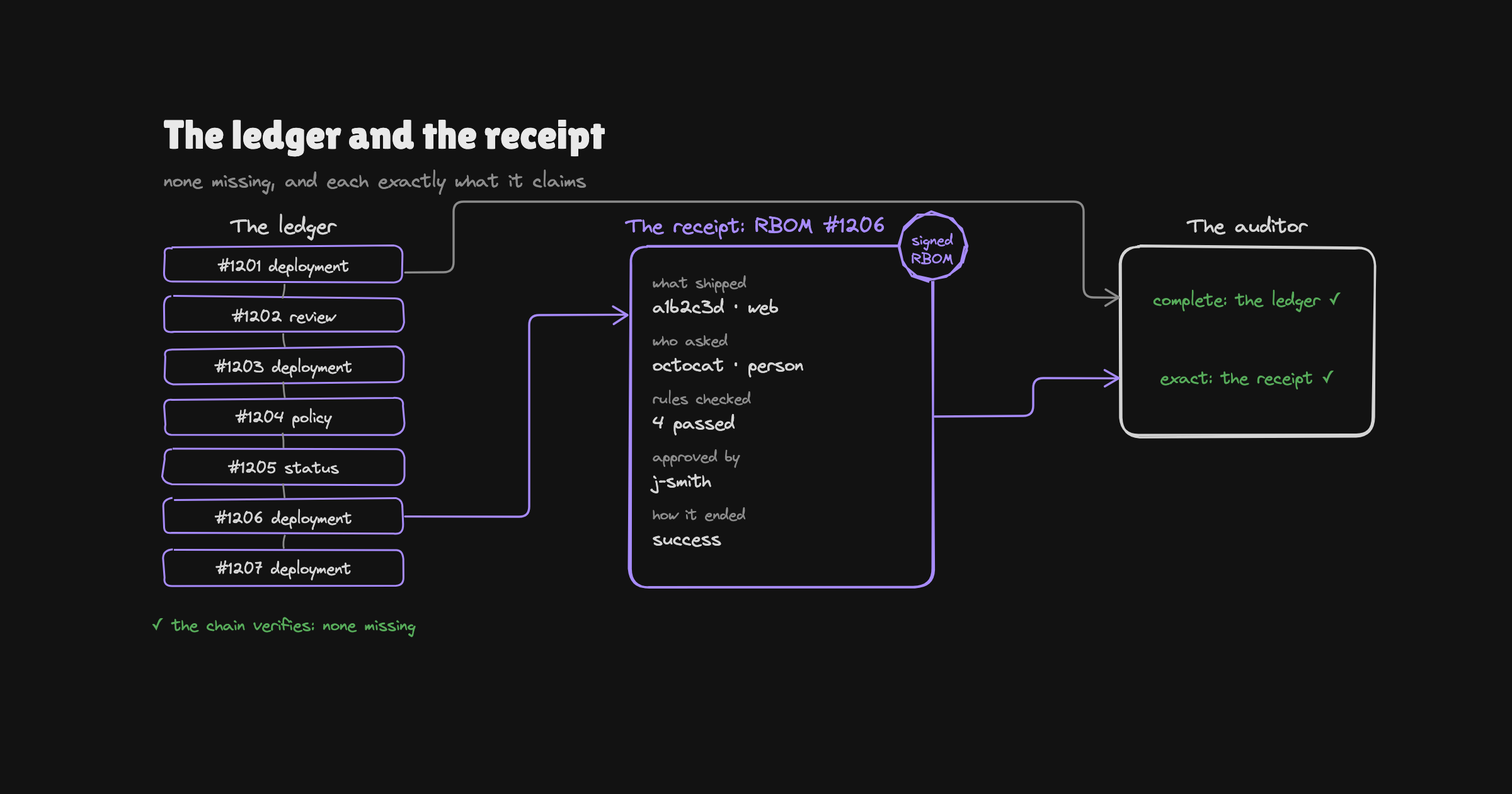
The ledger and the receipt: how SpockOps proves every deployment
A hash-chained audit trail proves no deployment is missing. An RBOM proves each one is exactly what it claims. Why regulated firms need both, and how an audit uses them.
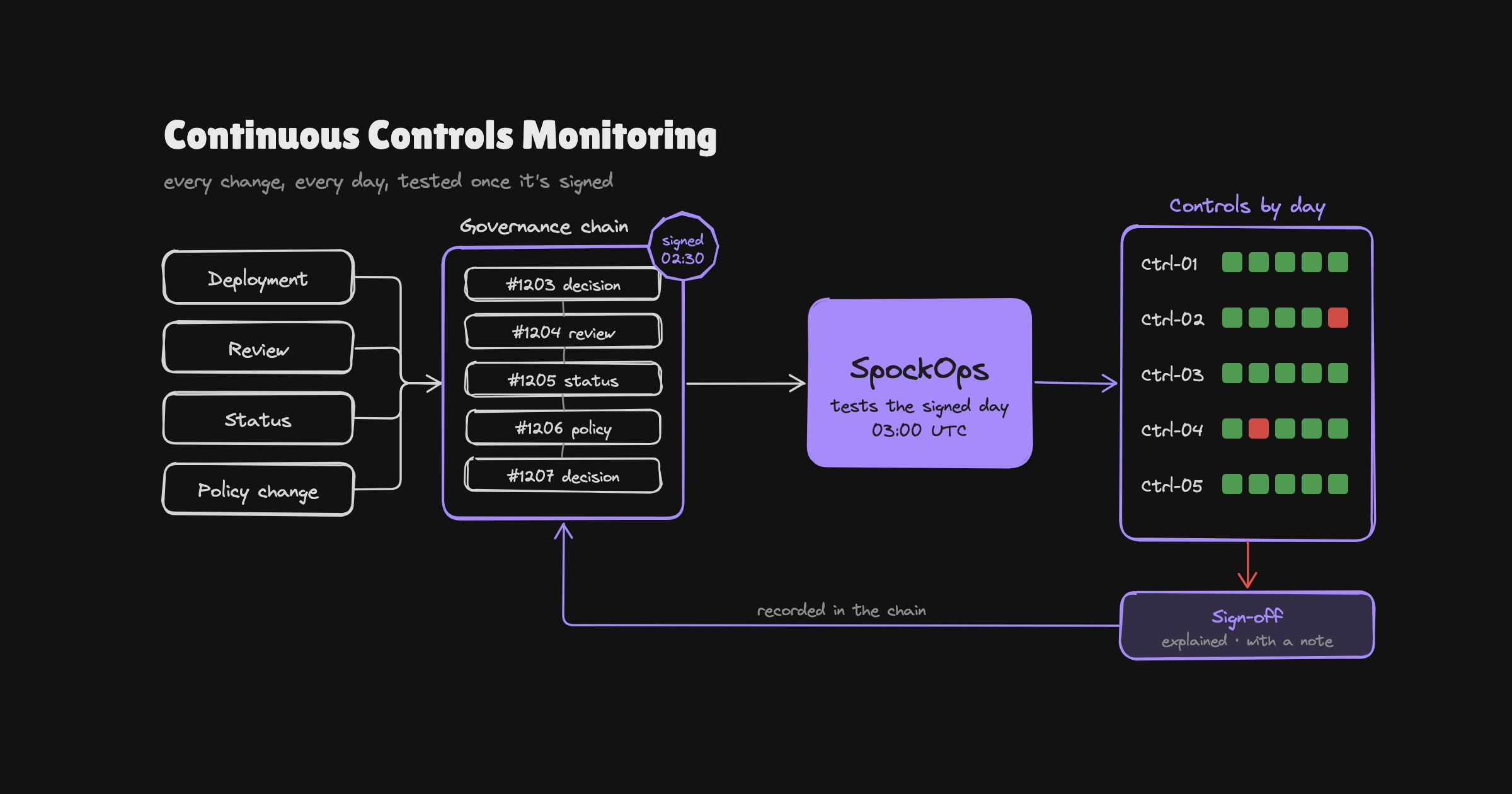
Continuous controls monitoring: testing every change, every day
Change management is usually tested once a year on a sample. SpockOps tests seven change controls every day over every production deployment, from a signed record an auditor can check.
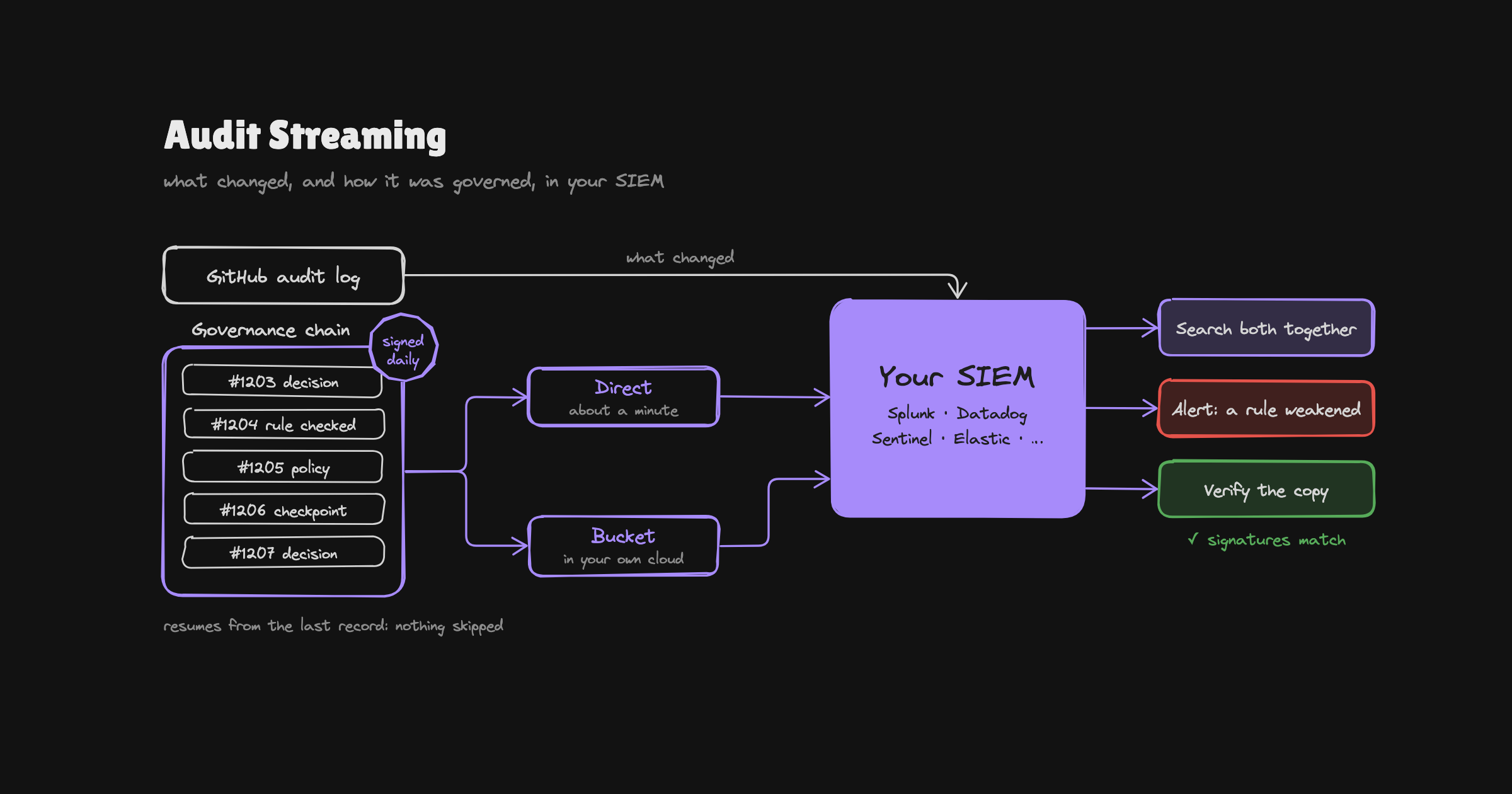
Audit streaming: what GitHub's audit log cannot tell your SIEM
GitHub's audit log shows what changed. The governance chain shows how that change was governed, and audit streaming sends it to your SIEM in the same format, with a copy you can verify.
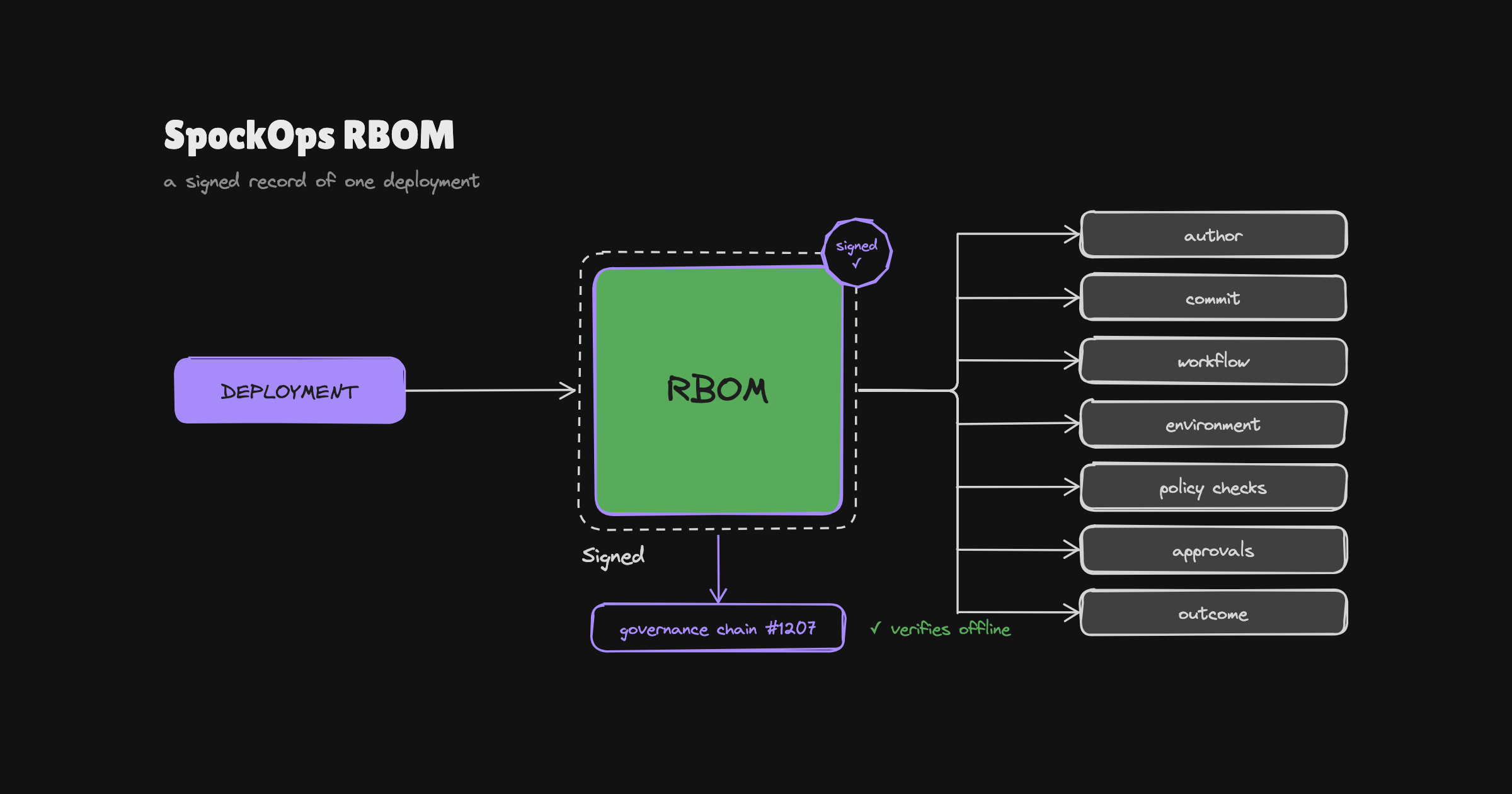
The Release Bill of Materials: a signed record of every deployment
An RBOM is a signed, chained record of one deployment: what shipped, who asked, which rules were checked, who approved it and how it ended.
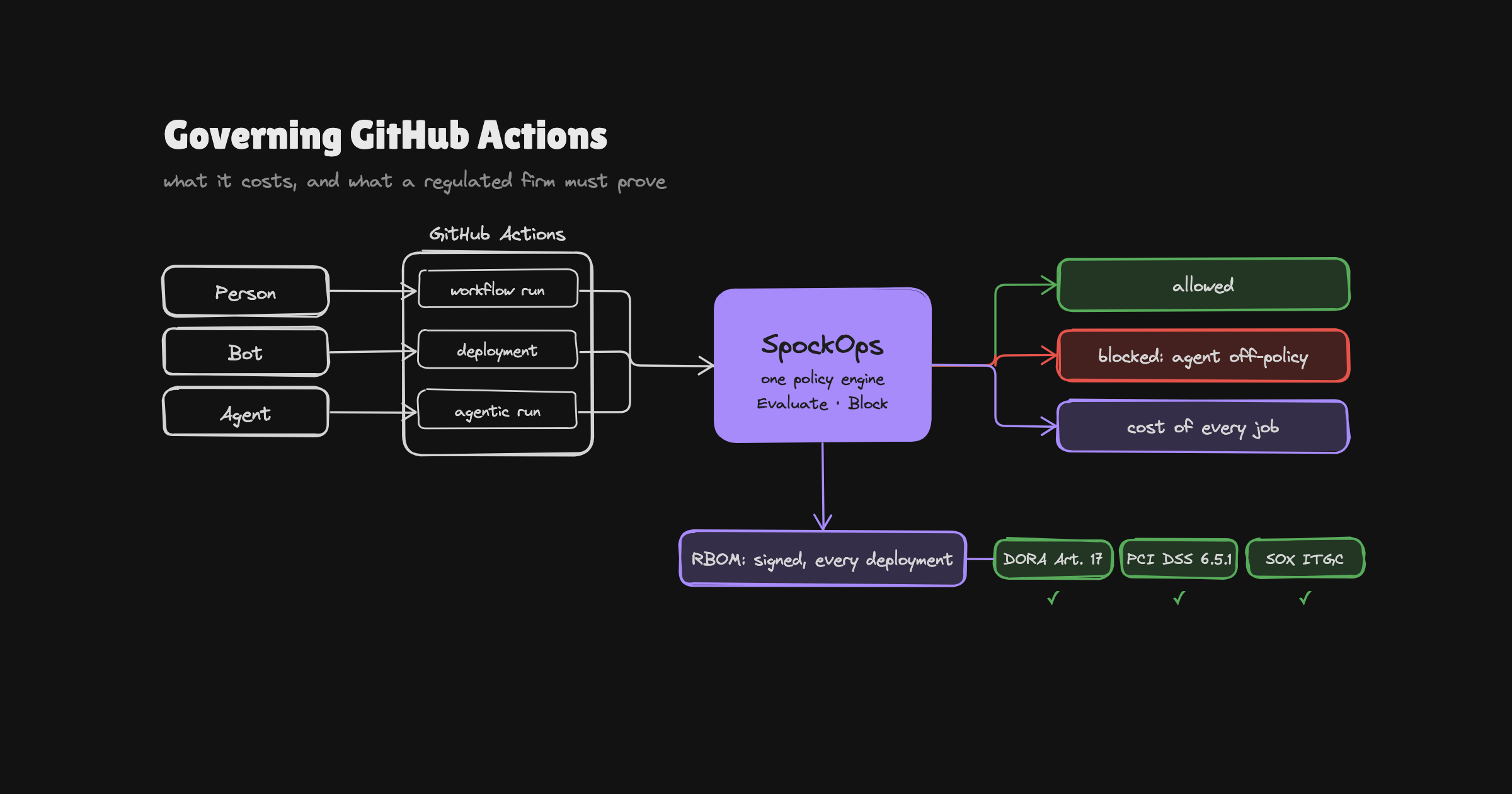
What GitHub Actions costs a regulated engineering team, and what it costs to govern it
What GitHub Actions, runners and agents cost a regulated engineering team, what DORA, PCI DSS and SOX require of a change, and how SpockOps governs all of it.
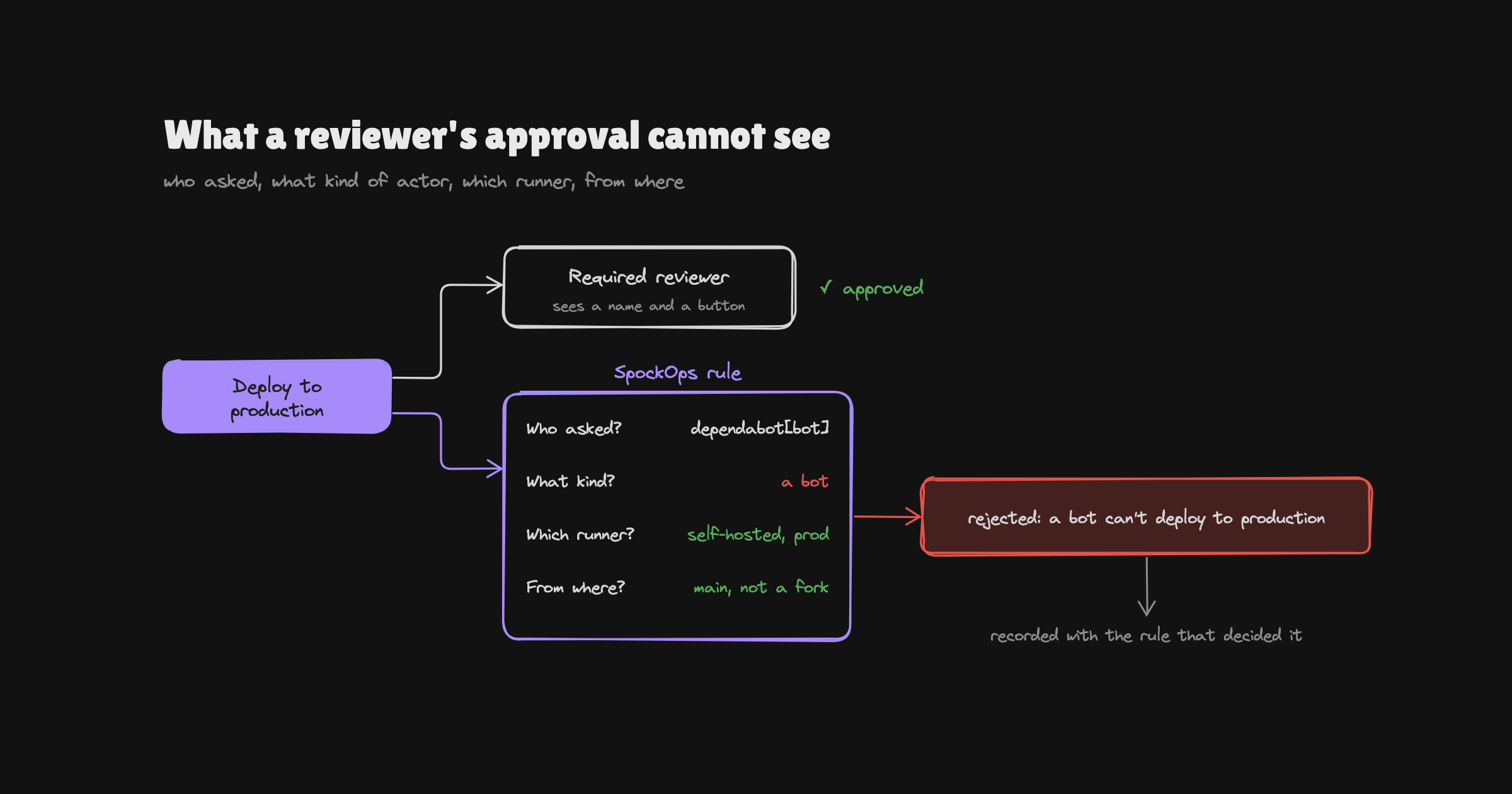
Deployment protection rules: what a reviewer's approval cannot see
How GitHub deployment protection rules work, what required reviewers cannot see, and how SpockOps approves each deployment by actor, runner, kind and origin.